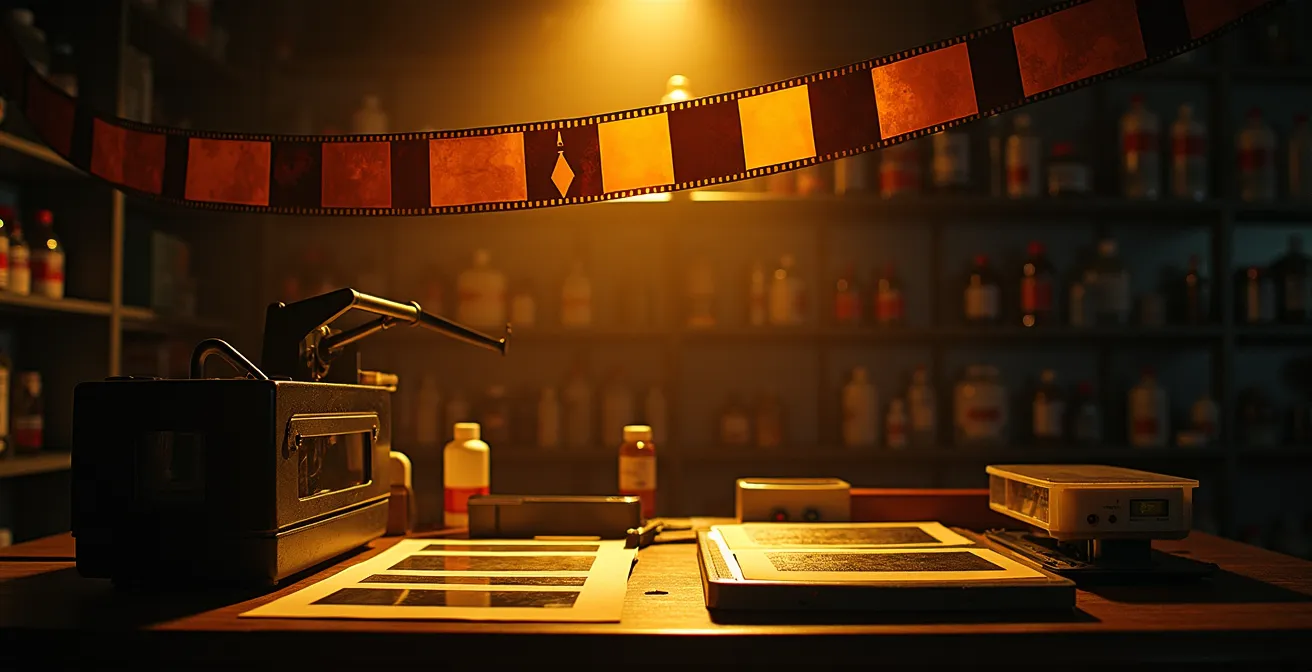
The comeback of analog photography is not about mimicking a ‘vintage’ look; it’s a rebellion in favor of the photograph as a unique, physical artifact whose imperfections are proof of its authenticity.
- Authentic film grain is a three-dimensional structure of silver halide crystals, a texture that digital filters can’t truly replicate.
- The hands-on darkroom process creates one-of-a-kind prints that command a higher market value due to their irreplaceability.
Recommendation: Shift your perspective from viewing film’s ‘flaws’ as defects to appreciating them as tangible markers of craft and artistic integrity.
In a world saturated with digital perfection, where every image can be endlessly duplicated and flawlessly retouched, a quiet rebellion is taking place. It smells faintly of chemicals and feels like textured paper in your hands. Digital natives and seasoned collectors alike are turning back to analog photography, drawn by something more profound than simple nostalgia. While many assume this trend is about chasing a “vintage vibe” with sepia filters and artificial grain overlays, they are missing the point entirely. The true magic isn’t in simulating the look; it’s in embracing the physical reality of the medium.
The allure of film lies in its tangible nature. Each negative is a physical record of light, a moment etched into an emulsion. The process is deliberate, finite, and deeply human. This resurgence isn’t a rejection of digital convenience but a celebration of craft, imperfection, and the value of an object that is truly one of a kind. It’s about understanding that the grain in a photograph is not a flaw to be removed, but a texture to be felt—the very fingerprint of the artistic process.
This article dives into the soul of analog photography, exploring the physical characteristics that make it an irreplaceable art form. We will dissect the anatomy of a print, from the master negative to the final performance, and uncover why the scent of the darkroom is the scent of true artistry. It’s a journey into why, in an age of infinite copies, the singular, tangible artifact reigns supreme.
For those who prefer a visual introduction to the hands-on process, the following video offers a glimpse into the classic art of black and white film development, showcasing the tangible steps that bring an image to life.
To fully appreciate the depth of this analog renaissance, we will explore the key elements that define its value and soul. This guide breaks down everything from the fundamental nature of the negative to the subtle signs of a print’s authenticity and the hands-on artistry of the darkroom.
Summary: The Enduring Soul of the Analog Print
- Why the Negative Is the ‘Master Score’ and the Print Is the ‘Performance’?
- How to Distinguish Real Film Grain from a Photoshop Filter Overlay?
- Hours in the Darkroom or Clicks on a Mouse: Which Process Adds More Value?
- The Vinegar Syndrome: How to Smell if a Vintage Photo Collection Is Rotting?
- How to Scan Analog Negatives to Print Large Without Losing Sharpness?
- Hand-Painted Dots or Digital Pixels: Which Has More Soul?
- How to Spot the Graphite Sheen That Inkjet Prints Can Never Replicate
- Traditional Darkroom Techniques: Why the Chemical Smell Is the Scent of True Artistry?
Why the Negative Is the ‘Master Score’ and the Print Is the ‘Performance’?
The heart of the analog process lies in a beautiful duality: the negative is the absolute truth, but the print is its living interpretation. Think of the negative as a composer’s master score—it contains all the essential information, the full dynamic range of light and shadow, captured with unwavering fidelity. This physical strip of celluloid is the foundational artifact, the unchangeable source from which all artistry flows. Its recent comeback is undeniable; industry analysis shows that over 20 million rolls of photographic film were sold in 2023, a significant 15% increase from the previous year.
However, the score is not the concert. The print is the performance. In the darkroom, the photographer becomes a conductor, using techniques like dodging and burning to interpret the negative. They choose the paper, the contrast, and the exposure time, making creative decisions that bring the image to life. Each print is a unique performance, subtly different from the last. This is a stark contrast to digital, where a file is simply copied, identically, forever. This context is important; as Manny Almeida, President of Fujifilm’s imaging division, noted, while the film market peaked in 2003 with 960 million rolls, today’s market represents a dedicated niche, focused on the premium value of this unique process.
This distinction is crucial for both artists and collectors. The negative holds the potential, but the print holds the soul of the artist’s hand. It is a singular object born from a specific moment of creation, embodying a performance that can never be perfectly replicated. This uniqueness is the foundation of its intrinsic value.
How to Distinguish Real Film Grain from a Photoshop Filter Overlay?
The most misunderstood element of the “film look” is grain. Digital filters add noise, a flat, uniform pattern of pixels designed to look like grain, but they miss the essential quality of the real thing. Authentic film grain is not noise; it is the image itself. It is comprised of physical silver halide crystals that have clumped together in the emulsion during development. These crystals are three-dimensional, with varying sizes and random distribution, creating a tangible texture rather than a flat pattern.
To tell the difference, you must look for depth and randomness. Real grain interacts with the light and focus of the image, appearing sharper in focused areas and softer in others. It has a physical structure that sits *within* the photograph’s layers, a quality that an overlay on a grid of pixels cannot fake. An analysis of classic analog photographs confirms that this organic, non-repeating pattern creates a sense of depth that digital filters struggle to emulate.
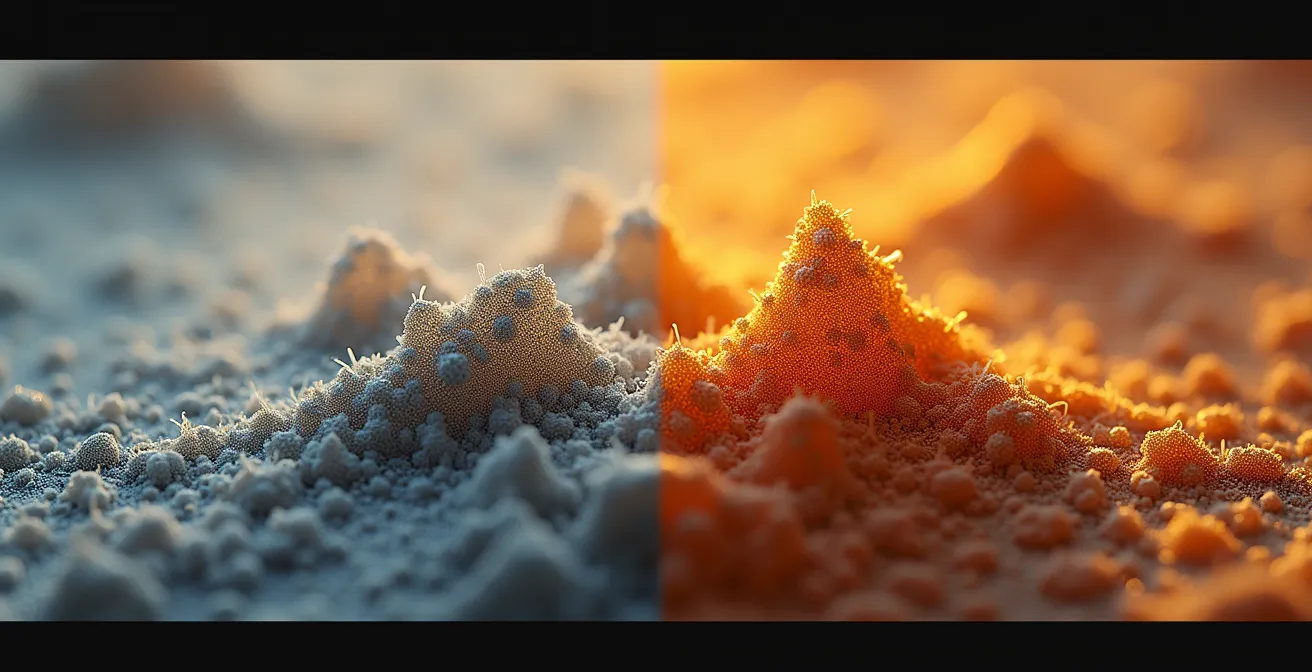
As the comparison above illustrates, digital noise is a monotonous grid, while real film grain is an organic constellation. Look closely at a fine art print. You’ll see how the grain enhances the sharpness (a quality known as acutance) and gives the image a sense of life and breath. A filter is a costume; real grain is the skin and bone of the photograph.
Hours in the Darkroom or Clicks on a Mouse: Which Process Adds More Value?
In terms of value, the process is inseparable from the product. While a digital workflow is efficient, the darkroom process imbues a photograph with a value that time and cost alone cannot measure. It’s a hands-on, alchemical transformation where the artist’s touch is evident in every final print. This commitment to craft is a significant reason wedding photographers and fine artists are returning to film. As Fujifilm’s President Manny Almeida explained to TIME Magazine, the distinct look and feel of film “allows them to charge for a premium product.”
The value proposition becomes clear when comparing the two methodologies directly. The investment in time and materials in the darkroom leads to a unique, archival-quality object that commands a significant market premium. A digital file, while quick to produce, can be infinitely replicated, inherently reducing the value of any single print.
| Factor | Darkroom Process | Digital Process |
|---|---|---|
| Time Investment | 2-4 hours per print | 5-30 minutes |
| Material Cost | $5-20 per print | $0.50-2 per print |
| Uniqueness | Each print unique | Infinite identical copies |
| Market Premium | 200-500% higher prices | Standard rates |
The table doesn’t lie: the darkroom is an investment. But it’s an investment in scarcity and authenticity. For a collector, owning a darkroom print means owning a singular piece of the artist’s time and intention—an irreplaceable artifact. The hours spent under the red glow of the safelight are not just labor; they are a crucial part of what makes the final object a work of art.
The Vinegar Syndrome: How to Smell if a Vintage Photo Collection is Rotting?
Part of embracing the physicality of film is accepting its mortality. Unlike a digital file that can exist forever on a server, a photograph is a physical object subject to the laws of chemistry and time. One of the most significant threats to film archives is “vinegar syndrome,” a form of chemical decay that affects acetate-based film, which was common for much of the 20th century. The name is literal: as the film base decomposes, it releases acetic acid, the same chemical that gives vinegar its sharp smell. This is a critical concern, as recent research reveals that some films may last as little as 70 years before decay sets in, a far cry from previous estimates of centuries.
For collectors, smelling that tell-tale odor is a sign of irreversible damage. The decay causes the film to shrink, warp, and become brittle. But this vulnerability is also part of its story. It is a reminder that the photograph is a real, tangible artifact with a finite lifespan, making its preservation an act of cultural importance. Detecting the syndrome early is crucial to saving a collection.
Action Plan: Detecting Early Signs of Vinegar Syndrome
- Smell Test: Open film canisters carefully, away from your face. A sharp, vinegar-like smell is the most obvious sign of acetic acid release.
- Visual Inspection for Shrinkage: Before the smell becomes strong, look for physical changes. The film base may start to shrink and warp, causing it to buckle or appear wavy.
- Check for Channeling: Look for channel-like patterns or bubbles forming in the film’s emulsion layer, which indicates separation from the film base.
- Use A-D Strips: For a proactive approach, use Acid-Detection (A-D) strips. These tools can detect the presence of acid in the film’s environment even before visible symptoms or a strong smell develops.
- Quarantine Immediately: If you detect any signs of vinegar syndrome, immediately isolate the affected films from the rest of your collection. The acidic vapors can accelerate decay in healthy film.
This process of decay, while destructive, reinforces the core idea: film is a physical medium. It lives, it ages, and it requires care. Its fragility is inseparable from its beauty and its value as a historical artifact.
How to Scan Analog Negatives to Print Large Without Losing Sharpness?
Bridging the analog and digital worlds is a critical step for the modern film photographer, and scanning is the key. The goal of scanning is not to create a digital image that replaces the negative, but to create a “digital negative”—a master file of the highest possible quality. This approach, championed by professional labs, preserves the soul of the original while allowing for the flexibility of digital printing and distribution. It’s not about achieving a higher resolution than digital cameras in terms of pixel count, but about faithfully capturing the essence of the film itself.
The secret to a great large-format print from a scan lies in how you treat the grain. A poor scan will either obliterate the grain, creating a flat, lifeless image, or exaggerate it into distracting digital noise. A masterful scan, often done with a high-end drum scanner, aims to resolve the grain’s acutance. This means capturing the fine, sharp edges of the silver halide crystals, preserving their three-dimensional structure and texture. The goal is to see the grain’s beautiful, organic pattern, not to pretend it isn’t there.
When preparing to print large from a scan, the focus should be on this “digital negative.” It should be a high-bit-depth file (like a 16-bit TIFF) with a wide color gamut, capturing the maximum amount of information from the physical negative. This file then becomes a new master score, allowing for multiple interpretations (prints) without ever degrading the original source. The sharpness doesn’t come from artificial sharpening filters, but from a high-quality scan that has respected and resolved the film’s inherent structure.
Hand-Painted Dots or Digital Pixels: Which Has More Soul?
At its core, the debate between analog and digital is a question of soul. A digital image is a perfect grid of pixels, a mathematical representation of light. An analog photograph is something else entirely. It’s a physical object, a chemical reaction frozen in time. As one analysis beautifully put it, “It’s more than just a picture—it’s a moment carved in silver halide.”
It’s more than just a picture—it’s a moment carved in silver halide.
– 121clicks Photography Magazine, Analysis of analog photography’s timeless appeal
This sentiment resonates powerfully with a generation raised on screens. It’s no surprise that market research from 2023 indicates 68% of photography enthusiasts under 35 expressed a preference for shooting film, either occasionally or regularly. These are not luddites; they are digital natives seeking a tangible connection to the creative process. They are drawn to the imperfections, the happy accidents, and the sense of holding a real, physical object that they helped create. Each roll of film is a small treasure hunt, filled with the anticipation of seeing how the moments they captured will materialize.
The “soul” of an analog print comes from its humanity. The slight variations in a darkroom print, the unique pattern of the grain, the very texture of the paper—these are not errors. They are the fingerprints of the artist, proof that a human hand and eye were involved. A pixel is data. A silver halide crystal is an artifact.
How to Spot the Graphite Sheen That Inkjet Prints Can Never Replicate
One of the most sublime and hardest-to-fake characteristics of a traditional black and white print is its physical interaction with light. A vintage or expertly made silver gelatin print doesn’t just display an image; it has a depth and luminosity that changes as you move it in your hands. This is due to a quality often called “graphite sheen” or “silvering out.” This is not a defect but a hallmark of authenticity.
This distinctive sheen is created by the image-forming silver itself. In a silver gelatin print, microscopic particles of metallic silver are embedded within the paper’s gelatin emulsion. When you view the print, you are not just seeing ink on a surface; you are seeing light reflect off this metallic silver *within* the paper’s fibers. As Andrew Prokos’s work demonstrates, this creates dynamic visual properties. The tonal depth and metallic luster shift and change with the viewing angle, an effect that surface-applied inkjet inks can never replicate. An inkjet print looks the same from almost any angle; a silver gelatin print feels alive.
For a collector, this is a key authentication method. Hold the print at a low angle to a light source. In the dark areas of the image, you should see this subtle, reflective sheen. It’s a sign that you are holding a true artifact, an object with a three-dimensional presence. This physical property is a direct result of the chemical process and is a beautiful, tactile confirmation of the print’s analog origins.
Key Takeaways
- The value of analog photography lies in its physical uniqueness, with each print being an irreplaceable artifact of a specific creative moment.
- Authentic film grain is a three-dimensional, organic structure of silver halide crystals, offering a depth and texture that flat, grid-based digital filters cannot replicate.
- The darkroom process, while more time-consuming and costly, creates singular, archival-quality objects that command a significant market premium over infinitely reproducible digital prints.
Traditional Darkroom Techniques: Why the Chemical Smell Is the Scent of True Artistry?
For those uninitiated, the darkroom can seem like an intimidating, anachronistic laboratory. The smell of developer, stop bath, and fixer can be sharp and unfamiliar. But for the analog artist, that chemical aroma is the scent of creation itself. It is the atmosphere of a place where images are not captured, but born. The growing interest in this hands-on craft is clear, as industry projections show the darkroom chemicals market shows a robust growth trajectory, expected to reach a significant size by 2025.
The darkroom experience is profoundly tactile and meditative. It’s about working in near-darkness, guided by touch and timing. It’s about the magic of watching an image slowly emerge on a blank piece of paper submerged in a tray of developer. As one professional guide notes, “The tactile experience of working with film and chemicals, combined with the anticipation of seeing a print emerge in the developer tray, fosters a sense of connection to the medium that is unparalleled.” This connection to the physical process is everything the digital workflow is not: slow, deliberate, and deeply personal.
This hands-on artistry is the final, crucial element that gives the analog print its soul. It represents a direct lineage from the artist’s hands to the final object. The chemical smell isn’t a byproduct to be endured; it is the very perfume of authenticity, a sensory reminder that the object you hold is not a file, but a physical artifact brought into the world through skill, patience, and a little bit of magic.
This journey back to analog is more than a trend; it’s a profound statement about what we value in art. It is a choice to favor the tangible over the virtual, the singular over the infinite, and the perfectly imperfect craft of the human hand. The next step is to experience it for yourself.
Frequently Asked Questions about Analog Photography
What causes the distinctive ‘graphite sheen’ in vintage prints?
The sheen results from metallic silver particles embedded within the gelatin emulsion reflecting light differently at various angles, a three-dimensional quality impossible to replicate with surface printing.
How can collectors identify authentic silver gelatin prints?
Observe the print under different light angles – authentic prints show dramatic changes in tonal depth and metallic luster, while inkjet prints maintain consistent surface appearance.
Is silvering out a defect or feature?
What appears as ‘silvering out’ or surface mirroring in aged prints is actually a noble sign of authenticity and age, adding to the print’s value and historical significance.