
The return to classical draftsmanship is a conscious investment in verifiable artistic skill over conceptual ambiguity.
- Atelier training provides a direct, traceable link to historical mastery, creating what collectors value as a “pedagogical lineage.”
- Technical proficiency, including anatomical accuracy, tonal control, and line quality, offers a timeless and universal measure of an artwork’s quality.
Recommendation: Seek artists who fuse classical technique with a contemporary voice to acquire works of lasting value, avoiding technically skilled but soulless “kitsch.”
In a contemporary art world often dominated by the abstract idea and the conceptual statement, a significant shift is occurring. Discerning collectors and art lovers, fatigued by works that require lengthy manifestos to justify their existence, are turning their attention back toward a more fundamental and immutable quality: skill. This is not a retreat into nostalgia, but a deliberate flight to quality—a search for what can be described as “proof-of-work” in an artist’s creation. The ability to render the human form with anatomical veracity, to create depth on a flat surface through light and shadow, and to command a line with confidence is becoming a primary criterion for acquisition once more.
For decades, the narrative has often prioritized the concept over the execution. While this has produced groundbreaking art, it has also created a market where technical mastery can be seen as secondary, or even old-fashioned. The current resurgence of interest in classical draftsmanship challenges this notion directly. It posits that the true, lasting power of an artwork lies not just in the idea it represents, but in the tangible, demonstrable skill required to bring it into being. This skill forms a universal language, understood across cultures and centuries, that speaks to a deep- seated human appreciation for dedication, practice, and mastery.
This article will explore the reasons behind this revival. We will delve into the world of the atelier, where this training is forged, and provide the tools to distinguish masterful work from the merely competent. We will examine the delicate balance between technique and soul, the practicalities of preserving these intricate works, and the foundational elements—from pencil grades to the use of empty space—that constitute the language of classical drawing. This is a guide for the collector seeking not just an object, but an artifact of profound human endeavor.
To navigate this return to foundational principles, this guide breaks down the essential facets of classical draftsmanship, from its educational roots to the practical criteria for judging quality. The following sections offer a structured journey into this world of tangible skill.
Summary: The Enduring Value of Classical Draftsmanship in a Modern World
- Why an Atelier-Trained Artist Commands More Respect from Purist Collectors?
- How to Spot Flawed Anatomy in a Figure Drawing in Under 5 Seconds
- Technique or Idea: Which Matters More for Long-Term Art History Relevance?
- The ‘Kitsch’ Risk: Buying Classical Styles That Lack Modern Soul
- How to Control Humidity to Save Draftsmanship on Cotton Rag Paper?
- Why a 9B Pencil Creates Depth That an HB Simply Cannot Achieve?
- Why Empty Space (Ma) is as Important as the Ink in Wash Painting?
- Cross-Hatching Technique: How to Judge the Quality of an Ink Drawing?
Why an Atelier-Trained Artist Commands More Respect from Purist Collectors?
For purist collectors, the term “atelier-trained” is more than a descriptor; it is a mark of authenticity and a guarantee of a specific, rigorous education. Unlike a standard university art program, which may focus on conceptual development and broad experimentation, a classical atelier is dedicated to the methodical transmission of historical drawing and painting techniques. This creates what is known as a pedagogical lineage, where skills are passed down from master to student in a chain that can often be traced back for generations. This direct connection to the methods of the Old Masters is a powerful signifier of quality and commitment for collectors investing in an artist’s long-term value.
The training within an atelier is systematic and disciplined. As noted by Juliette Aristides, a leading figure in the contemporary atelier movement, in her book Classical Painting Atelier, “The educational process begins as students copy masterworks, then gradually progress to painting as their skills develop.” This foundational practice of copying is not about imitation, but about absorption—internalizing the principles of form, light, and composition that have defined great art for centuries. It is an act of deep study that builds a formidable technical vocabulary before the artist even begins to develop their own unique voice.
The success of this model is evident in institutions like the Sadie Valeri Atelier, which has gained a reputation as a premier school for historic painting and drawing techniques. By focusing exclusively on this classical methodology, such ateliers produce artists whose work demonstrates a profound understanding of their craft. For a collector, acquiring a piece from an atelier-trained artist is an investment in this proven history of excellence. It is a validation of the “proof-of-work”—the thousands of hours of dedicated practice evident in every confident line and subtle transition of value.
How to Spot Flawed Anatomy in a Figure Drawing in Under 5 Seconds
One of the most immediate indicators of an artist’s classical training is their handling of the human figure. While perfect anatomical replication is not always the goal, a masterful artist possesses a deep understanding of anatomy that allows them to create figures that are believable, weighted, and full of life, even when stylized. For a collector, developing an eye for anatomical veracity is a critical skill. It allows one to quickly differentiate between a drawing with structural integrity and one that is merely a superficial copy of a photograph, often inheriting its distortions.
A quick but effective method to assess a figure’s structure is to check its balance and gesture. The most common errors in amateur work relate to the figure’s center of gravity. A simple mental check can reveal these weaknesses almost instantly:
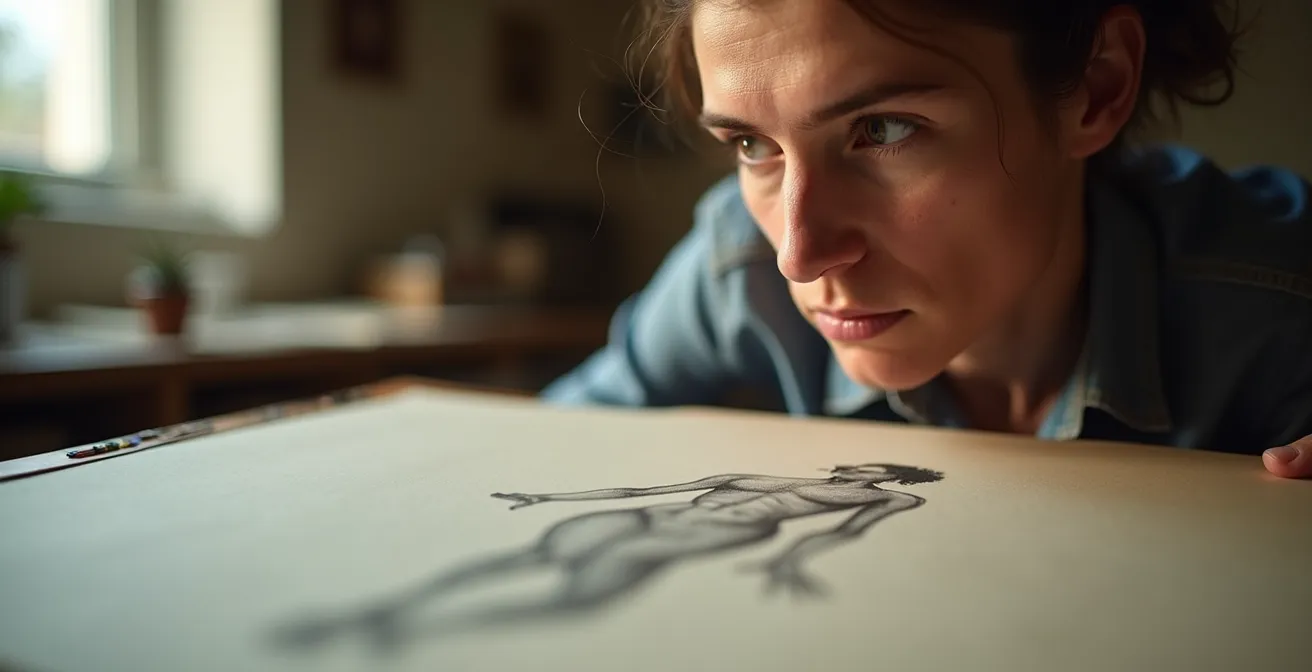
As the illustration suggests, a key technique is the ‘Gravity Plumb Line.’ Imagine a vertical line dropping from the pit of the neck (the suprasternal notch) to the ground. In a stable, standing pose, this line should fall between the figure’s feet, aligning with its center of gravity. If the figure appears as if it would topple over, it’s a sign that the artist has not fully grasped the mechanics of weight and balance. Another crucial element is the ‘line of action’—a single, flowing curve that describes the main energy of the pose. If this line is stiff, broken, or absent, the figure will lack dynamism, regardless of how accurately its individual parts are rendered.
This ability to see beyond surface detail and assess the underlying structure is what separates a knowledgeable collector from a casual buyer. It is a focus on the fundamental architecture of the drawing, recognizing that true mastery lies in building a figure that feels structurally sound and alive from the inside out.
Technique or Idea: Which Matters More for Long-Term Art History Relevance?
The perennial debate in the art world often pits technique against idea, as if they were mutually exclusive forces. However, from the perspective of classical draftsmanship, this is a false dichotomy. For artists in this tradition, technique is not merely a mechanical process; it is the very language through which ideas are expressed, refined, and given enduring form. A powerful concept rendered with poor technique remains a fleeting thought, but even a simple subject rendered with masterful skill can convey profound emotion and beauty that resonates across centuries. This is why collectors focused on long-term value often prioritize demonstrable craft.
The mastery of technique is an arduous, multi-year endeavor. As noted in the curriculum of the School of Realist Art’s classical drawing program, artists at the height of the Classical Realist period spent multiple years mastering technique before being considered masters themselves. This intensive training—this immense “proof-of-work”—is embedded in the final artwork. It represents a store of value that is both visible and difficult to replicate, unlike a concept, which can be easily described or imitated. A collector who invests in a technically superior work is investing in this accumulated knowledge and discipline.
Master artist Kurt Wenner offers a powerful perspective on this relationship, arguing that drawing is a language developed over millennia. He states:
Every generation of artists must, therefore, assimilate the discoveries of past artists to attain mastery. That is the goal of learning classical drawing.
– Kurt Wenner, Learning Classical Drawing – Kurt Wenner, Master Artist
In this view, technique is not a limitation on creativity but the key that unlocks it. It provides the artist with a vast “smorgasbord of formal ideas” from which to build a personal expression. For art history, works that introduce a new idea through a powerful and innovative use of technique (like Caravaggio’s chiaroscuro or Turner’s atmospheric effects) are the ones that truly endure. The idea and its execution become inseparable, creating a legacy that is both intellectually and aesthetically significant.
The ‘Kitsch’ Risk: Buying Classical Styles That Lack Modern Soul
While the return to technical skill is a welcome development for many, it comes with its own inherent risk: the acquisition of “kitsch.” Kitsch, in this context, refers to art that is technically proficient but emotionally hollow. It skillfully imitates the appearance of classical work but lacks the genuine feeling, intellectual curiosity, or contemporary relevance that transforms craft into art. These are works that may look impressive at first glance—a perfectly rendered portrait or a photorealistic landscape—but ultimately feel sterile, sentimental, or devoid of a unique authorial voice. For the discerning collector, learning to identify the difference between authentic mastery and soulless imitation is paramount.
The most successful contemporary realists are not simply reviving old styles; they are using the classical language to speak about the modern world. They apply centuries-old techniques to explore contemporary psychological states, social commentaries, or personal narratives. Their work avoids kitsch because it is imbued with a modern sensibility. As one analysis on Realism Today notes, in an era where “craft is undermined, unappreciated, and supplanted in favor of expedience and the superficial,” artists who successfully navigate this challenge use their technical foundation to create something new and relevant. The work feels alive and of its time, even as it honors the past.
An artist like Cesar Santos, for example, has been praised for his ability to communicate with classic art as a solid foundation while creating work in his own unique way. He fuses classical aesthetics with a surreal or contemporary twist, creating a dialogue between the past and the present. When evaluating a work, a collector should ask: Does this piece simply replicate a style, or does it use that style to say something new? Is there a sense of discovery and personal vision, or does it feel like a polished academic exercise? The answer often lies in the subtle choices the artist makes—the composition, the subject’s expression, the quality of the light. These are the elements that reveal the presence of a “modern soul.”
How to Control Humidity to Save Draftsmanship on Cotton Rag Paper?
For collectors of classical draftsmanship, the acquisition is only the beginning. Drawings, particularly those on high-quality cotton rag paper, are delicate objects susceptible to environmental damage. Unlike oil on canvas, paper is highly sensitive to fluctuations in temperature and, most critically, humidity. Excessive moisture can lead to “foxing” (brown spots), mold growth, and “cockling” (a wavy distortion of the paper). Conversely, excessive dryness can make the paper brittle. Therefore, understanding and implementing proper conservation practices is not a luxury but a necessity for protecting one’s investment.
The primary defense for a work on paper is proper archival framing. This creates a stable microclimate that buffers the artwork from the surrounding environment. An archival frame is more than just a decorative border; it is a complete conservation system. This includes using UV-protective glazing (like museum glass or acrylic) to prevent light damage, incorporating acid-free mats and backing boards to prevent chemical degradation, and sealing the back of the frame to slow the exchange of air and moisture. These components work together to preserve the integrity of the paper and the media upon it.
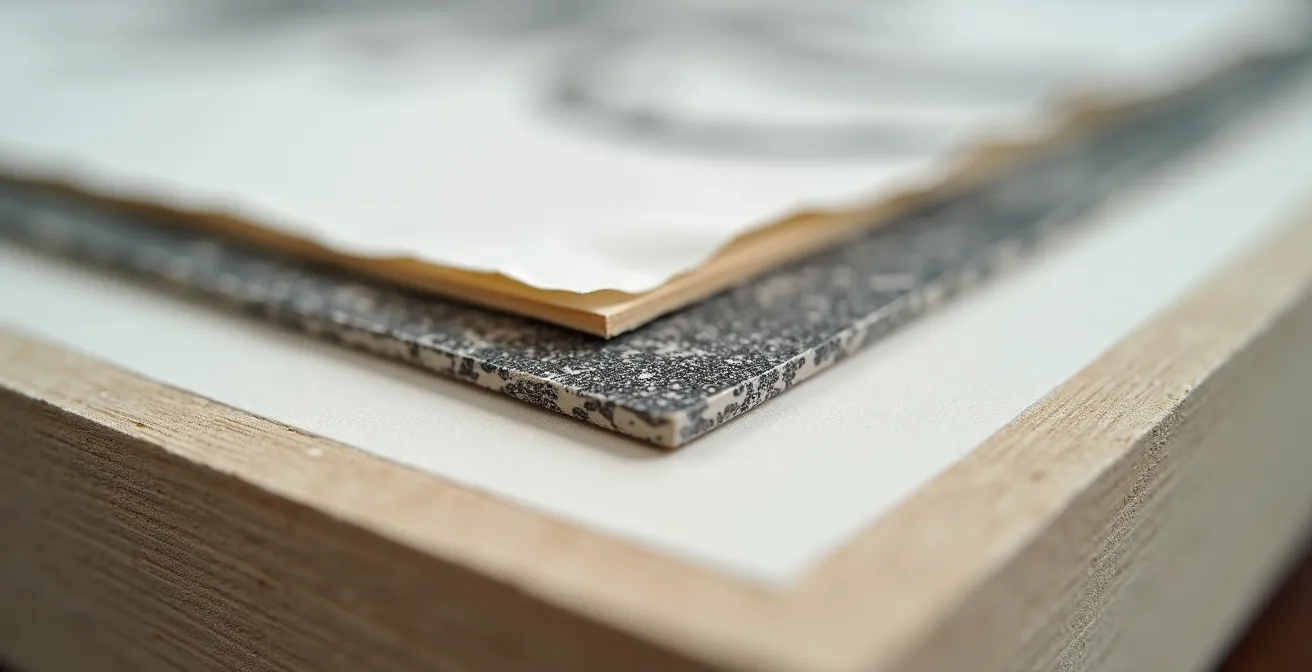
Beyond framing, controlling the ambient environment is crucial for the long-term health of a collection. The ideal conditions are often cited as a stable temperature around 65-75°F (18-24°C) and a relative humidity between 30-50%. Drastic swings are more damaging than a consistently high or low level. For serious collectors, investing in a good hygrometer to monitor humidity levels, and potentially a humidifier or dehumidifier to regulate them, is a wise decision. Regular inspection of artworks, even those in storage, is also essential to catch any potential issues like insect damage or mold before they become severe.
Essential Conservation Checklist: Protecting Paper Artworks
- Use UV-protective glazing to prevent light damage and fading of the artwork.
- Install acid-free mats to create a protective buffer between the artwork and the frame’s glazing.
- Apply a sealed backing to the frame to create a stable microclimate and protect from dust and pests.
- Maintain a relative humidity between 30-50% in the display or storage area to prevent foxing and cockling.
- Keep the environment at a stable temperature, ideally between 65-75°F (18-24°C), to minimize expansion and contraction cycles.
Why a 9B Pencil Creates Depth That an HB Simply Cannot Achieve?
To the uninitiated, a pencil is just a pencil. But for an artist and a knowledgeable collector, the small alphanumeric code on its side—HB, 2B, 9B—represents an entire spectrum of expressive potential. The difference between a hard (H) and a soft (B, for “blackness”) pencil is fundamental to classical drawing. An HB pencil, the standard for writing, contains more clay in its graphite core, making it harder and capable of producing fine, light lines. A 9B pencil, at the other end of the spectrum, contains much more graphite and less binder, making it incredibly soft. This softness allows it to deposit a deep, rich black on the paper that an HB pencil is physically incapable of achieving.
This ability to create profound blacks is essential for achieving a full range of tonal values, which is the cornerstone of creating the illusion of three-dimensional form. As artist Tuomas Tuimala explains, “The drawing of tonal values brings depth and realism to the drawing. The cartoon type of linear 2D drawing is molded and shaped into a 3D form through the correct rendering of tonal values.” A drawing that utilizes only a limited range of mid-tones will inevitably appear flat and lifeless. The strategic use of a 9B pencil for the darkest accents—the deepest shadows, the pupil of an eye—creates a dynamic value range that makes the entire image pop with realistic depth.
Many artists work with a specific number of values in mind to achieve this realism. According to classical drawing instruction methods, some artists adhere to a 9-value scale, from pure white to the darkest black. To achieve this full range, an artist must use a variety of pencils. An HB might be used for the initial light sketch, a 2B or 4B for building up mid-tones, and a 6B to 9B for pushing the darks to their absolute limit. When examining a drawing, a collector should look for this full and masterfully controlled value range. Is there a true, deep black present? Do the tones transition smoothly and logically to create a convincing illusion of light falling across a form? The presence of these rich darks is a hallmark of an artist who fully understands their materials.
Why Empty Space (Ma) is as Important as the Ink in Wash Painting?
In the Western tradition of draftsmanship, there is often an impulse to fill the page, a “horror vacui” that equates empty space with unfinished work. However, a more sophisticated understanding of composition, shared by both Eastern and Western masters, recognizes that empty, or “negative,” space is not a void. It is an active and essential element of the artwork. In Japanese art, this concept is known as Ma (間), which can be translated as “gap,” “space,” or “pause.” It refers to the artistic interpretation of empty space, recognizing its power to define subjects, create rhythm, and guide the viewer’s eye.
This principle is not foreign to the Western classical tradition, even if it is named differently. Master artists have always understood that the shapes formed by the areas *around* the subject are just as important as the subject itself. As Kurt Wenner articulates, “The process of drawing was about developing ideas of form and space… the structure of drawing was a composition of artistic ideas.” This means that every part of the picture plane is a conscious choice. Leaving an area of paper blank is a deliberate compositional decision designed to give the drawn elements room to breathe, to create a sense of atmosphere, or to place emphasis on the primary subject.
In an ink wash painting, this is particularly evident. The stark contrast between the rich, fluid ink and the pristine white of the paper makes the Ma a powerful co-star. The empty space can represent mist, light, or simply a quiet moment for contemplation. It prevents the composition from becoming cluttered and suffocating. For a collector, evaluating an artist’s use of negative space is a sign of deeper connoisseurship. Does the empty space feel intentional and balanced? Does it enhance the subject, or does it feel like an afterthought? A masterful artist composes with both the mark and the void, understanding that what is left out is just as important as what is put in. It is, as the School of Realist Art suggests, a strategic decision that moves the artist away from just “copying what’s there to expressing a vision.”
Key Takeaways
- Verifiable Skill is Value: The return to draftsmanship is driven by a desire for “proof-of-work”—tangible, timeless skill in a market saturated with ephemeral concepts.
- Lineage Matters: Atelier training provides a direct pedagogical link to historical masters, a quality highly prized by purist collectors.
- Technique with Soul: The best contemporary artists use classical techniques not to imitate the past, but to create a modern, relevant voice, thus avoiding the “kitsch” trap.
Cross-Hatching Technique: How to Judge the Quality of an Ink Drawing?
Cross-hatching is one of the quintessential techniques of classical ink drawing, used by masters from Dürer to da Vinci to create tone, volume, and texture with simple lines. At its most basic, it involves layering sets of parallel lines (hatching) at an angle to one another. However, the difference between amateur and masterful cross-hatching is vast. Judging its quality provides a collector with a clear window into an artist’s control, confidence, and understanding of form. A quick look at the line work can reveal a great deal about the hand that made it.
Masterful cross-hatching is not a mechanical process of filling in an area. Each line has a purpose. One of the primary indicators of quality is whether the lines follow the form of the object they are describing. On a curved surface, like a sphere or a muscle, the hatch marks should curve and wrap around the volume, enhancing its three-dimensional feel. Flat, straight hatching on a curved form will instantly flatten the drawing. As noted by instructors like Luis Borrero, who teach the techniques of the old masters, this “form-following” principle is fundamental. It demonstrates that the artist is thinking like a sculptor, carving out form with their lines.
Beyond describing form, the quality of the lines themselves is crucial. Look for a sense of rhythm and confidence. The lines should be clean and decisive, not hesitant or scratchy. A master’s hatching often has a beautiful, almost woven quality, where the intersections are clean and create a harmonious optical texture. An overworked or messy patch of cross-hatching, by contrast, can look like a chaotic tangle, creating a “dirty” gray rather than a clean, controlled tone. An astute collector should also look for line economy. A great artist uses the fewest lines necessary to achieve the desired effect. Their work feels efficient and elegant, never labored.
In summary, when judging a cross-hatched ink drawing, look for these key indicators:
- Form-Following Lines: Do the hatches wrap around the object’s volume?
- Confident Execution: Are the strokes clean and decisive, or hesitant and overworked?
- Harmonious Weave: Do the layers of lines interact to create a clean, consistent texture?
- Line Economy: Does the artist achieve the effect with an elegant efficiency of marks?
Ultimately, the renewed focus on classical draftsmanship is a search for permanence in an accelerating world. It is an affirmation that the disciplined, skilled human hand can create objects of profound and lasting value. For collectors, this path offers not only the reward of owning a beautiful object but also the satisfaction of supporting a timeless artistic legacy. To truly engage with this art form, the next logical step is to begin training one’s own eye by viewing original works and applying these principles. The journey begins with understanding the core principles of atelier training that form the very foundation of this enduring craft.