
The greatest risk to your collage art investment is not a single copyright claim, but the combined, often invisible, erosion of value from material instability and a weak legal foundation.
- Material degradation, or “inherent vice,” from non-archival glues and papers can make a work unsalable.
- Legal defensibility hinges on proving “transformative use,” a conceptual quality that requires careful analysis beyond surface aesthetics.
Recommendation: Shift from a passive buyer to a forensic investigator. Conduct rigorous due diligence on both the physical materials and the legal warranties before every acquisition.
For the discerning collector, the allure of collage and mixed media art lies in its layered complexity—a rich dialogue of texture, form, and appropriated imagery. However, acquiring these works is an exercise in navigating dual liabilities. Beyond the visible surface, two primary risks threaten the long-term value of your investment: the physical self-destruction of the piece due to its own components, a concept known as inherent vice, and the legal vulnerability stemming from the use of copyrighted source materials. Many collectors focus on the aesthetics, while others might have a vague concern about copyright, but few understand that these two risks are deeply intertwined.
The stability of the glue and paper is as critical as the legal clearance of the images. An artist’s choice of materials can either bolster or undermine the work’s defense against a copyright claim, just as it determines its physical longevity. This guide bypasses surface-level advice. It is structured as a legal and forensic framework for the prudent collector. We will dissect the material, legal, and market-based factors you must scrutinize to protect your collection. Your role is not merely to acquire but to conduct thorough due diligence, ensuring the artwork you bring into your collection is built to last, both physically and legally.
This article provides a structured approach for evaluating these intertwined risks. By examining each facet, from the chemical stability of the adhesives to the conceptual strength of the artistic statement, you will gain the necessary expertise to make informed and secure acquisition decisions.
Summary: A Collector’s Forensic Guide to Acquiring Mixed Media Art
- Why Glue Sticks Fail in 5 Years and What Archival Glue to Look For?
- How to Light a Collage That Mixes Matte Paper and Glossy Photos?
- Cut-and-Paste Original or Digital Composite Print: Which is Worth More?
- The Yellowing Newspaper: Why Newsprint Elements Will Self-Destruct in Your Art
- How to Read the Hidden Story in the Juxtaposition of Collage Images?
- The Copyright Mistake That Means You Don’t Actually Own the Image
- The ‘Curated’ Label Mistake That Can Devalue Your Collection in 5 Years
- Gouache Art: Why Is This Designer’s Medium Making a Comeback in Fine Art?
Why Glue Sticks Fail in 5 Years and What Archival Glue to Look For?
The most fundamental threat to a collage’s integrity is often the most overlooked: the adhesive. A standard, acidic glue stick is an agent of decay. Its chemical composition actively breaks down paper fibers, leading to discoloration, embrittlement, and eventual delamination. From a conservation standpoint, this is a textbook case of inherent vice, where the object’s own materials guarantee its eventual destruction. Research confirms that regular glue sticks lose adhesion within 5-10 years, while archival-quality Polyvinyl Acetate (PVA) adhesives can maintain stability for over 50 years.
For a collector, an artwork constructed with inferior adhesives is a depreciating asset with a built-in deadline for costly conservation intervention. Therefore, your first line of inquiry should be a forensic examination of the work’s construction. This requires moving beyond the artist’s statement to ask direct questions about the materials used. The term “archival” should be treated not as a marketing adjective but as a technical specification that requires verification.
A professional artist conscious of their work’s longevity will use stable, acid-free, and reversible adhesives. Common archival choices include wheat or rice starch pastes, methyl cellulose, or specific formulations of archival-grade PVA. The reversibility is key; it allows a future conservator to safely remove and replace the adhesive without damaging the original paper elements. When acquiring a work, requesting a “materials list” or a statement of conservation-grade construction is a reasonable and essential part of your due diligence.
To systematically assess this risk, collectors should verify the following points:
- Adhesive Type: Inquire if the artist used wheat starch paste, methyl cellulose, or archival PVA. Be wary of works where dextrin-based or unidentified craft glues were used.
- Paper Acidity: Request pH testing results for the paper elements or look for formal “acid-free” or “archival-grade” certification in the artwork’s documentation.
- UV Protection: Confirm if the work has been framed with UV-filtering glazing or treated with a UV-resistant varnish, which is crucial for protecting both the paper and the adhesives from light damage.
- Lightfastness Ratings: For any applied colors (inks, paints), ensure they meet ASTM lightfastness standards I or II, which indicates they will not fade or change color for over 100 years under museum conditions.
- Reversibility: The most critical question for future conservation. Confirm that the adhesives used are water-reversible, allowing for future treatment without damaging the artwork.
How to Light a Collage That Mixes Matte Paper and Glossy Photos?
Once a materially sound collage is acquired, its preservation is largely dependent on the collector’s environment. Lighting is the most significant external factor. Mixed media collages present a unique challenge because they combine different surfaces—the diffuse, absorbent quality of matte paper and the specular, reflective nature of glossy photographs. Improper lighting can either wash out details on one surface or create distracting glare and hotspots on the other. More critically, excessive light exposure, particularly UV radiation, accelerates the chemical degradation of paper and pigments.
Conservation standards are stringent. For highly light-sensitive materials commonly found in collage, such as watercolor, newsprint, and certain photographs, the recommendation is a maximum exposure of 50 lux, a stark contrast to the 200 lux permissible for more robust oil paintings. A collector must therefore think like a museum curator, creating a display environment that balances visibility with preservation. This means avoiding direct sunlight at all costs and utilizing controlled, artificial light sources.
Case Study: LED Technology in Museum Conservation
Museums globally have increasingly adopted LED lighting systems, particularly those with a high Color Rendering Index (CRI) of 95-98, for displaying mixed media. Unlike older halogen bulbs, LEDs emit negligible UV and infrared radiation, reducing the risk of light-induced damage by up to 90%. Furthermore, modern LED systems allow for precise control over color temperature (from a warm 2700K to a neutral 4000K). This flexibility enables a lighting scheme that can articulate the subtle textures of matte paper while simultaneously revealing the rich detail in glossy photographic elements without causing harmful glare. This technology not only ensures superior preservation but has also been shown to reduce institutional energy costs by as much as 75%.
For the collector, this means investing in a high-CRI LED lighting system with adjustable dimmers and directional heads is not a luxury but a fundamental component of responsible ownership. The goal is to use “raking light”—light angled from the side—to emphasize the physical layers and textures of the collage without creating direct reflections off glossy surfaces. By carefully controlling the intensity, color, and direction of light, you can reveal the artist’s full intent while safeguarding the work for decades to come.
Cut-and-Paste Original or Digital Composite Print: Which is Worth More?
The medium of collage exists on a spectrum from the unique, physically assembled object to the infinitely reproducible digital print. From a collector’s and a legal standpoint, the distinction is paramount, as it fundamentally alters the work’s scarcity, value, and risk profile. A traditional “cut-and-paste” collage is a unique, one-of-one object. Its value is intrinsically tied to this singularity. A digital collage, printed in an edition, distributes its value across multiple copies, with each individual print being inherently less scarce.
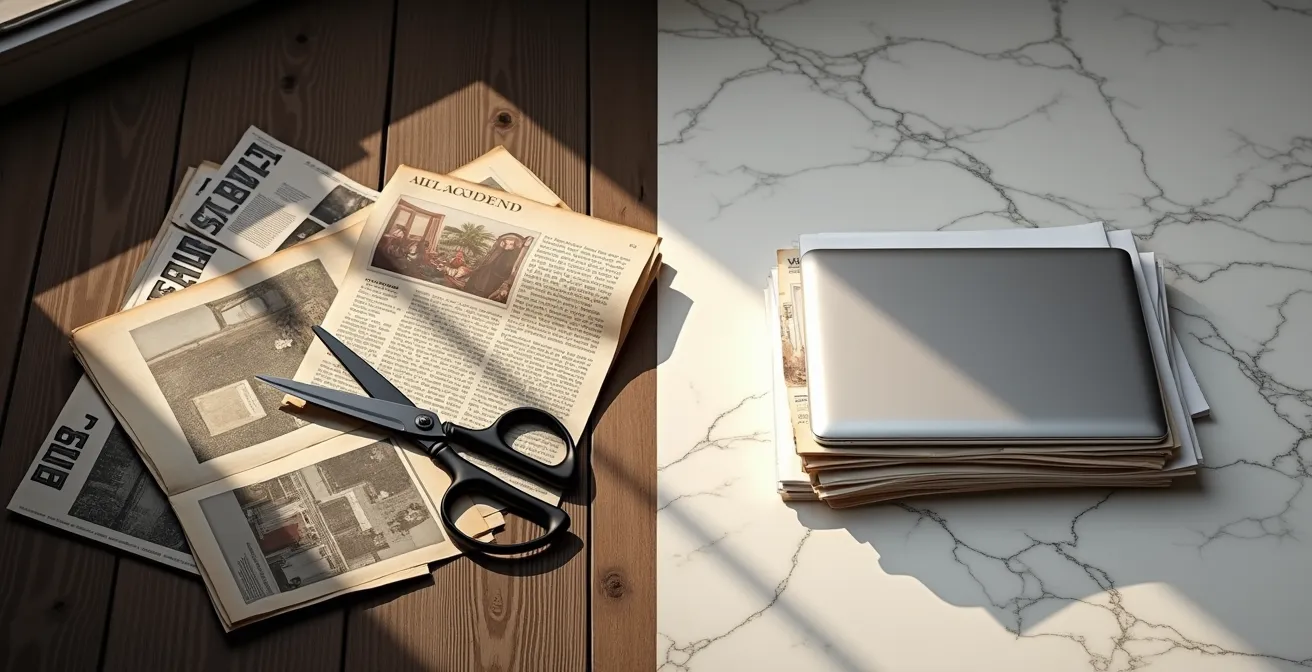
This distinction has profound legal implications. While tracing the origins of a small clipping from a 50-year-old magazine in a physical collage can be nearly impossible, the digital source files for a composite print are often easily traceable via reverse image searches. This elevates the copyright risk significantly. If a copyright infringement claim is successful against an editioned digital work, the potential damages can be multiplied by the number of prints in the edition, creating a substantial financial liability that can extend to the gallery and the collector.
As a result, the due diligence process for each format differs. For a physical collage, the focus is on material analysis and provenance. For a digital print, the priority must be a warranty of rights clearance from the artist. The market reflects this dichotomy, often placing a significant premium on unique physical works over their digital counterparts, assuming all other factors like artist reputation are equal.
The following table outlines the key differences in risk and value assessment that a prudent collector must consider. As demonstrated by a recent legal and market analysis, these factors directly impact an artwork’s long-term investment potential.
| Aspect | Physical Cut-and-Paste | Digital Composite Print |
|---|---|---|
| Legal Risk Profile | Low – vintage/orphan works harder to trace | High – digital sources easily traceable |
| Edition Size Impact | Unique 1/1 – highest scarcity value | Editions of 50-500 – diluted value |
| Copyright Damages Potential | Limited to single work | Multiplied by edition size |
| Authentication Requirements | Material analysis certificate | Rights clearance warranty essential |
| Market Premium | 300-500% for unique works | Standard print market rates |
The Yellowing Newspaper: Why Newsprint Elements Will Self-Destruct in Your Art
The inclusion of newsprint in collage art, a practice popularized by Cubist and Dadaist masters, introduces a potent but perilous material. Newsprint is manufactured from wood pulp that has not had its lignin removed. Lignin is a natural polymer in wood that is highly acidic and light-sensitive. When exposed to oxygen and light, it triggers a chemical reaction that breaks down the cellulose fibers of the paper, causing the characteristic yellowing, brittleness, and eventual disintegration. This is the ultimate example of inherent vice: the material is engineered for obsolescence and actively works to destroy itself.
Using newsprint creates an inherent vice – the material’s own chemical composition causes its deterioration, which can make the artwork uninsurable or require costly conservation, directly impacting collector ROI.
– Conservation specialist, Art Preservation Services documentation
For a collector, purchasing a collage with significant newsprint elements is akin to acquiring an asset with a known, recurring maintenance cost. The degradation is not a possibility; it is a certainty. While the aesthetic of aging can be part of the artist’s intent, unchecked decay will ultimately render the work worthless. Professional conservation can slow this process, but it cannot reverse it, and it is expensive.
Cost Analysis: Conservation of Newsprint-Based Artworks
A professional de-acidification treatment for a moderately sized collage containing newsprint typically costs between $1,500 and $3,000. The complex process involves carefully applying an alkaline buffer to neutralize the acid in the paper and then encapsulating the work in archival, acid-free materials. Major museums with significant newsprint-based works in their collections must budget for these treatments every 10 to 15 years as part of their ongoing conservation strategy. While this intervention can extend the artwork’s displayable life by 50 to 100 years, it cannot undo existing yellowing or embrittlement. This recurring expense is a material factor that serious collectors must build into their total cost of ownership calculation.
Therefore, when assessing a work containing newsprint, a collector must ask two questions. First, is the decay part of the work’s conceptual message about ephemerality? If so, are you prepared to accept its eventual loss? Second, if preservation is the goal, has the artist taken any pre-emptive conservation measures, such as de-acidification sprays or archival encapsulation? Answering these questions is critical to making a sound investment and avoiding the acquisition of a work that is, by its very nature, programmed to self-destruct.
How to Read the Hidden Story in the Juxtaposition of Collage Images?
Beyond material concerns, the legal defensibility of a collage hinges on the conceptual work performed by the artist. In copyright law, particularly in the United States, the doctrine of “fair use” protects appropriation if the new work is “transformative.” A work is considered transformative if it does not merely repackage the original but instead uses it to create a new message, meaning, or commentary. For a collector, learning to “read” a collage for transformative intent is a critical skill for assessing its legal risk.

This is not a purely aesthetic judgment. It is an analysis of juxtaposition. How has the artist altered the original context of the source images? A collage that simply arranges beautiful flowers cut from a magazine in a decorative pattern is likely not transformative; it merely re-presents the original’s purpose. However, a collage that places those same flowers next to images of industrial pollution or military hardware creates a new commentary on nature, consumerism, or conflict. This new meaning is the cornerstone of a successful fair use defense.
The degree of physical and conceptual intervention is key. Has the artist painted over, torn, written on, or otherwise obscured the source material? This “artistic intervention” serves as physical evidence of transformation, demonstrating that the source material is not just being copied but is being used as a raw ingredient for a new creation.
Fair Use Analysis in Practice
Courts actively evaluate how an artist’s choices create new meaning. In a landmark case, a collage that used corporate logos to critique capitalist culture was deemed highly transformative and thus protected as fair use. Conversely, an artist who created decorative arrangements of celebrity photographs without adding any critical or conceptual framework was found liable for copyright infringement. In these legal battles, the artist’s documented intent, gallery interpretive texts, and the visible evidence of transformation within the artwork itself serve as crucial pieces of evidence. This legal precedent directly links the conceptual strength of a collage to its defensibility and, by extension, its stable market value.
A prudent collector should therefore analyze a work’s composition with a critical eye. Ask: What is the dialogue between these images? Does the juxtaposition create irony, critique, or a new narrative? The more evident the artist’s new message, the stronger the work’s legal standing.
The Copyright Mistake That Means You Don’t Actually Own the Image
A fundamental misconception among many collectors is that purchasing an artwork grants them all rights to it. This is legally incorrect. When you acquire a piece of collage art, you are purchasing the physical or digital object itself. You are not, unless explicitly and separately negotiated, purchasing the underlying copyright. This means you have the right to possess, display, and sell that specific object, but you do not have the right to reproduce it—for example, by making prints, using it on a website, or licensing it for commercial purposes.
This distinction is critical. More importantly for a collector of appropriation art, the artist from whom you are buying may not themselves hold the copyright to the source materials used in the collage. This creates a chain of potential liability. If a source image was used without permission and is not protected by fair use, the original copyright holder could bring a claim not only against the artist but also potentially against the gallery and the collector for displaying and distributing an infringing work.
Therefore, the most significant copyright mistake a collector can make is failing to conduct due diligence on the legal warranties provided at the point of sale. A reputable artist and gallery, aware of these risks, should be prepared to offer specific legal assurances. Relying on a handshake or a simple invoice is insufficient. A prudent acquisition requires contractual protection.
Collector’s Copyright Audit: Essential Warranties to Secure
- Demand a written warranty: The purchase agreement must include a clause where the artist expressly warrants that the work does not infringe upon any third-party copyrights.
- Require an indemnification clause: This is a crucial legal protection. It stipulates that the artist will defend the buyer and cover any legal costs or damages if a future copyright claim arises from the work.
- Verify source material documentation: For high-value digital collages, the artist should be able to provide a chain of title or licenses for any stock imagery used. For physical works, this is less feasible but the warranty is even more important.
- Clarify moral rights: In some jurisdictions, artists retain “moral rights” which can prevent the owner from altering or destroying the work, even if they own the object. Understand the specific laws that apply.
- Confirm transfer of rights: If you intend to reproduce the image of the artwork for any purpose, you must secure a separate, written license from the artist that explicitly grants these rights.
Treating the purchase agreement with the same rigor as any other significant investment contract is the only way to mitigate the latent legal risks inherent in collecting collage art.
The ‘Curated’ Label Mistake That Can Devalue Your Collection in 5 Years
In an increasingly crowded art market, the “curated” label is often used as a shorthand for quality and investment potential. However, the term has become diluted, and collectors must be cautious. There is a vast difference between a collection curated by a seasoned art historian based on conceptual significance and material integrity, and one “curated” by an algorithm or a trend-forecaster based on fleeting aesthetic preferences.
Relying on a superficial curation label without scrutinizing the curator’s methodology and credentials is a significant financial risk. A collection built on a passing trend is likely to see its value plummet once the cultural mood shifts. The collector is left holding assets that have lost both their cultural cachet and their market value.
Impact of Curation Strategy on Collection Value
Market analysis shows a clear divergence in long-term value based on curation strategy. Collections marketed as ‘curated’ around ephemeral aesthetic trends (e.g., ‘millennial pink art’ in the late 2010s) have experienced a 40-60% depreciation in value as those trends faded. In stark contrast, collections assembled by established art professionals who focus on art-historical significance, artist career trajectory, and, crucially, perform due diligence on copyright and material stability, consistently maintain or increase their value. In fact, works sold with a provenance from a reputable, professionally curated collection can command a 15-20% premium at auction over similar works without such a history.
A legitimate curation process for collage art must extend far beyond simple visual harmony. A professional curator or reputable gallery acts as the collector’s first line of defense. Their process should include vetting the work for potential copyright issues, assessing the stability of the materials, documenting the work’s provenance, and providing clear conservation guidelines. This rigorous background work is the true value of curation.
When presented with a “curated” selection, the prudent collector must ask: Who is the curator? What are their credentials? What was their selection criteria? Did their process include legal and material vetting? Buying from an established gallery with a long track record is an effective form of pre-curation, as their reputation is staked on this due diligence. Anything less is simply marketing.
Key Takeaways
- The physical longevity of a collage (its glues, papers) is as critical to its value as its aesthetic and legal standing.
- “Fair use” is not an automatic defense; it requires a clear “transformative” intent that a collector must learn to identify.
- Acquiring a collage is a transfer of risk. Secure legal warranties, especially an indemnification clause, to protect your investment.
Gouache Art: Why Is This Designer’s Medium Making a Comeback in Fine Art?
In the context of the material and legal risks of collage, the recent resurgence of gouache in fine art is not merely a stylistic trend; it is a strategic response. Gouache, an opaque watercolor, possesses unique properties that directly address the core vulnerabilities of mixed media. Its dense, velvety matte finish allows an artist to physically intervene in a source image, partially or completely obscuring it to create a powerful transformative statement. This act of painting over an image provides clear, irrefutable evidence of artistic intervention, significantly strengthening a fair use defense in a potential copyright dispute. It is a material choice with direct legal benefits.
This growing awareness is reflected in artist practices. As copyright concerns have become more prominent, a reported 70% increase in gouache use for the physical alteration of source materials has been noted among mixed media artists since 2020. Artists are actively using the medium as a tool for both aesthetic expression and legal fortification.
Gouache as a Marker of Authenticity and Value
The distinct physical properties of gouache also serve as a crucial marker of authenticity, helping to distinguish a unique, hand-altered work from a simple digital print. The characteristic matte texture and the visible ridges of hand-applied paint can be definitively identified through conservation analysis, providing proof of “the artist’s hand.” This physical evidence of direct intervention is highly valued in the market. Studies of auction results indicate that mixed media works featuring demonstrable physical alteration, such as gouache overpainting, can increase their perceived value by 25-40% compared to collages that consist purely of unaltered photographic elements. The material simultaneously strengthens legal defense and enhances market value.
For the collector, the presence of gouache or similar physical interventions in a collage is a positive indicator on multiple fronts. It signals an artist who is not only engaged in a sophisticated visual dialogue but is also likely conscious of the need to create a legally defensible, unique, and materially distinct object. Seeing gouache should prompt a collector to look closer, recognizing it not just as paint, but as a deliberate strategy to create a work of lasting artistic and legal integrity.
Ultimately, a collector’s best defense is a proactive, forensic mindset. By asking rigorous questions about materials, demanding contractual legal protections, and learning to analyze a work for its transformative intent, you shift from being a passive consumer to a knowledgeable custodian of art. This diligence is not cynicism; it is the highest form of respect for the art, the artist, and your own collection.
Frequently Asked Questions About Collecting Collage Art
How can I verify if ‘curated’ actually adds value?
Check the curator’s credentials. Established art historians, museum professionals, or galleries with a track record of 10+ years indicate legitimate curation that adds value, as opposed to a simple marketing buzzword used for a visually appealing but potentially risky selection.
What should a quality curation process include beyond aesthetics?
Professional curation must go beyond visual appeal. It should include verification of copyright clearance, a thorough assessment of the work’s material stability, documentation of its provenance, and providing the collector with clear conservation recommendations. This due diligence is the true value of a curated work.
Is buying from a reputable gallery considered a form of curation?
Yes, absolutely. An established gallery stakes its long-term reputation on the quality and legal standing of the works it sells. Their internal vetting process functions as a powerful form of pre-curation that protects the collector’s interests regarding legal, conservation, and authenticity factors.