
A conceptual photograph is not a picture of a fiction; it is the construction of a new, self-contained reality. The artist’s role is not merely to illustrate an idea, but to architect a world with its own internal logic, laws of physics, and history. This guide explores how to use props, light, and context as the building blocks of these alternate realities, inviting the viewer to become an archaeologist of the unreal.
As a visual artist, you carry worlds in your mind—scenes and feelings that defy the physics and logic of the world outside your window. The common advice suggests that realizing these visions is a matter of technical prowess: mastering Photoshop, acquiring faster lenses, or finding the perfect location. We are told to document, to capture, to find. But what if the most powerful conceptual work is not found, but built? What if our true role is not to capture reality, but to challenge its very definition?
This approach moves beyond simply illustrating an idea. It involves a fundamental shift in perspective. Instead of faking reality, you are architecting a new one, complete with its own history and internal consistency. The camera ceases to be a tool for documentation and becomes an instrument for constructing controlled anomalies—realities that are plausible enough to be believed, yet strange enough to fracture the viewer’s perception of truth. This is where the real work of conceptual art begins: in the subtle manipulation of narrative elements to create a self-contained universe within the frame.
This article will not give you a list of software filters or camera settings. Instead, it will provide a philosophical and practical framework for building these nonexistent worlds. We will explore how a single prop can become a story’s anchor, how light can define a new set of physical laws, and how the space around your subject can tell a story richer than any caption. We will treat the photographic frame not as a window, but as a foundation upon which to build a reality of your own design.
For those who prefer a visual format, the following video offers a journey into surrealist aesthetics. It serves as an excellent visual companion, exploring the kind of dreamlike logic and atmosphere that complements the philosophical concepts discussed in this guide.
To navigate this exploration into the architecture of the unreal, this guide is structured around the core elements of conceptual construction. The following summary outlines the key pillars we will dissect, from the narrative power of a single object to the fine line between commercial work and collectible art.
Summary: Architecting Fictional Worlds Through Photography
- Why a Single Prop Can Change the Entire Narrative of a Conceptual Photo?
- How to Light a Staged Scene so it Feels Eerily Real to the Viewer
- Built on Set or Photoshop Composite: Which Method Do Collectors Respect More?
- The Title Mistake: Why Giving Too Much Away Ruins the Viewer’s Interpretation
- How to Use Visual Metaphors That 80% of Viewers Will Understand Immediately
- Ad Campaign or Art Series: Can Commercial Work Be Collectible Fine Art?
- How to Make the Set Design Tell the Backstory Without Dialogue?
- Immersive Storytelling: How to Tell a Story When the Viewer Can Look Anywhere?
Why a Single Prop Can Change the Entire Narrative of a Conceptual Photo?
In a constructed reality, a prop is never just an object; it is a piece of evidence. It’s the controlled anomaly that anchors the entire fiction. While a scene can be filled with details, a single, carefully chosen prop has the power to establish, or shatter, the world’s internal logic. Its function is not decorative but narrative. It can introduce temporal dissonance, like a modern smartphone in a Victorian setting, or create psychological impact through its sheer mundanity in a surreal landscape, like a plastic cup in a pristine forest.
The history of conceptual art is built on this principle. When Marcel Duchamp presented a urinal as art, the object itself was unchanged. It was the act of recontextualization—placing it in a gallery, giving it a title—that transformed it into “Fountain.” Alfred Stieglitz’s 1917 photograph immortalized this act, proving how photography could elevate a mundane object into a symbol of artistic rebellion. The prop becomes a catalyst, forcing the viewer to ask “What is this doing here?” and “What happened just before this moment?”
The most effective props create this question. They are not passive symbols but active agents in the story. Consider these techniques:
- Temporal Disruption: Place objects from conflicting time periods together to create an immediate narrative puzzle.
- Material Subversion: Replace an expected object with one of a similar shape but different material to create unease. A vinyl record used as a clock face, for example, speaks volumes about time, memory, and sound.
- Psychological Weight: Use aggressively mundane items in emotionally charged or beautiful settings to create a sense of profound displacement.
Ultimately, a prop’s power lies in its ability to inject a specific, undeniable fact into a fictional world. It is the first clue you offer the viewer, the archaeologist of the unreal, on their quest to understand the scene you’ve built.
How to Light a Staged Scene so it Feels Eerily Real to the Viewer
Lighting in conceptual photography is not about illumination; it’s about defining the physics of your fictional world. A scene’s reality, however strange, is sold by the believability of its light. Yet, the goal is often not perfect realism, but an eerie, uncanny hyper-realism. This is achieved when the light is technically flawless but motivationally wrong—a hard key light with no visible source, or shadows that contradict the logic of the scene.
This dissonance creates a subconscious feeling that something is “off,” drawing the viewer deeper into the image. You can ground a fantastical scene with a single, explainable practical light (like a desk lamp), making the other, more mysterious light sources feel even more intrusive. This creates a collision of realities within the frame. Another powerful technique is to introduce subtle, unnatural color casts, like a sickly green or a deep magenta, bleeding in from off-camera to hint at an unseen presence or emotional state.
This level of control doesn’t necessarily require a massive studio. Photographer John Flury famously developed a “zone lighting” technique where he lights a scene piece by piece with small speedlights, working from back to front like a painter. In a detailed tutorial, he demonstrates creating complex surreal images with just a few lights, allowing for immense control over the final composite. This method allows an artist to “paint” with light, crafting impossible lighting scenarios that still feel tangibly real.
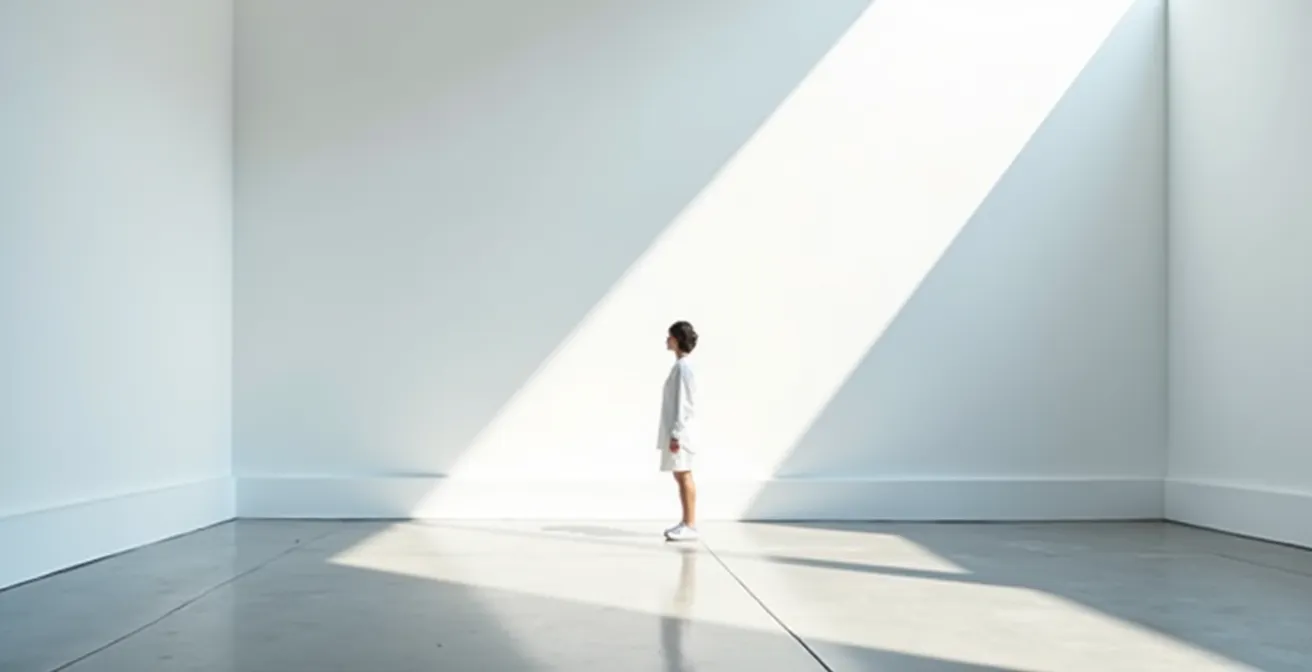
As seen in the image above, manipulating shadows to contradict the apparent light source is one of the most effective ways to create this unsettling feeling. When a single figure casts multiple shadows in impossible directions, the viewer is forced to question the very nature of the reality they are witnessing. Is there more than one sun? Or is the figure themselves the source of this temporal or dimensional rift? The light tells a story that the subject cannot.
Built on Set or Photoshop Composite: Which Method Do Collectors Respect More?
The debate between in-camera purity and digital manipulation is a recurring theme in photography. For the conceptual artist, this is not a technical question but a philosophical one. Does the final image’s power reside in the artifact itself—the tangible, painstakingly built set—or in the seamless illusion of the final print? The truth is, collectors and institutions are less concerned with the method than with the strength and coherence of the artistic vision.
Whether you build an elaborate physical set or composite dozens of images in Photoshop, the primary criterion for success is the final image’s narrative gravity—its ability to pull the viewer into its self-contained logic. A poorly executed physical set feels just as artificial as a clumsy Photoshop composite. Conversely, a masterfully crafted digital reality, like those of artists such as Erik Johansson, can command just as much respect and market value as a large-scale installation photograph by Gregory Crewdson.
The photography market is robust, and collectors are increasingly sophisticated. While the medium has its own specific market dynamics, the value is ultimately tied to the artist’s unique voice. In fact, photography auction sales reached $116.9 million in early 2024, showing a healthy appetite for the medium. In this market, the story behind the work, the consistency of the artist’s portfolio, and the limited nature of the edition often matter more than the specific tools used in its creation.
The choice of method, therefore, should be dictated by the needs of the concept and the resources of the artist. Building a physical set can lend a tangible weight and texture that is difficult to replicate digitally. Digital compositing, on the other hand, allows for the creation of scenes that are physically impossible, freeing the artist from the constraints of gravity and budget. Both are valid tools in the architect’s toolkit.
The Title Mistake: Why Giving Too Much Away Ruins the Viewer’s Interpretation
In conceptual photography, a title is not a caption. It is not there to explain what the viewer is seeing. Instead, a title should be the first thread the viewer pulls to unravel the mystery you’ve constructed. The biggest mistake an artist can make is to provide a title that is too descriptive, one that collapses all potential interpretations into a single, definitive statement. This robs the viewer of their role as the archaeologist of the unreal and transforms them from an active participant into a passive observer.
An effective title opens doors; it doesn’t close them. It should function as a piece of the puzzle, not the solution printed on the box. Consider framing titles as unanswerable questions, or using short, ambiguous phrases that can be interpreted in multiple ways. Some artists even use titles as red herrings, deliberately misdirecting the viewer’s initial analysis to create a delayed revelation when they look closer at the image.
Photographer Philip Toledano, in his series ‘Maybe,’ masterfully used this technique. He created a body of work exploring his fears and anxieties about the future, staging potential scenarios of his own demise. The titles are simple, evocative, and withhold as much as they reveal. They don’t dictate the story; they set a mood and invite the viewer to project their own narratives onto the scene. This strategy deepens engagement and makes the work intensely personal for each viewer.
The option of ‘Untitled’ should be used with extreme care. It works best within a series where the surrounding images provide the necessary context. On its own, an untitled conceptual piece can feel unmoored, lacking the initial anchor point the viewer needs to begin their investigation. The title, however brief, is your first handshake with the viewer; it should be firm, intriguing, and hint at the depths to come without giving away the ending.
How to Use Visual Metaphors That 80% of Viewers Will Understand Immediately
A visual metaphor is a powerful tool for communicating complex emotions and ideas in a single frame. It works by substituting an expected object or state with an unexpected one, creating an instant connection in the viewer’s mind. The most effective metaphors tap into a collective unconscious—shared symbols and experiences that resonate across cultures. Clocks melting to represent the fluidity or loss of time, a cracked mirror to signify a fractured identity, or a lone tree in a barren landscape to evoke isolation are all examples of metaphors that are almost universally understood.
The challenge for the conceptual artist is to use these universal metaphors in a way that feels fresh and personal, rather than clichéd. This can be achieved by combining them with a specific, personal context or by rendering them with such unique visual flair that they are reborn. The key is to find the balance between clarity and poetry. If a metaphor is too obscure, the message is lost; if it’s too literal, it lacks impact.
This is a craft of nuance. An artist must translate an internal, abstract feeling into an external, concrete image. The goal is to create a visual that prompts the viewer to say, “I’ve felt that way before, but I’ve never seen it put like that.”

The image above is a perfect example of this principle. The idea of “time slipping through one’s fingers” is a common phrase, an abstract concept. By visualizing it literally—with clock faces and gears melting like liquid mercury through a person’s hands—the metaphor becomes visceral and unforgettable. It takes a universal feeling and gives it a tangible, impossible form, creating a powerful and immediately understandable piece of conceptual art.
Ad Campaign or Art Series: Can Commercial Work Be Collectible Fine Art?
The line between commercial photography and fine art has always been porous, and in the contemporary art market, it is more blurred than ever. Historically, commercial work was defined by its intent: to fulfill a client’s brief and sell a product. Fine art was defined by the artist’s personal vision. Today, however, many artists move freely between these two worlds, and collectors are increasingly willing to acquire work that originated in a commercial context.
The determining factor is no longer the origin of the work, but its transcendent qualities. Can a photograph created for an ad campaign stand on its own as a compelling artistic statement once it’s removed from its commercial context? Does it possess a unique aesthetic, a conceptual depth, and the signature of a strong artistic voice? Artists like Annie Leibovitz, David LaChapelle, and even Irving Penn built legendary careers by infusing their commercial assignments with such a high degree of artistry that the work now hangs in museums and commands high prices at auction.
For collectors, several factors come into play when evaluating commercially-derived work. The edition size is critical; fine art is built on scarcity. A work’s value is also tied to its place within the artist’s broader oeuvre and its representation by a reputable gallery. The following table breaks down some of the key distinctions that influence collector perception.
This comparison highlights the structural differences that often separate the two realms. As a recent analysis of the photography market shows, these factors directly impact valuation and collectibility.
| Aspect | Commercial Photography | Fine Art Photography |
|---|---|---|
| Primary Intent | Client brief fulfillment | Artist’s personal vision |
| Edition Size | Often unlimited | Limited editions (typically 5-25) |
| Average Price Point | $500-$5,000 | $5,000-$50,000+ |
| Collector Demographics | Design professionals, brands | Private collectors, institutions |
| Gallery Representation | Rarely exhibited | Essential for market credibility |
Ultimately, a photograph’s ability to cross over from commercial to collectible depends on whether it can shed its original function and speak to a deeper, more universal human experience. If it can, it has the potential to become fine art.
How to Make the Set Design Tell the Backstory Without Dialogue?
In conceptual photography, the environment is never a passive background; it is an active character. The set design, or what can be called psychological set dressing, is the art of imbuing a space with a history and an emotional residue. Every object, every texture, and every sign of decay is a word in a silent story. The goal is to create an environment that tells the viewer who lives here, what happened here, and what emotional state this place embodies.
This is the essence of environmental storytelling. It’s about revealing a narrative through clues embedded in the scene. A water stain on the ceiling, the specific pattern of dust on a forgotten object, or the way items are clustered in one corner of a room can all suggest past events, timelines of abandonment, and the habits of an unseen protagonist. The set itself becomes a portrait of a character or a psychological state.
Artist Nicholas Bruno is a master of this technique. He translates his personal experiences with sleep paralysis into hauntingly beautiful photographs. As detailed in profiles of his work, each element in his meticulously staged sets—from the weathered textures of the walls to the sculptural forms he incorporates—is a narrative layer that communicates a state of mind without a single word of explanation. The environment is the story.
Building this kind of narrative depth requires thinking like a forensic investigator. You must “scar” the environment with intention to imply a backstory. The following checklist can serve as a guide for auditing the narrative potential of your own set design.
Your Action Plan: Auditing Your Set’s Backstory
- Analyze Wear Patterns: Where would water stains, cracks, or scuff marks naturally appear over time? Add them deliberately to imply past trauma or neglect.
- Arrange a ‘Character Nest’: Where does the character spend their time? Cluster objects (books, cups, tools) in this area to reveal their personality, habits, and obsessions.
- Plant Foreshadowing Clues: Place subtle objects in the scene that hint at a future event or a hidden aspect of the narrative. A single out-of-place object can carry immense weight.
- Control the Disarray: Is the mess chaotic, or is it organized in a specific way? The nature of the disarray can reveal a character’s psychological state, from frantic anxiety to depressive lethargy.
- Use Dust and Decay: The accumulation of dust and cobwebs is a powerful tool for showing the passage of time. Use it strategically to suggest which objects have been forgotten and for how long.
By treating the set as a canvas for a silent history, you create a world that feels lived-in and emotionally resonant, inviting the viewer to piece together the story for themselves.
Key Takeaways
- Your role as a conceptual artist is that of an architect of worlds, not a documentarian of the existing one.
- Every element—a prop, a shadow, a color cast—is a narrative choice that must reinforce the internal logic of your constructed reality.
- The viewer’s engagement depends on the depth of the mystery you build, not the clarity of the answers you provide.
Immersive Storytelling: How to Tell a Story When the Viewer Can Look Anywhere?
In a complex conceptual image, you grant the viewer freedom. Their eye can wander, investigate, and draw its own conclusions. This freedom is a gift, but it presents a challenge: how do you guide a narrative when there is no fixed path? The answer lies in creating narrative gravity. This is the invisible force you generate through composition, light, and focus that gently pulls the viewer’s attention towards key narrative nodes within the frame.
You are not telling a linear story, but creating a story-space. Within this space, you can embed multiple narrative threads simultaneously. A figure in the foreground might be experiencing one emotional moment, while a detail in the background reveals a contradictory or complementary story. The tension and interplay between these nodes create a rich, immersive experience that rewards exploration. Your composition becomes a map of clues.
This is not about forcing the viewer’s gaze, but about orchestrating it. You can use leading lines, zones of high contrast or color, and selective focus to create a visual hierarchy. The most important narrative element might not be the largest or brightest, but the one that feels most emotionally charged. You create focal points of meaning and allow the viewer to connect the dots themselves. This act of discovery is what makes the story their own and what makes the artwork an immersive experience rather than a simple picture.
Your journey as an architect of the unreal is a deeply personal one. It requires you to look inward, to excavate your own ideas and anxieties, and to find a visual language to give them form. Begin by choosing a single object or a single emotion, and ask not what it is, but what story it wants to tell. Your next reality awaits its architect.