The common belief is that cryptoart is about selling JPEGs; the reality is it’s about weaponizing code to turn art into a living system that defies physical laws.
- Art can now be a dynamic algorithm that evolves over time, not a static image.
- Ownership can be collective, with the project’s governance becoming part of the aesthetic itself.
Recommendation: Stop thinking about your art as a final product. Start designing it as an interactive system with its own rules, materiality, and lifespan.
The term “cryptoart” often conjures images of digital collectibles and volatile markets. Artists are told to build a community, master a marketplace, and hope for a sale. This narrative, however, misses the point entirely. It treats a profound artistic revolution as a mere technological update for distribution, focusing on the frame instead of the painting. The true potential of this medium has little to do with simply creating a digital file and attaching it to a token.
The real paradigm shift lies in moving beyond the constraints of the physical world. For centuries, art has been bound by gravity, material decay, and static form. A sculpture needs a base, a painting cannot change once the paint is dry, and ownership is singular. Cryptoart shatters these limitations. It offers artists a new set of fundamental principles to work with: code as a material, decentralization as a structural force, and the blockchain as a medium for permanent, evolving creation.
But what does it mean to create art that “defies the laws of physics”? It’s not about creating fantastical images. It’s about building art as a system. This is a departure from traditional practice, demanding a new mindset where the artist is as much an architect of systems as a creator of aesthetics. The canvas is no longer a static rectangle; it is a smart contract, a set of rules that can react to data, time, and human interaction.
This guide explores this new frontier. We will dissect how to create sculptures unbound by gravity, manage art projects owned by dozens of collaborators, and design artworks that live and breathe on the blockchain. It’s time to forget what you know about making art and start designing experiences that were, until now, impossible.
To navigate this new creative landscape, this article breaks down the core concepts that empower artists to transcend physical limitations. We will explore the foundational principles, from conceptual design to market realities, providing a clear roadmap for your first steps into this revolutionary domain.
Summary: Cryptoart Creativity: Creating Art That Defies Physics
- Why Sculpture in the Metaverse Doesn’t Need a Base or Gravity?
- How to Manage a ‘DAO’ Art Project Where 50 People Own the Creative Process
- Jpeg or Code: Why Art That Evolves Over Time Is Worth 3x More?
- The Hostage Risk: What Happens to Your Art if the Marketplace Goes Bankrupt?
- How to Compress High-Res Art Under 100MB Without Losing Visual Quality?
- Unique Masterpiece or 10k Avatar Project: Which Hold Value During a Bear Market?
- Direct vs. Managed: Which Marketplace Model Offers Better Resale Value?
- NFT Art Market: How to Verify Provenance on the Blockchain Before Buying?
Why Sculpture in the Metaverse Doesn’t Need a Base or Gravity?
In the physical world, sculpture is a constant negotiation with gravity. Mass, balance, and material integrity are its core constraints. The metaverse, however, is a realm governed by code, not physics. Here, the concept of digital materiality emerges: data, algorithms, and network states become the raw materials. This allows for the creation of forms that are not only weightless but are alive, reacting to invisible forces like data streams, user interaction, or the passage of time.
Case Study: Refik Anadol’s ‘Unsupervised’ at MoMA
Turkish-American artist Refik Anadol’s ‘Unsupervised’ is a monumental data sculpture that reinterprets the entire 200-year history of art in MoMA’s collection through a sophisticated AI. The result is a massive, fluid digital form that evolves in real-time. It is not a static object but a living, breathing data organism that morphs based on algorithmic inputs. The work, sold as an NFT, exists without physical constraints, demonstrating how digital sculptures can be defined by information flows rather than gravitational forces.
This new freedom allows artists to design impossible geometries, floating structures, and forms that change their very substance algorithmically. The sculpture no longer needs a base because its anchor is not the ground, but a coordinate in virtual space and a record on the blockchain. This is not just a visual trick; it’s a fundamental redefinition of what a sculpture can be: an ephemeral, data-driven event rather than a permanent, solid object.
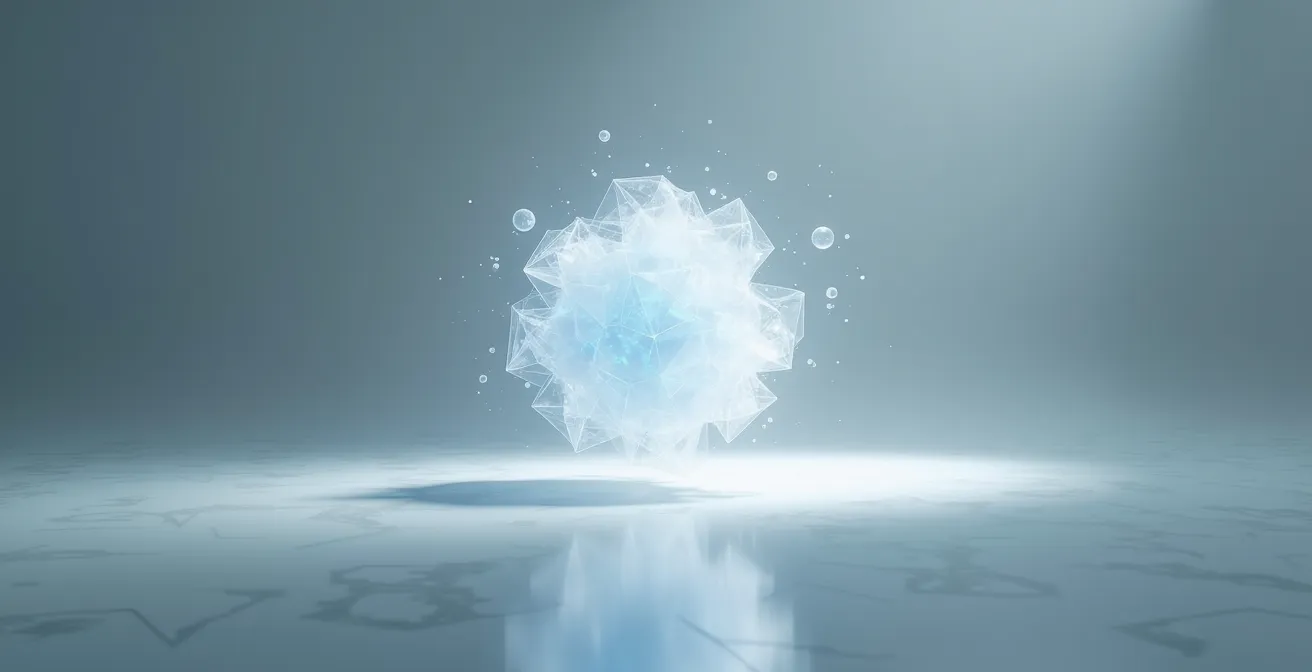
As the illustration above suggests, the focus shifts from physical stability to conceptual coherence. The forces acting upon the artwork are no longer physical but informational. A sculpture might ripple in response to cryptocurrency price fluctuations, or change color based on real-world weather patterns. The artist’s job is to define these rules, creating a system that gives the artwork its unique behavior and form, entirely independent of physical laws.
How to Manage a ‘DAO’ Art Project Where 50 People Own the Creative Process
The revolution of cryptoart extends beyond aesthetics into the very structure of creation and ownership. A Decentralized Autonomous Organization (DAO) allows a group of token-holders to collectively manage a project and its treasury. When applied to art, this model transforms the lone artist’s studio into a collaborative, decentralized entity. However, managing the creative vision of 50 co-owners presents a unique challenge: How do you foster collective creativity without descending into chaos?
The solution lies in a concept we can call governance as aesthetics. The rules, voting mechanisms, and organizational structure of the DAO are not just administrative tools; they are an integral part of the artwork’s conceptual framework. As crypto-thinker Justin Cone notes, the artist’s role fundamentally changes:
The artist’s role shifts from ‘creator’ to ‘governance architect’ – designing systems that enable collective creativity while preventing aesthetic chaos.
– Justin Cone, The Skeptics’ Introduction to Cryptoart and NFTs
The choice of a governance model is therefore an artistic decision. A project might use direct democracy, where every member votes on every detail, creating a slow but highly inclusive process. Another might opt for a council-based model, where elected experts make swift decisions, prioritizing professional execution over mass consensus. Each model produces a different creative outcome and tells a different story about collaboration.
This table compares common governance models, illustrating the trade-offs between speed and control. The “best” model depends entirely on the artistic intent of the collective.
| Governance Model | Decision Speed | Creative Control | Best For |
|---|---|---|---|
| Direct Democracy | Slow (all vote) | Chaotic but inclusive | Small groups (<20) |
| Liquid Democracy | Moderate | Delegated to experts | Medium groups (20-100) |
| Futarchy | Fast | Market-driven | Large experimental projects |
| Council-Based | Fast | Centralized committees | Professional productions |
Ultimately, a successful DAO art project is one where the governance system itself is a work of art, carefully designed to channel the collective energy of its members towards a unified, yet emergent, creative output.
Jpeg or Code: Why Art That Evolves Over Time Is Worth 3x More?
The “just a JPEG” critique fundamentally misunderstands the medium. While many early NFTs were indeed static images, the true power of cryptoart lies in its ability to be dynamic and generative. This is the difference between a photograph of a butterfly and a living butterfly. Art that is written in code, rather than saved as a file, can evolve, react, and change over its lifetime. This introduces a powerful form of conceptual scarcity tied to time and change.
Generative art platforms like Art Blocks are pioneers in this domain. Here, the artwork is not the final image but the algorithm itself. When a collector mints a piece, they run the artist’s script at that specific moment, using the transaction hash as a unique “seed.” This generates a one-of-a-kind output from a single algorithm. The artwork’s journey—its moment of creation—becomes an inseparable part of its identity and value. Some generative artworks go even further, changing their appearance based on the seasons, the owner’s wallet activity, or even the current phase of the moon.
This evolution creates a living connection between the art, its owner, and the world. The artwork is no longer a static relic of the past but a dynamic process unfolding in the present. This “liveness” is highly valued by collectors because it offers an experience that a static image cannot. It’s not just an asset to be held, but a system to be observed and interacted with over time. Each evolutionary state adds to the work’s provenance and narrative, making its history a visible and valuable attribute.
While the “3x more” figure is metaphorical, the market consistently shows a premium for well-executed generative and dynamic art. This is because these pieces leverage the unique capabilities of the blockchain as a medium, rather than just using it as a digital ledger for a static file. They offer a glimpse into a future where art is not a noun, but a verb—an ongoing process of creation and transformation.
The Hostage Risk: What Happens to Your Art if the Marketplace Goes Bankrupt?
One of the most persistent fears for digital artists and collectors is the fragility of their assets. If you mint your masterpiece on a marketplace and that company goes out of business, is your art lost forever? This question cuts to the core of digital ownership and highlights the importance of algorithmic immortality—the idea that on-chain art can achieve a level of permanence far exceeding that of physical objects or centrally-hosted files.
The key is to understand the difference between on-chain and off-chain data. A properly minted NFT is a token that exists on a public blockchain like Ethereum, independent of any single company. You, the owner, control it with your private key. However, the associated media file (the JPEG, video, or 3D model) is often too large to store directly on the blockchain. If that file is stored on the marketplace’s private servers, you have a problem. If the server goes down, your NFT points to a dead link.
This is where decentralized storage solutions like the Interplanetary File System (IPFS) and Arweave come in. IPFS distributes files across a peer-to-peer network, ensuring that the data persists as long as at least one node is hosting it. Arweave goes a step further, aiming for permanent storage by creating a self-sustaining “permaweb.” When your NFT’s metadata points to a file on one of these systems, you sever the dependency on the marketplace. Your art is no longer a hostage; its survival is tied to a global, decentralized network, not a single corporate entity.
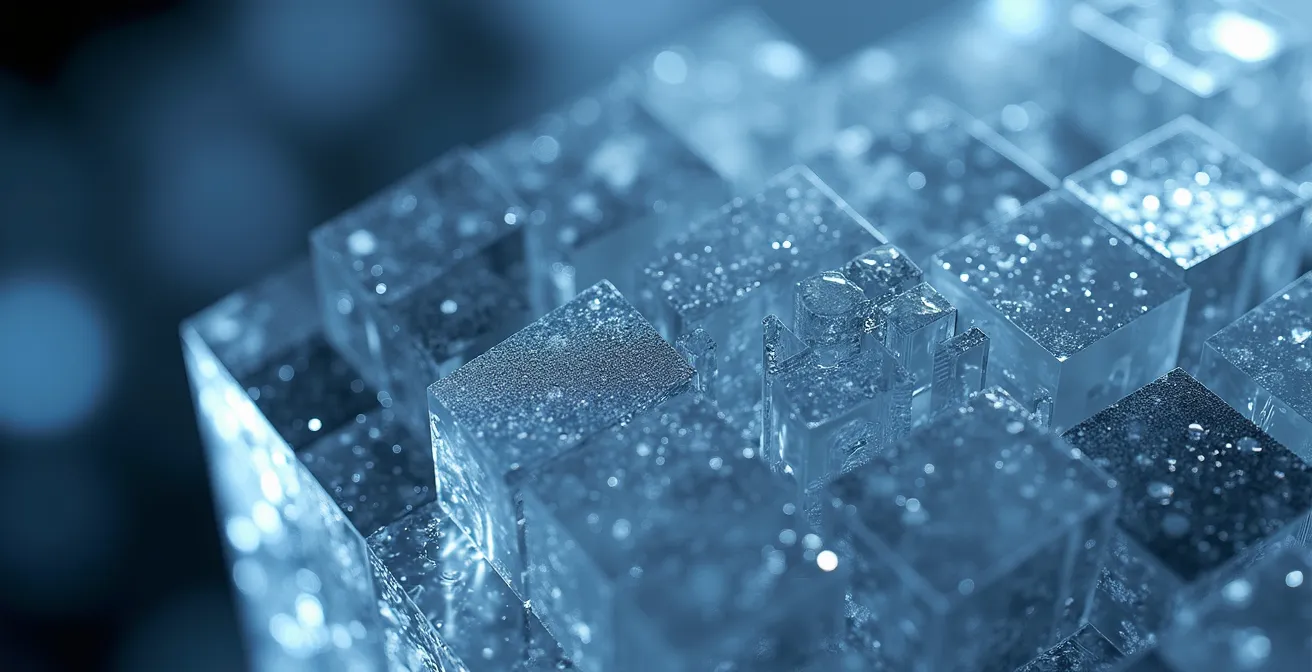
This crystalline structure visualizes the concept of data permanence—each facet represents a node in a decentralized network, creating a resilient and redundant system for preserving digital culture. True ownership in the crypto space means ensuring both your token and its underlying media are sovereign and censorship-resistant. Before minting or buying, it’s crucial to verify where and how the art is stored.
Your Digital Asset Resilience Checklist
- Check Data Permanence: Verify if the artwork is stored on IPFS or Arweave, not just on the marketplace’s servers.
- Assess Metadata Centralization: Ensure the token’s metadata, which links to the art, also points to a decentralized storage location.
- Test Renderer Dependency: Confirm that the artwork can be displayed without needing the marketplace’s specific, proprietary viewer.
- Verify Smart Contract Sovereignty: Use a blockchain explorer like Etherscan to check if you can transfer the NFT using the contract directly, bypassing the marketplace UI.
- Document Provenance: Independently save transaction hashes, contract addresses, and IPFS links as a personal record.
How to Compress High-Res Art Under 100MB Without Losing Visual Quality?
The question of file size is a classic problem for digital artists, but in the world of cryptoart, it reveals a flawed premise. Trying to compress a massive, high-resolution file to fit on-chain is thinking with a physical-world mindset. The truly revolutionary approach is not to shrink a finished product, but to store a tiny recipe that can generate an infinitely scalable artwork. This is the essence of procedural generation and the ultimate solution to the compression dilemma.
Consider the iconic CryptoPunks project. Larva Labs didn’t store 10,000 unique images on the Ethereum blockchain. Instead, they stored a single composite image of all the Punks’ attributes and a small amount of code that could generate any of the 10,000 Punks from that sheet. The art isn’t the pixelated image; it’s the efficient system that creates it. This way, a vast collection is stored in a remarkably small footprint.
Modern generative artists take this even further. A few kilobytes of code written in a language like p5.js or a shader language like GLSL can produce breathtakingly complex and detailed visuals. Because the artwork is an algorithm, it has no native resolution. It can be rendered flawlessly on a watch face or a skyscraper-sized screen. The “file size” becomes almost irrelevant because the asset being stored is the generative code, not a rendered image.
Even for artists who work with static images or videos, the mindset should shift. Instead of brute-force compression, consider more elegant techniques:
- Vector Formats: For geometric or illustrative art, SVG files are tiny yet infinitely scalable, offering perfect quality at any size.
- Modern Codecs: Using WebP for images can reduce file size by up to 40% compared to JPEG with minimal quality loss. For video, AV1 offers superior compression over older formats.
- AI Upscaling: A novel approach is to store a low-resolution “seed” image on-chain and use metadata to reference a client-side AI model (like ESRGAN) that upscales it to high resolution on the viewer’s device.
The goal is not to cram a large file into a small box. It is to rethink the artwork as a piece of efficient, elegant code that blossoms into a rich visual experience.
Unique Masterpiece or 10k Avatar Project: Which Hold Value During a Bear Market?
As the initial gold rush of the NFT boom subsides, questions of long-term value become critical. After all, research published in Scientific Reports reveals that while NFT adoption peaked in March 2021, a new, more stable equilibrium was established by June of that year. In a bear market, when speculative frenzy evaporates, what kind of art holds its value: the singular, 1/1 masterpiece or the 10,000-piece PFP (Profile Picture) collection?
The answer is that both can, but for entirely different reasons. They represent two distinct models of value creation. The 1/1 masterpiece derives its value primarily from the artist’s reputation, conceptual strength, and aesthetic execution—the traditional drivers of the fine art market. Its defense against a market downturn is its prestige. If the artist remains culturally relevant and continues to produce significant work, their key pieces are likely to be seen as long-term cultural assets by serious collectors, making them less susceptible to short-term market fluctuations.
Conversely, the 10k PFP collection derives its value from network effects and community. The art itself may be algorithmically generated, but its primary function is to act as a token of identity and membership in a social club. The project’s value is defended by the strength, engagement, and utility provided to its community. As long as the community remains active and the project continues to offer benefits (events, access, games), the floor price will find a level of support, even during a market-wide slump.
This table breaks down the key differences in how these two models behave in the market:
| Aspect | 1/1 Masterpiece | 10k PFP Collection |
|---|---|---|
| Value Driver | Artist reputation | Community network effects |
| Liquidity | Low (unique buyer needed) | High (active trading) |
| Price Discovery | Subjective valuation | Clear floor price |
| Bear Market Defense | Prestige holds if artist relevant | Community provides support |
| Risk Profile | Binary (sells or doesn’t) | Gradual (can sell at loss) |
Neither model is inherently superior. For artists, the choice depends on their goals. An artist focused on deep conceptual work and a legacy in the fine art world might choose the 1/1 path. A creator who excels at world-building and community management might find more success with a PFP collection. Both require a long-term vision that extends beyond a quick sale.
Direct vs. Managed: Which Marketplace Model Offers Better Resale Value?
The choice of where to sell your art is more than a logistical decision; it’s a strategic one that can significantly impact its long-term value and your career trajectory. The cryptoart ecosystem offers two primary models: direct, open marketplaces like OpenSea, and curated, managed platforms like SuperRare. Each offers a different balance of access, prestige, and financial return.
The most revolutionary aspect of cryptoart is its ability to empower artists financially. On-chain royalties automatically give the creator a percentage of every secondary sale—a pipe dream in the traditional art world. Furthermore, the disintermediation of galleries drastically changes the economics. As Gemini’s Cryptopedia highlights, the shift in earnings is dramatic: in the traditional model, an artist might get 50% of a primary sale, but with NFTs, they can earn 80% or more, plus ongoing royalties.
In the traditional model, an artist typically gets 50% of an artwork’s sale price and the gallery takes the other 50%. In the cryptoart world, however, an artist can earn 80% or more.
– Gemini Cryptopedia, Crypto Art: NFT Art on the Blockchain
Managed platforms like SuperRare or Nifty Gateway act like digital-era galleries. They are highly curated, and getting accepted lends an immediate air of prestige to an artist’s work. This scarcity and vetting process can lead to higher initial sale prices and attract high-profile collectors. The platform’s reputation effectively rubs off on the artist.
On the other hand, open platforms like OpenSea or Foundation offer unparalleled freedom and discovery. Anyone can mint and sell their work, creating a vast and chaotic but democratic arena. While it’s harder to stand out, the potential audience is enormous. Success here depends more on the artist’s own ability to market their work and build a community. The enforced on-chain royalties ensure that even if an artwork sells for a low price initially, its creator will benefit if its value appreciates over time. The choice isn’t about which is “better,” but which aligns with an artist’s career strategy: the prestige and support of a curated platform, or the freedom and long-term potential of an open market.
Key Takeaways
- Cryptoart’s true power is not selling JPEGs, but designing living systems with code.
- Artistic success depends on mastering new concepts like digital materiality, governance as aesthetics, and conceptual scarcity.
- True ownership and permanence are achieved through decentralized storage (IPFS/Arweave), not by trusting a marketplace’s servers.
NFT Art Market: How to Verify Provenance on the Blockchain Before Buying?
In the traditional art world, provenance—the documented history of an artwork’s ownership—is a cornerstone of value and authenticity, often relying on paper certificates and expert opinions. The blockchain offers a radical alternative: a transparent, immutable, and publicly auditable ledger. As research from sources like Coinbase indicates, the transparency provided by NFTs is a powerful tool against fraud and forgery. However, this transparency is only useful if you know how to read it.
Verifying provenance is not a one-click process. It requires a bit of digital detective work to ensure the NFT you’re buying is legitimate and created by the artist it claims. The first step is to move beyond the marketplace interface and look directly at the blockchain data using an explorer like Etherscan. The smart contract address is the artwork’s true home and holds the key to its history.
An artist serious about their work will often deploy their own custom smart contract (e.g., via Manifold) rather than using a generic marketplace contract. This is a sign of professionalism and gives the artist greater control. You should always cross-reference the contract address with the artist’s official social media channels, like Twitter or Discord, where they will typically announce their legitimate drops. Tracing the transaction history back to the original minting event confirms that it originated from the artist’s wallet. This on-chain data is the ultimate source of truth.
For digital art created before the NFT era, the verification process can be more complex, involving off-chain forensics. This might include searching the Wayback Machine for early website publications or examining file EXIF data to confirm creation dates. The following steps outline an expert’s method for comprehensive provenance verification:
- Contract Source: Check if the NFT was minted from the artist’s custom smart contract or a generic marketplace factory contract.
- Cross-Reference: Match the contract address with official announcements on the artist’s verified Twitter, Discord, or website.
- Trace History: Use a blockchain explorer to trace the full transaction history of the token from the current owner back to the original minting wallet.
- Pre-NFT Forensics: For older digital art, use the Wayback Machine to find evidence of the artwork’s publication date on early blogs or portfolios.
- Data Verification: For static files, check EXIF data (though it can be manipulated) and cross-reference with early posts to confirm the claimed creation timeline.
This rigorous process is the final piece of the puzzle, transforming the blockchain from a complex technology into a powerful tool for building trust and preserving artistic legacy.
Now that you understand the principles of creating and verifying revolutionary art, the next logical step is to begin designing your first art system. Start by outlining the rules, behaviors, and data inputs that will bring your concept to life.
Frequently Asked Questions about Cryptoart Creativity and Security
Can a marketplace hold my NFT hostage if they go bankrupt?
No, not if it was properly minted on-chain. The NFT exists on the blockchain, independent of any marketplace. As long as you control the private key to your wallet, you can always interact with the smart contract directly using a blockchain explorer to transfer or manage your asset.
What happens to the artwork file if IPFS nodes go offline?
IPFS is a distributed network, so the file is typically stored on multiple nodes (computers) around the world. For one node to go offline is common and not a risk. For maximum security, serious collectors should “pin” important files to their own IPFS node or use a permanent storage service like Arweave, which incentivizes storage for centuries.
How do I verify true ownership without the marketplace interface?
Use a public blockchain explorer like Etherscan (for Ethereum). By entering the NFT’s smart contract address and token ID, you can see the current owner’s wallet address recorded directly on the blockchain. This on-chain data is the ultimate source of truth, independent of any marketplace’s front-end display.