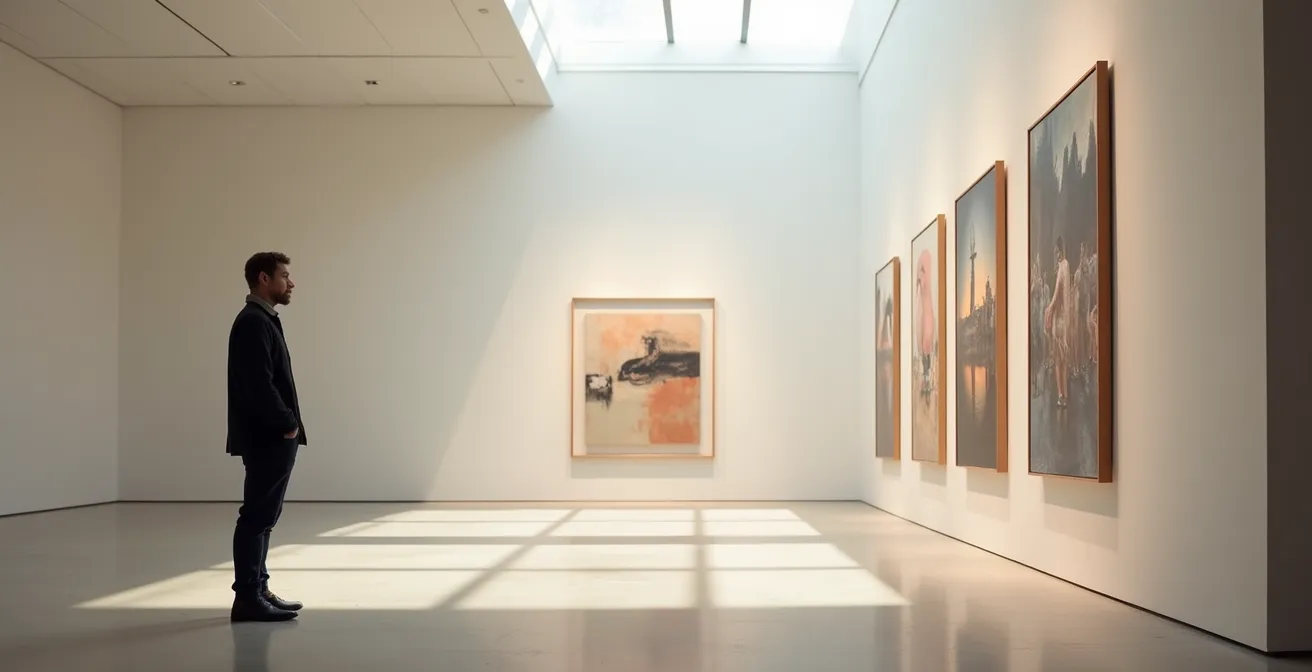
Trusting online art curation isn’t a leap of faith; it’s a skill built on auditing specific, verifiable signals of quality.
- True curation has a clear curatorial thesis and a rigorous selection process, often rejecting over 95% of submissions.
- Digital provenance goes beyond a simple Certificate of Authenticity; it involves cross-referencing databases and direct artist studio communication.
Recommendation: Shift your focus from the artwork’s image to the curator’s process. The rigor of their selection is your best guarantee of value and authenticity.
The decision to acquire a significant piece of art has always been a tactile, intimate experience. You stand before the work, sensing its texture, its scale, the subtle shifts in color under the gallery lights. For discerning collectors, this physical encounter is the bedrock of confidence. Yet, the art world has irrevocably shifted online, presenting you with high-value masterpieces through a cold, glass screen. The hesitation is natural. How can a JPEG, no matter how high-resolution, replace the certainty of a physical viewing? The common advice—check return policies, read reviews—feels inadequate when a five-figure investment is on the line.
Many platforms now use the term “curated” as a marketing buzzword, creating more noise than signal. This creates a critical challenge: discerning genuine expert selection from a simple, algorithm-driven catalogue. The fear of misjudging color, misinterpreting scale, or worse, investing in a work with a questionable long-term value, is a significant barrier. This is the sensory gap that every serious online collector must learn to bridge, not with hope, but with a new set of skills tailored for the digital age.
But what if the key to trust wasn’t in trying to replicate the physical viewing, but in learning to audit the curatorial process itself? The true measure of an online gallery’s worth lies not in its user interface, but in the rigor, transparency, and intellectual foundation of its selection. It’s about learning to read the digital signals of quality with the same acuity you’d use to inspect brushstrokes in person. This is not about trusting blindly; it is about verifying intelligently.
This guide will equip you with that framework. We will deconstruct the layers of professional curation, from the brutal rejection rates that define elite platforms to the subtle but crucial differences between human and AI-driven selections. You will learn to validate authenticity before a single dollar is transferred and understand why the artist’s background remains a powerful indicator of value. This is your new due diligence.
Summary: Your Guide to Trusting Online Art Curation
- Why 95% of Submitted Artworks Are Rejected by Top Online Galleries?
- How to Spot Color Discrepancies on Your Screen Before Spending $5,000
- Human Expert vs. AI Algorithm: Which Curator Finds the Best Investment Pieces?
- The ‘Curated’ Label Mistake That Can Devalue Your Collection in 5 Years
- When to Buy: The 24-Hour Window Where Best Curated Pieces Sell Out
- How to Validate a Certificate of Authenticity via Email Before Wiring Money
- Why an Atelier-Trained Artist Commands More Respect from Purist Collectors?
- Exclusive Works Online: How to Gain Access to “Hidden” Digital Rooms?
Why 95% of Submitted Artworks Are Rejected by Top Online Galleries?
The first and most powerful signal of a truly curated platform is not what it shows you, but what it doesn’t. In the world of high-end art, scarcity and exclusivity are paramount. A gallery’s reputation is built on the strength of its artistic vision and its discipline in upholding it. This is why the most respected online galleries operate with a rejection rate that often exceeds 95%. This isn’t about elitism; it’s a fundamental commitment to quality control. They are not merely marketplaces listing everything that is submitted; they are gatekeepers defending a specific curatorial thesis. Each accepted work must not only be technically proficient but also align with a coherent, long-term artistic narrative.
This extreme selectivity is a stark contrast to the open-for-all model of many art platforms. The sheer volume of artists seeking representation is immense; some analyses show that only 1 in 5 artists will exhibit their work in their lifetime. A high rejection rate indicates that a team of experts is investing significant time and resources into vetting each artist and artwork. They assess the artist’s career trajectory, the originality of their voice, and the work’s potential to resonate with discerning collectors. For you, the buyer, this rigorous filtering process is a crucial, if invisible, service. It means the handful of works you see have survived a brutal selection process, providing a baseline of quality and relevance that a vast, uncurated inventory simply cannot offer.
Therefore, when evaluating a platform, your first question should be about its selection process. Is it a guarded gateway or an open door? A gallery that proudly showcases a small, cohesive roster of artists is demonstrating confidence in its curatorial judgment. This selectivity acts as your first layer of insurance against the noise of the mass market, ensuring you are viewing works that have already been pre-qualified for their artistic merit and potential longevity.
How to Spot Color Discrepancies on Your Screen Before Spending $5,000
One of the most significant anxieties for any collector buying online is the “sensory gap”—the fear that the artwork arriving at your door will look different from the image on your screen. This concern is entirely valid. Variations in screen calibration, ambient lighting, and even the browser you use can alter the appearance of colors. However, trustworthy galleries understand this and employ specific strategies to mitigate the risk, and you can adopt your own methods to verify what you see.
Before committing to a purchase, request additional media. Ask the gallery for photos of the artwork in different lighting conditions—for example, natural daylight versus gallery spotlights. A video call for a live view of the piece can also be invaluable. Pay attention to how the gallery describes the work. Vague descriptions are a red flag. A professional curator will provide detailed notes on the palette, noting specific pigments or subtle tonal shifts that a photograph might not capture. They are bridging the sensory gap with their expertise. Also, view the artwork on multiple devices (your phone, your tablet, your laptop). While not a perfect solution, this helps you identify if one of your screens is significantly miscalibrated by showing you a range of color variations.

As the image above illustrates, comparing the artwork across different screens is a critical step in the digital vetting process. Ultimately, the most reliable galleries demonstrate their confidence through their policies. A generous, no-questions-asked return policy is a powerful signal of trust.
Case Study: Zatista’s Buyer-Centric Approach to Color Accuracy
The online gallery Zatista directly addresses the collector’s “sensory gap” by backing their high-resolution photography with a 14-day return policy. They acknowledge that screen variations make perfect color matching impossible online. By allowing buyers to inspect the work in their own home and covering up to $100 in return shipping, they remove the financial risk of color disappointment. This policy is a strong signal of confidence in their visual representations and a commitment to buyer satisfaction, transforming a point of anxiety into a pillar of trust.
Human Expert vs. AI Algorithm: Which Curator Finds the Best Investment Pieces?
The rise of artificial intelligence has introduced a new dynamic to art curation. Many large-scale platforms now use algorithms to “recommend” or “curate” works based on your viewing history and market trends. While AI is an incredibly powerful tool for data analysis, relying on it solely to build a valuable collection is a significant risk. The key is to understand the distinct strengths of both human and machine curation to determine which approach best aligns with your goals as a collector.
An AI algorithm can process millions of data points on sales, styles, and color palettes in seconds. It excels at identifying quantitative trends and can be highly accurate in tasks like artist attribution. However, AI often lacks the ability to understand the nuances that define great art: cultural context, emotional resonance, and groundbreaking innovation. An algorithm trained on past successes will often promote works that are similar to what is already popular, potentially overlooking the outlier artist who will define the next movement. A human curator, on the other hand, operates on a foundation of deep historical knowledge, intuition, and personal relationships within the art world. They champion artists based on vision and mastery, not just data patterns.
The most sophisticated online galleries use a hybrid approach. They leverage AI as a tool to support, not replace, human expertise. The ideal combination is a human curator who uses data to inform their decisions while retaining the final, intuitive judgment. As a collector, especially one interested in the investment potential of art, the human element remains irreplaceable. It is the curator’s belief in an artist’s long-term vision that often creates value where an algorithm would see none.
This table breaks down the core competencies, showing where each excels and where the critical gaps lie. A recent analysis of AI’s role in curation highlights its impressive analytical power.
| Aspect | Human Curator | AI Algorithm |
|---|---|---|
| Market Analysis | Intuitive understanding of trends | Processes vast amounts of sales data rapidly |
| Cultural Context | Deep understanding of historical significance | Limited grasp of nuanced cultural meanings |
| Pattern Recognition | Identifies emotional resonance | Excels at spotting quantitative trends |
| Innovation Detection | Champions outlier artists | Tends to promote similar popular styles |
| Authentication | Uses expertise and provenance research | 96% accuracy in attribution analysis |
An experiment at Duke University’s Nasher Museum, where ChatGPT was used to curate an exhibition, powerfully illustrated this point. The curator, Marshall Price, concluded that while “AI can be a powerful tool, it’s the human element that remains essential” for creating a meaningful and coherent artistic statement. For the investment-minded collector, that human element is not a feature; it’s the entire foundation.
The ‘Curated’ Label Mistake That Can Devalue Your Collection in 5 Years
The word “curated” has become one of the most overused and diluted terms in the online art market. Many platforms apply this label to what is essentially an algorithmically filtered inventory, not a thoughtful, expert-led selection. This distinction is critical. Mistaking a vast, loosely “curated” marketplace for a genuinely selective gallery can lead to acquiring works with fleeting appeal and weak long-term value. A true curatorial program is not about having something for everyone; it’s about having a strong, defensible point of view.
So, how do you distinguish authentic curation from mere marketing? You must look for evidence of a clear curatorial thesis. This is the intellectual and artistic narrative that guides the gallery’s choices. Does the gallery specialize in a particular movement, region, or theme? Is there a consistent aesthetic or conceptual thread connecting the artists on their roster? A gallery with a strong thesis can articulate *why* they chose a particular artist and how that artist fits into their program. In contrast, a platform that simply aggregates thousands of artists across countless styles is a retailer, not a curator. The latter offers selection, but the former offers conviction—and conviction is a cornerstone of value.
Another powerful indicator is the gallery’s relationship with its artists. Genuinely curated platforms invest in their artists for the long term, supporting their careers beyond market trends. They produce scholarly content, exhibit their work in a thoughtful context, and build the artist’s provenance. This is a resource-intensive model, and it explains why a study has revealed that 30% of all art galleries are losing money; maintaining high standards is financially challenging. For a collector, a platform that treats artists as partners rather than inventory is a sign that you are investing in a program with integrity.
Your Action Plan: Vetting the ‘Curated’ Label
- Verify Curatorial Thesis: Look for galleries with clear, focused artistic narratives that go beyond just commercial trends. Can they explain *why* their collection is composed the way it is?
- Check Roster Size: Genuinely curated galleries almost always maintain small, coherent artist selections. A roster of thousands is a red flag for algorithmic filtering.
- Research Exhibition History: Review past online or physical shows. Do you see thematic consistency and depth, or does it look like they are chasing fleeting market trends?
- Assess Platform Scale: Be skeptical of high-volume platforms that use the word “curated.” It often means “filtered,” not “selected by an expert.”
- Track Artist Longevity: True curation supports artists over the long term, not just during periods of market hype. See if the gallery has a history of sticking with its artists.
When to Buy: The 24-Hour Window Where Best Curated Pieces Sell Out
In the world of highly selective online curation, the paradox is that while the digital storefront is always open, the window of opportunity for the best works is incredibly small. For premier pieces by sought-after artists, the decision to buy must often be made within 24 to 48 hours of their release. This isn’t an artificial sales tactic; it’s the natural result of high demand meeting a deliberately limited supply. Understanding this dynamic is crucial for any serious collector looking to acquire top-tier work online.
Elite online galleries cultivate a dedicated following of collectors who trust their judgment. When a new body of work from a respected artist is released, or a newly discovered talent is introduced, these collectors are prepared to act swiftly. They have done their homework on the artist, they understand the gallery’s curatorial direction, and they recognize the opportunity. The best works—the ones that are most representative of the artist’s vision or that have the strongest wall presence—are invariably the first to sell. Waiting a week, or even a few days, often means settling for secondary pieces or missing out entirely.
To position yourself for success, you must move from being a passive browser to an engaged follower. The key is preparation. Follow the gallery’s newsletters, artist announcements, and social media channels to be among the first to know about new releases. When an artist you admire is scheduled for a new collection, do your research in advance. Revisit their past work, understand their pricing, and decide what you might be interested in. This way, when the works become available, you are not starting from scratch. You are making an informed decision within a compressed timeframe. In this environment, hesitation is the primary obstacle to acquisition.
How to Validate a Certificate of Authenticity via Email Before Wiring Money
A Certificate of Authenticity (CoA) is a standard element of any art purchase, but its mere existence is not enough to guarantee an artwork’s legitimacy. In the digital realm, where you can’t physically inspect the document, the process of validation becomes an active, communicative task. A CoA is only as good as its source and its verifiability. Before you even consider wiring funds, you must treat the validation of the CoA as a critical step in your due diligence.
Your first move should be to request a high-resolution scan of the CoA. Examine it closely. A robust CoA should include a high-quality image of the artwork, its full details (title, dimensions, medium, year), the artist’s signature, and a clear statement of authenticity. However, the most critical element is a path to independent verification. Does the CoA have a unique identification number or a QR code? If so, ask the gallery where this number can be verified. Some artists or their estates maintain a digital catalogue raisonné or a database where these numbers can be cross-referenced. This creates a closed-loop system of verification, or what we can call a strong “digital provenance.”
Furthermore, consider the source. A CoA signed directly by the artist is the gold standard. A certificate generated by the gallery is good, but one from the artist’s studio or official foundation is even better. Don’t hesitate to take an extra step: ask the gallery to facilitate an email confirmation from the artist’s studio. A reputable gallery will understand this request and assist. Document every step of this communication. These email exchanges become part of the artwork’s provenance—your personal record of due diligence.
The Customer experience was fantastic. I really appreciated everyone checking up to see if I received the icon. Buying original art from overseas was something that I was nervous about, but having a person assigned to my shipment and tracking it made my experience enjoyable instead of stressful.
– A Saatchi Art collector
As this collector’s experience shows, a gallery’s willingness to engage in a transparent, communicative verification process is often the best indicator of their legitimacy. It transforms the process from a transaction into a trusted relationship.
Why an Atelier-Trained Artist Commands More Respect from Purist Collectors?
In a contemporary art market often dominated by conceptual ideas, the tangible skill of a classically trained artist has become a powerful and enduring signal of value. For many purist collectors, an artist with a verifiable “atelier” background—meaning they have undergone rigorous, traditional training in disciplines like drawing, painting, and sculpture—represents a hedge against fleeting trends. This respect is not rooted in nostalgia, but in an appreciation for technical mastery as a foundation for lasting artistic expression. As the global art market recorded an estimated USD 57.5 billion in sales in 2024, collectors are increasingly seeking assets with demonstrable, intrinsic quality.

Atelier training emphasizes a deep understanding of materials, anatomy, and the principles of light and form. It is a lineage of knowledge passed down through generations. An artist who has mastered these foundational skills possesses a visual language that transcends momentary fads. They can execute their vision with a precision and confidence that is immediately apparent, even on a screen. For a collector, this technical proficiency provides a tangible criterion for assessment. You can judge the quality of the draftsmanship, the complexity of the composition, and the handling of the medium. It’s a layer of quality that is objective and verifiable.
This doesn’t mean that conceptually-driven or self-taught artists lack value. However, the discipline and proven skill set of an atelier-trained artist provide a bedrock of confidence for buyers, particularly those wary of the art market’s volatility. It is seen as an indicator of commitment, seriousness, and a deep respect for the craft itself.
Case Study: Technical Mastery as a Hedge Against Market Trends
A 2024 analysis by Fine Art Brokers revealed a telling market dynamic: while the value of 19th-century academic painting has declined, contemporary artists with verifiable classical training have maintained remarkably stable and strong market positions. This phenomenon demonstrates that purist collectors view technical mastery as a form of insurance against the volatility of the conceptual art markets. Atelier training signals a durable quality that holds its value, creating sustained demand for artists who pair traditional skills with a contemporary vision.
Key Takeaways
- Audit the Process, Not Just the Art: A gallery’s high rejection rate (>95%) and a clear curatorial thesis are your strongest initial signals of quality.
- Bridge the Sensory Gap Proactively: Request multiple forms of media (photos, videos) and rely on platforms with robust, buyer-friendly return policies to eliminate the risk of color discrepancy.
- Trust Human Expertise, Supported by Data: Prioritize platforms where human curators make the final call. Their ability to see cultural context and innovation is what creates long-term value, a feat AI alone cannot yet achieve.
Exclusive Works Online: How to Gain Access to “Hidden” Digital Rooms?
The ultimate reward for a discerning collector who has learned to navigate the digital art world with confidence is gaining access to its most exclusive spaces. The best online galleries often reserve their most significant or sensitive works for “private viewing rooms” or “hidden rooms.” These are invitation-only digital spaces, direct analogues to the back rooms of physical galleries, where the most important transactions take place. Gaining access is the final step in moving from a simple buyer to a trusted client.
Access to these rooms is not granted based on a single purchase. It is earned through a demonstrated commitment and a relationship built on mutual respect with the gallery. Curators extend these invitations to collectors who have shown a serious interest in their program, who engage in thoughtful dialogue about the art, and who have proven themselves to be decisive and reliable buyers. When you provide insightful feedback, ask intelligent questions about an artist’s practice, and follow through on acquisitions, you are signaling that you are a serious partner in the cultural enterprise, not just a customer.

Once inside, you will find works that may never be offered publicly—pieces straight from an artist’s studio, works with a particularly significant provenance, or more experimental pieces the gallery is testing with its most trusted clientele. This is where you can build a truly unique collection that stands apart. The experience is no longer about browsing a public catalogue; it’s a personalized, one-on-one consultation with a curator who understands your taste and goals. It is the pinnacle of the online collecting experience, where the digital interface finally dissolves into a relationship of pure trust and shared passion.
By consistently applying the principles of digital due diligence, you not only protect your investments but also build the credibility needed to be invited into these inner circles. Your journey of learning to trust becomes your key to unlocking the most rewarding opportunities the digital art world has to offer.
Start building these relationships today. Engage with the galleries that demonstrate a clear curatorial thesis and begin the dialogue that will elevate you from a buyer to a valued collector, unlocking access to the art world’s most exclusive digital spaces.