A photograph’s multi-million-dollar valuation is rarely about its beauty; it is determined by its ‘objecthood’—a calculated convergence of artistic signature, material integrity, and market validation.
- An artist’s intellectual signature, like a visual DNA, makes their work recognizable and conceptually unique, separating it from mere technical skill.
- Controlled scarcity, through strictly limited editions and specific printing proofs, transforms a reproducible image into a rare, tangible asset.
Recommendation: An aspiring collector must learn to evaluate a photograph not as an image, but as a constructed object whose value is cemented by curatorial and market consensus.
The contemporary art market often presents a perplexing scenario: a photograph, an infinitely reproducible medium, auctions for a price that rivals an Old Master painting. For the aspiring collector, this raises a critical question. When anyone with a high-resolution camera can produce a technically flawless image, what separates a decorative snapshot from a museum-grade asset fetching millions? The common answers—composition, lighting, a compelling subject—are woefully incomplete. They describe aesthetics, not value. They fail to explain why a Gursky or a Sherman retains its commanding presence and price point in a world saturated with images.
The truth is, the journey from image to icon has little to do with the picture itself and everything to do with its conceptual and physical manifestation. The key is not in what is depicted, but in how the artist establishes a unique intellectual territory. This is achieved through a trifecta of control: the development of an unmistakable artistic signature, the meticulous management of the print’s physical creation and scarcity, and the strategic navigation of the institutional frameworks that bestow legitimacy. A photograph does not simply become valuable; it is constructed to be valuable.
This is not a matter of subjective taste, but of objective, market-defined principles. Understanding these principles is the first and most crucial step for any collector aiming to acquire works of lasting significance rather than fleeting appeal. It requires a shift in perspective: from looking at the photograph as an image to analyzing it as a carefully crafted art object, a tangible asset whose every detail, from the artist’s conceptual framework to the method of its mounting, contributes to its final valuation.
This guide will deconstruct the elements that truly define a photograph’s worth. By examining the artist’s signature, the critical role of printing and editioning, and the impact of institutional validation, you will gain the discerning eye needed to navigate the complexities of the fine art photography market.
Contents: The Discerning Collector’s Framework
- Why You Can Recognize a Gursky or Sherman Without Seeing the Name?
- Did the Artist Print It? Why ‘Printed Under Supervision’ Matters for Value
- Ad Campaign or Art Series: Can Commercial Work Be Collectible Fine Art?
- The Open Edition Trap: Why Unlimited Prints Rarely Increase in Value
- How to Mount a 2-Meter Photo Without It Rippling or Bowing?
- AP or Numbered: Is the Artist Proof Really Worth a 20% Premium?
- Why a Solo Museum Show Increases a Painter’s Price by 40% Overnight?
- Striking Limited Editions: How Edition Size Directly Impacts Your Investment Potential?
Why You Can Recognize a Gursky or Sherman Without Seeing the Name?
The most valuable photographers are not merely camera operators; they are authors of a distinct visual language. This intellectual signature is the unique, recognizable DNA that runs through their body of work, making it identifiable even without a label. It is a conceptual framework, a consistent way of seeing and interpreting the world that transcends subject matter. For Andreas Gursky, this signature is a detached, god-like perspective, capturing vast, teeming scenes of globalization with an almost clinical precision. As Calvin Tomkins noted in The New Yorker, Gursky’s massive prints possess “the presence, the formal power, and in several cases the majestic aura of nineteenth-century landscape paintings.”
Case Study: Andreas Gursky’s ‘Aggregate Space’
By 1985, Gursky had already developed his signature ‘aggregate space’ approach, which describes a whole composed of countless individual parts. His early work, such as a photograph of his oven from 1980, demonstrates this eye for finding geometric and linear compositions within a larger frame. This intellectual rigor, which finds form and structure beyond the literal image, is the foundation of his recognizable style and a key driver of his work’s value.
This signature is not accidental; it is a cultivated, intellectual pursuit. Cindy Sherman’s signature is her relentless deconstruction of identity through self-portraiture, adopting myriad personas to critique female representation. This conceptual consistency is what collectors invest in. They are not buying a single image but a piece of a larger, coherent artistic project. This is reinforced by the artist’s market strategy; for instance, most of Gursky’s photographs come in editions of six with two artist’s proofs, a deliberate act of controlled scarcity that aligns with the monumental and singular nature of his vision.
Did the Artist Print It? Why ‘Printed Under Supervision’ Matters for Value
In the world of fine art photography, the print is not a reproduction; it is the final, definitive embodiment of the artist’s vision. Therefore, the provenance and process of its creation are of paramount importance to a discerning collector. A ‘vintage print’—one made by the photographer at or near the time the negative was created—is considered the most desirable, as it represents the artist’s direct physical and interpretive involvement. It is the purest expression of their intent, capturing the nuances of tone and texture they envisioned at that specific moment in their career.
However, for many contemporary artists working with large-scale or complex digital processes, printing is a collaborative effort with a master printer. In this context, the phrase “printed under the direct supervision of the artist” becomes a critical marker of authenticity and value. It certifies that the artist maintained full creative control, making key decisions on color balance, contrast, paper choice, and finish. This supervision ensures that the final object aligns perfectly with their artistic standards, distinguishing it from a posthumous or unauthorized print, which holds significantly less value.
The absence of the artist’s hand or explicit approval introduces uncertainty and diminishes the work’s standing as a direct product of their vision. For a collector, verifying the printing provenance is non-negotiable. It is a fundamental aspect of the work’s ‘objecthood’—its tangible, verifiable connection to the artist’s creative process. A print without this clear lineage is, in the eyes of the serious market, merely a copy, not a collectible asset.
Ad Campaign or Art Series: Can Commercial Work Be Collectible Fine Art?
The line between commercial photography and fine art can appear blurry, but for the collector, the distinction is stark and has profound implications for value. The determining factor is not aesthetic quality but authorial control and primary purpose. Commercial photography is fundamentally a work-for-hire, created to serve a client’s brief and sell a product or service. The ultimate creative control lies with the client, and the image’s life is tied to the campaign’s duration. Once the campaign ends, the image’s value typically depreciates to zero.
Fine art photography, conversely, is born from the artist’s singular vision. As Andreas Gursky states, “Art should not be delivering a report on reality, but should be looking at what’s behind something.” The artist retains final cut, and the work’s primary purpose is artistic expression, intended for a gallery wall or museum collection, not a billboard. This autonomy is crucial. While artists like Annie Leibovitz or Richard Avedon have successfully navigated both worlds, their work only becomes collectible when it is re-contextualized as part of their personal artistic inquiry, produced in limited editions, and divorced from its original commercial function.
The following table clarifies the essential differences that a collector must recognize:
| Aspect | Commercial Photography | Fine Art Photography |
|---|---|---|
| Authorial Control | Client brief dictates final image | Artist retains final cut |
| Edition Size | Often unlimited or very large | Limited editions (typically 3-10) |
| Primary Purpose | Sell product/service | Artistic expression |
| Context | Magazine, billboard, campaign | Gallery wall, museum collection |
| Value Trajectory | Depreciates after campaign ends | Potential appreciation over time |
The Open Edition Trap: Why Unlimited Prints Rarely Increase in Value
Scarcity is a foundational principle of the art market, and in photography, it is artificially and strategically imposed through the limited edition. An ‘open edition’—a print produced in unlimited quantities—is the collector’s equivalent of a poster. While it may be aesthetically pleasing, it lacks the essential quality of rarity required for value appreciation. Owning one of an unlimited number provides no sense of custodianship over a rare object; it merely signifies a purchase, not an acquisition. This psychological distinction is paramount in the high-stakes world of art collecting.
The serious collector focuses exclusively on works produced in small, strictly defined editions. The market standard for what is considered a collectible work has become increasingly stringent. For contemporary photographs and original prints, the edition size is usually between 2 and 20. This tight control signals that the artist and their gallery are protecting the work’s long-term value. An edition of 250, for example, is generally viewed with suspicion unless the artist is a global superstar like Damien Hirst, whose market is vast enough to absorb such a quantity without significant value dilution.
The numbering of a print (e.g., 3/10) is not just a formality; it is a legally binding contract with the collector. It guarantees that only ten such objects will ever exist in that size and format. This guarantee is the bedrock of the print’s investment potential. Any deviation, such as the later release of the same image in a slightly different size, must be managed with extreme transparency to avoid devaluing the original edition. The open edition, by its very nature, offers no such guarantee and thus remains outside the realm of serious art investment.
How to Mount a 2-Meter Photo Without It Rippling or Bowing?
For large-scale photography, the mounting is not an afterthought; it is an integral component of the artwork’s physical presence and long-term stability—its ‘objecthood’. A two-meter print improperly mounted will inevitably ripple, bow, or warp, destroying its aesthetic integrity and market value. The choice of mounting method is a critical artistic and preservation decision, one that a discerning collector must scrutinize as closely as the image itself. The process requires highly specialized workshops and a significant financial investment, reflecting the seriousness of the final art object.
The dominant method for achieving the hyper-real, glossy finish seen in the work of artists like Andreas Gursky is Diasec, or face-mounting. This process involves permanently bonding the front of the photographic print to a sheet of acrylic glass. The result is a perfectly flat, protected surface that enhances color saturation and creates a sense of depth, drawing the viewer into the image. As one curatorial analysis notes, “Gursky’s signature use of glossy face-mounting isn’t just for flatness; it creates the hyper-real, immersive surface his work requires. The medium is the message.” An alternative for a matte, non-reflective finish is Dibond, where the print is mounted onto an aluminum composite panel.
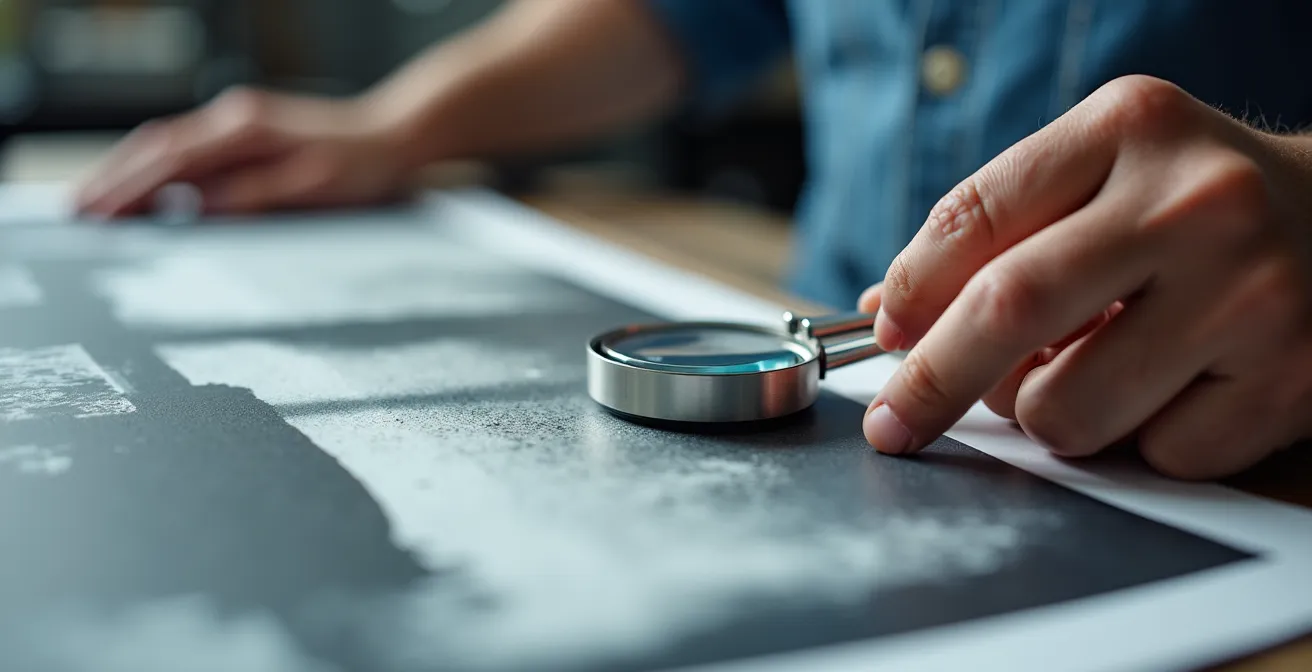
For any collector considering a large-scale work, understanding and verifying the mounting technique is essential. It speaks to the work’s archival quality and the artist’s commitment to the physical integrity of their vision. Below is a checklist for evaluating this critical aspect.
Action Plan: Verifying Mounting and Finishing Integrity
- Identify the Method: Confirm the specific archival mounting technique used (e.g., Diasec, Dibond) and ensure it is documented in the work’s provenance.
- Inspect the Surface: Examine the print’s surface under angled light for any signs of rippling, bubbling, or delamination, particularly at the edges.
- Check for Archival Quality: Verify that all materials used—the print paper, the adhesive, the backing—are of certified archival quality to prevent future degradation or color shifts.
- Assess the ‘Objecthood’: Consider how the mounting choice contributes to the overall artistic statement. Does it enhance the work’s intended effect or feel like a purely practical choice?
- Consult a Conservator: For any high-value acquisition, engage a professional art conservator to produce a condition report that validates the mounting’s stability and quality.
AP or Numbered: Is the Artist Proof Really Worth a 20% Premium?
Within a limited edition, not all prints are created equal. While the numbered prints (e.g., 1/10, 2/10) form the main body of the edition, a small number of additional prints are pulled for the artist and collaborators. These are designated with specific markings, and the most coveted among them is the Artist’s Proof (AP). Historically, these were the first prints pulled from the plate for the artist to approve. Today, they are compositionally identical to the edition but are produced in addition to the numbered run, typically for the artist’s personal use, to gift to curators, or to sell at their discretion.
The desirability of an AP stems from its perceived proximity to the artist’s hand. It is considered part of a more exclusive set, directly connected to the creator. This exclusivity translates directly into market value. Market analysis consistently shows that Artist’s proofs comprise just 10% of the print run and are typically 20-50% more valuable than their numbered counterparts. For a collector, acquiring an AP is a status symbol, an indication of a deeper and more serious engagement with the artist’s work.
Beyond the AP, a hierarchy of other proofs exists, each with its own designation and strategic value in the market. A discerning collector should be familiar with this terminology to understand the full landscape of an edition.
| Proof Type | Designation | Typical Premium | Strategic Use |
|---|---|---|---|
| Trial Proofs | TP | Variable | Early test prints, often unique |
| Bon à Tirer | BAT | 15-30% | Master print for edition |
| Artist’s Proofs | AP | 20-50% | Reserved for artist, gifts to curators |
| Printer’s Proofs | PP | 10-25% | Given to master printer |
| Hors de Commerce | HC | 15-35% | Not for sale, exhibition use |
Why a Solo Museum Show Increases a Painter’s Price by 40% Overnight?
While the principle applies across media, the effect is particularly potent in photography. A solo exhibition at a major museum or institution is the single most powerful act of market canonization an artist can receive. It is an institutional declaration that the artist’s work is not merely commercially viable but culturally significant and worthy of historical consideration. This validation acts as a powerful de-risking event for collectors, providing an authoritative, third-party endorsement that no gallery opening can replicate. The market response is often immediate and dramatic.
This “museum effect” is driven by three distinct forces, as outlined by market analysts:
A museum show provides three things: Curatorial Vetting, Historical Canonization, and Audience Expansion. It’s an institutional validation that no gallery can replicate.
– Art Market Analysis, State of the Photography Market Report
Curatorial Vetting signifies that a respected expert has judged the work to be of high quality and importance. Historical Canonization places the artist’s work within the grand narrative of art history. Audience Expansion introduces the work to a vast new pool of potential collectors, critics, and admirers, dramatically increasing demand. This confluence of factors often leads to a significant and permanent uplift in the artist’s primary and secondary market prices. For example, recent auctions have seen works by institutionally recognized artists soar past their estimates, such as when a Peter Hujar self-portrait sold for $252,000, more than five times the low estimate, following growing institutional acclaim.
Key Takeaways
- Intellectual Signature: True value lies in a unique, consistent artistic vision that makes the work conceptually recognizable, not just aesthetically pleasing.
- Controlled Scarcity: Small, strictly limited editions and specific proofs (like APs) transform a reproducible image into a rare, tangible asset class.
- Market Canonization: A solo museum show is the ultimate validation, providing curatorial vetting that de-risks the artist and permanently elevates their market value.
Striking Limited Editions: How Edition Size Directly Impacts Your Investment Potential?
Ultimately, for the collector who is also an investor, the edition size is the most direct and powerful lever influencing a photograph’s potential for financial appreciation. It is a simple equation: the smaller the edition, the greater the scarcity, and therefore, the higher the potential for value growth. This is not a matter of taste but of pure supply and demand. While the broader photography market shows healthy growth—with a recent report noting that images selling under $5,000 increased by 36% from 2022 to 2023—the most significant returns are found in works where scarcity is meticulously managed from the outset.
Sophisticated artists and galleries employ tiered pricing strategies to leverage this dynamic, rewarding early investors and creating market velocity. This model is a core component of turning a photograph into a performing asset.
Case Study: David Yarrow’s Tiered Pricing Strategy
The work of fine art photographer David Yarrow exemplifies a strategic approach to editioning. The price of an artwork increases systematically as the edition sells out. This tiered structure means that collectors who acquire a print early in the edition (e.g., 1/12 or 2/12) often pay a significantly lower price than those who purchase the final prints. As one gallery analysis confirms, “the earliest investors—those who acquired their artworks first—have achieved higher returns sooner,” creating a powerful incentive for early acquisition and building momentum in the market.
Therefore, a collector must evaluate edition size not just as a number, but as a statement of intent. A very small edition (e.g., 3, 5, or 7) signals a commitment to long-term value and positions the work as a rare object from its inception. It is a clear indication that the artist and gallery are cultivating a market for serious collectors, not just decorating walls. For anyone looking to build a collection that is both culturally significant and financially sound, prioritizing works with strictly limited editions is the most fundamental strategy.
The aspiring collector must therefore move beyond the surface-level appeal of an image and learn to operate with the rigor of a curator. Evaluating a photograph’s intellectual signature, its material integrity, and its position within the institutional canon is not an academic exercise; it is the essential due diligence required to build a collection of lasting worth. This framework is your primary tool for distinguishing a fleeting trend from a future classic.