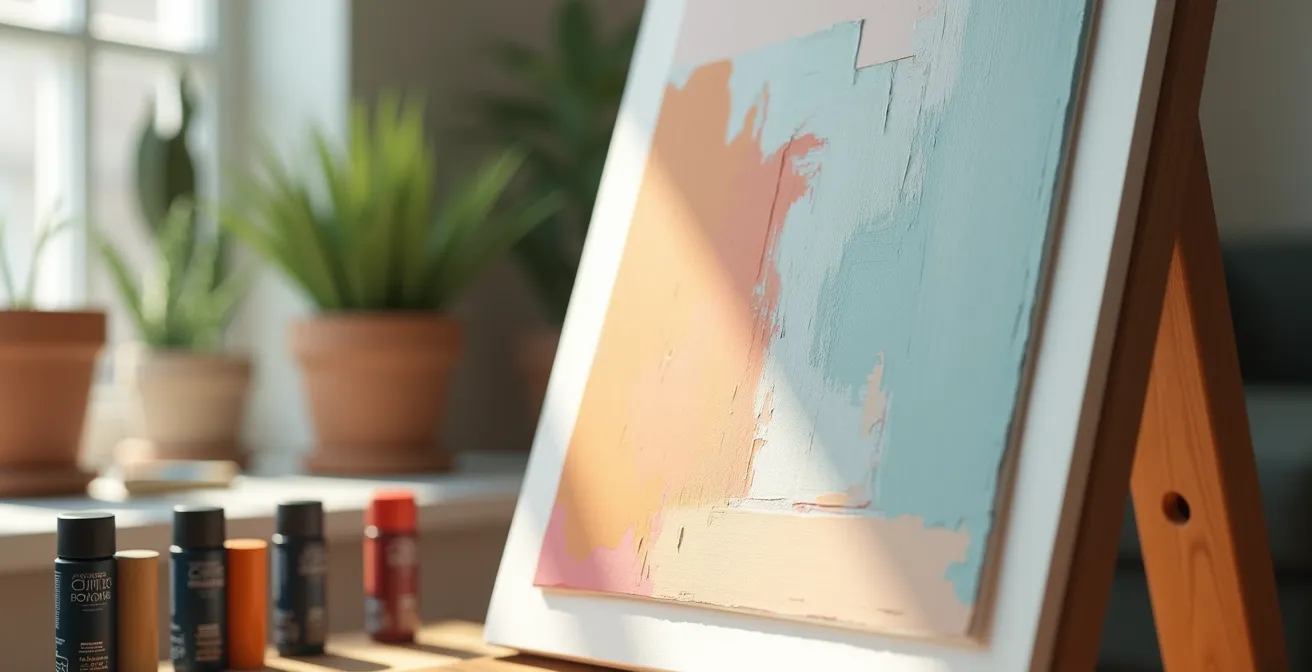
Gouache’s resurgence is an aesthetic rebellion against our glossy, digital-first world, championing a tangible, non-reflective matte finish.
- Its unique opacity allows for techniques impossible with traditional watercolor, offering a bridge to acrylic-style painting.
- The velvety matte surface eliminates glare, making it a perfect fit for modern interiors and challenging the dominance of high-gloss finishes.
Recommendation: Treat gouache not as a lesser watercolor, but as a distinct fine art medium with a powerful, contemporary aesthetic purpose.
If you’re an illustrator or a collector, you’ve felt it. There’s a shift in the visual landscape, a move away from the high-gloss perfection of oil and acrylic or the ethereal transparency of watercolor. Suddenly, a flat, velvety, and intensely pigmented look is everywhere, from gallery walls to high-end print shops. This is the unmistakable texture of gouache, a medium once relegated to the world of commercial illustration and design, now making a powerful and undeniable comeback in the realm of fine art. For years, the conversation has been dominated by its more famous cousins, but this revival isn’t just a trend.
Many will tell you that gouache is just an “opaque watercolor,” a simple medium for creating flat color fields. While technically true, this description completely misses the point of its current renaissance. This isn’t just about paint; it’s a quiet but firm aesthetic rebellion against the ubiquitous glow of our screens and the slick, reflective surfaces that have defined contemporary art for decades. The rise of gouache is a symptom of our collective digital fatigue, a craving for art that is tangible, present, and unapologetically matte. It’s a return to an art form that absorbs light rather than reflecting it, inviting a slower, more intimate viewing experience.
This article dives deep into the heart of the gouache movement. We’ll explore the unique properties that make it so compelling, from its ability to be layered light-over-dark to the challenges of preserving its delicate surface. We will uncover why its matte finish is a game-changer for modern interiors and how to distinguish a hand-painted original from a high-quality print. This is your guide to understanding not just how gouache works, but why it matters right now.
To navigate this exploration of the art world’s new favorite medium, here is a complete overview of the topics we will cover. Each section unpacks a specific quality or challenge of working with gouache, providing practical insights for both artists and collectors.
Summary: Gouache Art: Why Is This Designer’s Medium Making a Comeback in Fine Art?
- Why Gouache Can Be Layered Light over Dark Unlike Traditional Watercolor?
- How to Frame Gouache Without the Glass Touching the Surface
- Hand-Painted Matte or Inkjet Matte: Can You Tell the Difference?
- The Water Drop Hazard: Why One Splash Ruins a Finished Gouache Painting
- How to Scan Gouache Art Without Losing the Velvety Matte Texture?
- Why Matte Art Is Visible from Any Angle Regardless of Window Placement?
- How to Tell if It’s Waterproof India Ink or Re-Soluble Watercolor?
- Matte Form Aesthetic: Why Non-Reflective Art is Taking Over Modern Interiors?
Why Gouache Can Be Layered Light over Dark Unlike Traditional Watercolor?
The magic of gouache, and the primary reason for its versatility, lies in its opacity. Unlike traditional watercolor, which relies on the white of the paper to create luminosity through transparent layers, gouache is formulated with a higher pigment-to-binder ratio and often includes an inert white pigment like chalk. This gives it a dense, opaque quality that sits on top of the paper’s surface rather than soaking into it. This growing appreciation is reflected in market trends, with analysis showing the global gouache pigment market is projected to reach USD 141.25 million by 2031.
This fundamental difference is what allows artists to break free from watercolor’s strict “light to dark” rule. With gouache, you can lay down a dark, solid background and then paint light, crisp details directly on top of it. This opens up a world of possibilities more akin to working with acrylics or oils, but with the easy cleanup and re-workability of a water-based medium. You can correct mistakes by painting over them or build up complex compositions with overlapping shapes and colors. This control is a key reason illustrators have always loved it for graphic work requiring clean edges and flat color.
The choice between “artist” and “designer” gouache can influence this layering capability. Designer gouache is often formulated with extra brighteners and smoother pigments to ensure uniform, flat color perfect for photographic reproduction. Artist-grade gouache, conversely, may prioritize pigment purity and lightfastness over a perfectly smooth finish. Regardless of the type, the ability to layer opaquely is the medium’s defining characteristic, offering a unique bridge between the worlds of watercolor and acrylics and providing the technical foundation for its fine art comeback.
How to Frame Gouache Without the Glass Touching the Surface
The velvety matte surface of a gouache painting is its greatest asset, but also its most significant vulnerability. Protecting it properly is non-negotiable, and the cardinal rule is to never let the artwork touch the glazing (the glass or acrylic). Direct contact traps moisture and prevents air circulation, creating a micro-environment where condensation can build up, leading to mold growth and permanent damage to the paper and paint.
As the experts at Winsor & Newton advise, creating a space is crucial:
Gouache and all works on paper should not be placed in a frame directly onto the glass, as this does not allow for any circulation within the frame and condensation can build up, resulting in mold growth. A mount between the paper and glass allows just enough circulation to prevent this.
– Winsor & Newton Technical Advisory, WetCanvas Forums
The standard solution is using a mat board (or “mount”), which provides a decorative border while creating that critical air gap. For a more modern, gallery-style look, “floating” the artwork using hidden spacers to create a shadow box effect is an excellent option. This technique makes the artwork appear to hover within the frame, emphasizing its nature as a physical object and enhancing the depth of its matte surface.
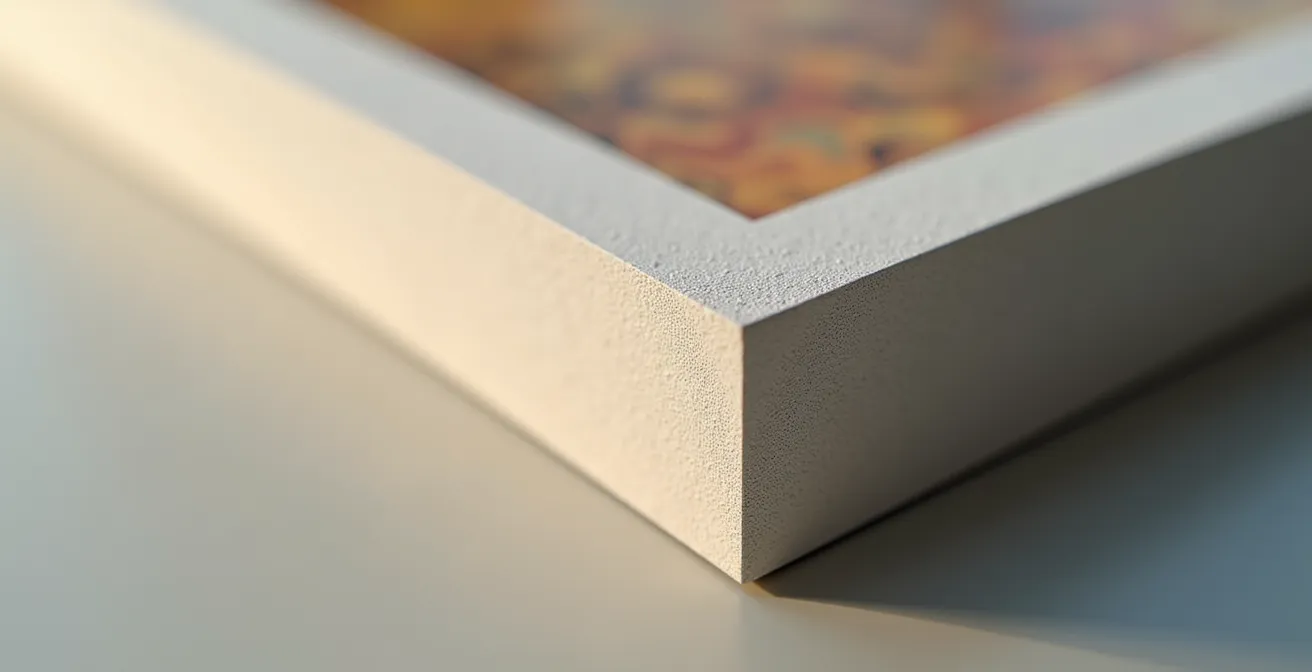
Choosing the right glazing is the next step. While basic glass is affordable, it offers no protection from harmful UV rays that can fade gouache’s vibrant pigments over time. For any piece you value, investing in conservation-grade glazing with 99% UV protection is essential. For the ultimate viewing experience, Museum Glass® or similar products offer both UV protection and anti-reflective properties, making the glass virtually invisible and allowing the gouache’s true matte texture to shine without distraction.
This table breaks down the common glazing options, helping you make an informed choice based on an analysis of different picture framing glass types.
| Glazing Type | UV Protection | Anti-Reflection | Best Use Case | Price Range |
|---|---|---|---|---|
| Basic Glass | None | No | Temporary display | $ |
| Conservation Clear® | 99% | No | Long-term protection | $$ |
| Museum Glass® | 99% | Yes | Professional display | $$$$ |
| Acrylic (Optium) | 99% | Yes | Static-sensitive gouache | $$$ |
Hand-Painted Matte or Inkjet Matte: Can You Tell the Difference?
As gouache gains popularity, so do high-quality reproductions. Modern giclée and inkjet printing technology can create stunningly accurate prints on matte fine art paper, mimicking the non-reflective surface of an original painting. For collectors and art lovers, being able to distinguish a hand-painted original from a premium print is a crucial skill. The difference lies not in the color, but in the subtle imperfections and physical topography of the paint itself.
An original gouache painting has a tangible presence that a print cannot replicate. The paint is applied in layers, creating microscopic ridges and variations in thickness. Brushstrokes, even when aiming for a flat finish, leave behind evidence of the artist’s hand. In contrast, an inkjet print is perfectly flat, composed of tiny, uniform dots of ink sprayed onto the paper. The “matte” of a print is the texture of the paper; the “matte” of a gouache painting is the texture of the dried pigment itself.
Authenticating an original involves looking for these physical clues. It requires moving beyond a simple frontal view and examining the artwork’s surface with a critical eye and, sometimes, with specialized tools. This is where the concept of tangible imperfection becomes the authenticator’s best friend. These small variations are not flaws; they are the signature of a handmade object.
Action Plan: Authenticating Original Gouache
- Perform the raking light test: Position a single light source at a 15-30 degree angle to reveal surface topography and brushstroke ridges.
- Examine micro-variations: Use a 10x magnification loupe to identify hand-applied irregularities in paint thickness.
- Check for pigment particle size: Original gouache shows inconsistent particle distribution, unlike the uniform dots of an inkjet print.
- Test edge quality: Hand-painted edges often show slight feathering or paint buildup, while prints have sharp, mechanical edges.
- Observe color shift: Gouache’s matte surface creates subtle luminosity changes at different angles that prints cannot replicate.
The Water Drop Hazard: Why One Splash Ruins a Finished Gouache Painting
The very property that makes gouache so wonderfully workable is also its Achilles’ heel: it is re-soluble. Gouache paint consists of pigment and a binder, most commonly gum arabic. When you add water, the gum arabic dissolves, allowing you to move the pigment around. The problem is that this process works just as well on a painting that has been dry for five years as it does on one that has been dry for five minutes. A single drop of water landing on a finished piece will instantly re-activate the binder, lifting the pigment and creating a “bloom” or tide mark that is nearly impossible to repair seamlessly.
This extreme sensitivity is why handling and displaying gouache requires such care. Unlike acrylics, which become a permanent, water-resistant plastic film once dry, gouache remains perpetually vulnerable to moisture. This inherent fragility is a core part of its character, demanding respect and careful conservation from both artist and collector. As artist and conservation expert Cecile Yadro notes, its composition is both a strength and a weakness:
Gouache is a water-based paint combining pigments, water, and a binding agent. Unfortunately, the very qualities that make gouache so appealing can also contribute to its fading over time. Light exposure, humidity, and temperature changes can all affect the stability and longevity of gouache paintings…
– Cecile Yadro, Professional Artist’s Guide to Gouache Protection
This vulnerability extends beyond accidental splashes. High humidity can make the paint surface feel tacky and susceptible to damage, while exposure to direct sunlight can cause the vibrant pigments to fade. While some artists choose to varnish their gouache paintings for protection, this is a controversial and irreversible step. A varnish will make the painting water-resistant but will also permanently alter its signature velvety matte finish, often adding a satin or gloss sheen that defeats the original aesthetic purpose of using gouache in the first place.
How to Scan Gouache Art Without Losing the Velvety Matte Texture?
For contemporary illustrators, a finished physical painting is often just the first step. The next is creating a high-quality digital file for prints, portfolios, or client work. However, digitizing gouache presents a unique challenge: how do you capture its deep, velvety matte texture without it looking flat, chalky, or worse, creating unwanted glare? A standard flatbed scanner often produces disappointing results, crushing the subtle surface details and introducing specular highlights.
The professional solution is not scanning, but photographing the artwork using a technique called cross-polarization. This method involves placing polarizing filters on both the light sources and the camera lens. By orienting the filters perpendicular to each other, you can effectively cancel out all specular reflections—the tiny points of glare that bounce off the surface of the paint. This allows the camera to capture only the diffuse color, revealing the true, rich pigment without any distracting shine.
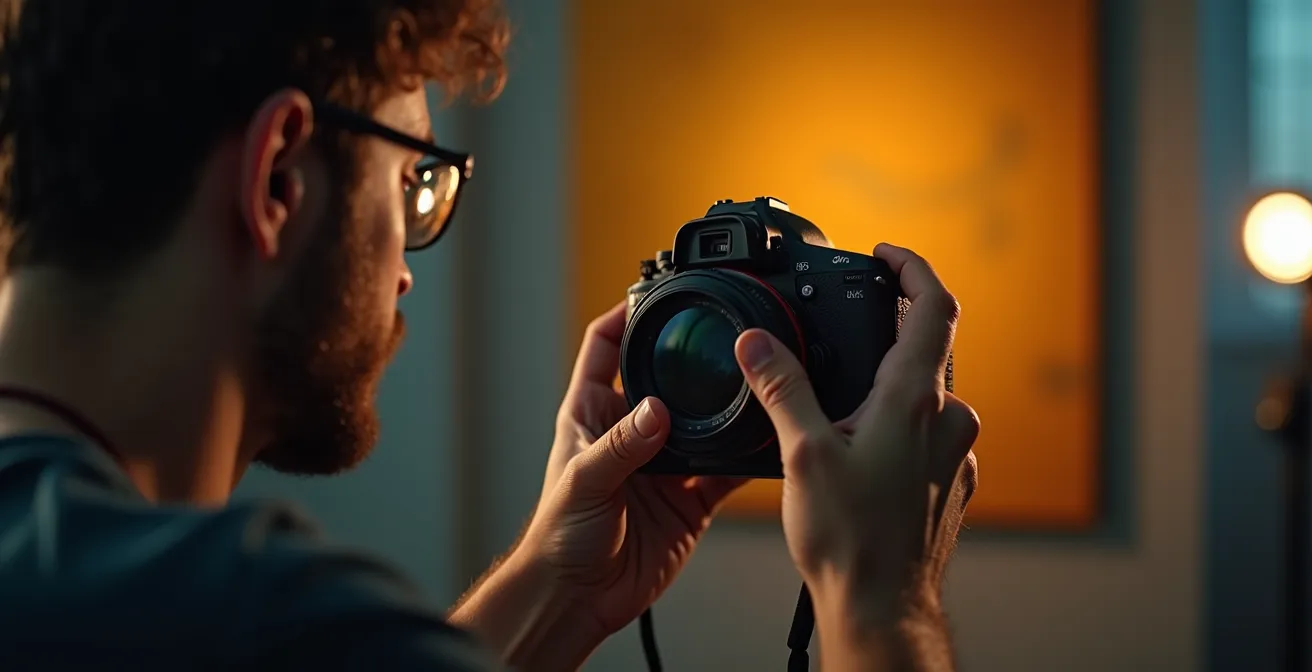
This setup, while technical, is the key to creating a digital file that honors the original artwork’s texture. It allows you to capture the subtle variations in the paint’s surface and the deep, non-reflective quality that makes gouache so appealing. Without cross-polarization, you are merely capturing a “shiny” version of a matte object. After capturing the image, careful color correction in software like Photoshop is the final step to ensure the digital colors perfectly match the physical pigments.
While a full cross-polarization setup might be out of reach for some, you can achieve better results than a direct scan by photographing the artwork in diffuse, indirect natural light (like on an overcast day) and using post-processing to adjust levels and remove any lingering sheen. The goal is always to preserve the non-reflective soul of the artwork.
Why Matte Art Is Visible from Any Angle Regardless of Window Placement?
The dominance of the matte aesthetic in modern interiors goes beyond a simple trend; it’s a practical response to the way we live and interact with art. One of the most significant functional advantages of a matte artwork, like a gouache painting, is its elimination of specular reflection. In simple terms: it doesn’t create glare. This is a game-changer for interior designers and collectors who struggle with placing art in rooms with large windows or complex lighting.
A painting with a glossy finish, such as an oil painting with a heavy varnish or a photograph framed under standard glass, acts like a mirror. Its visibility is entirely dependent on the viewer’s position relative to the light sources in the room. Stand in the wrong spot, and you see a reflection of the window or a bright light fixture instead of the artwork itself. This forces a compromise: you either place the art in a suboptimal, darker location or accept that it will only be properly visible from a few specific angles.
Matte art solves this problem entirely. The micro-textured surface of a gouache painting or a print on matte paper scatters light in all directions rather than reflecting it directly back at the viewer. This is called diffuse reflection. As a result, the color and detail of the artwork remain consistent and clear from almost any viewing angle and under any lighting conditions. You can hang a gouache painting directly opposite a bright window and still see it perfectly. This freedom is a key driver of the non-reflective art movement, allowing art to be integrated more seamlessly into living spaces without being dictated by light sources.
How to Tell if It’s Waterproof India Ink or Re-Soluble Watercolor?
For artists who combine line work with color, especially illustrators, understanding your materials is critical. A common pairing is ink lines with a wash of gouache or watercolor. The crucial distinction to make is between waterproof and re-soluble inks. Using the wrong one can lead to a smudgy, muddy disaster. The key difference lies in the binder used in the ink’s formulation.
Waterproof India ink typically uses shellac as a binder. When the ink dries, the shellac forms a hard, water-resistant film, locking the pigment particles in place. Once fully cured, you can paint over it with a water-based medium like gouache or watercolor without fear of the black lines bleeding or reactivating. This makes it the ideal choice for crisp, clean line work that needs to remain stable.
On the other hand, many other inks, including those found in fountain pens and some drawing inks, use a water-soluble binder similar to the gum arabic found in watercolor and gouache. These inks, like watercolor paint itself, are re-soluble. If you try to apply a wet wash of gouache over a line made with this type of ink, the line will dissolve and bleed into the color, creating a mess. The simplest way to test your ink is with a drop of water. Draw a line on a piece of scrap paper and let it dry completely. Then, take a clean, wet brush and paint over a section of the line. If the line stays sharp and does not smudge, it’s waterproof. If it blurs or bleeds, it’s re-soluble.
Key Takeaways
- Gouache’s opacity is its superpower, allowing for light-on-dark layering unlike watercolor.
- Always frame gouache with a mat or spacers to create an air gap; never let it touch the glass.
- Distinguish original gouache from prints by looking for surface texture and brushstroke ridges under raking light.
Matte Form Aesthetic: Why Non-Reflective Art is Taking Over Modern Interiors?
The resurgence of gouache is not happening in a vacuum. It is the leading edge of a larger cultural and aesthetic shift: the rise of the matte form aesthetic. In a world saturated with the glossy glow of screens, there is a growing desire for objects and art that are quiet, tactile, and non-reflective. This trend is about more than just paint; it’s a conscious move toward authenticity and tangible presence in our physical spaces. The velvety, light-absorbing surface of gouache perfectly captures this sentiment, offering a visual resting place for eyes fatigued by digital glare.
This movement is also reshaping the art market. While the speculative market for certain types of flashy, high-production contemporary art may be cooling—one report notes auction sales for young contemporary artists have seen a 71% contraction between 2022 and 2024—there is a renewed interest in craft, skill, and mediums with inherent material beauty. Collectors and designers are increasingly drawn to works that feel personal and handmade, where the artist’s touch is evident. Gouache, with its “tangible imperfections” and rich, earthy pigments, fits this new paradigm perfectly. It feels both modern in its graphic potential and timeless in its material honesty.
Ultimately, the gatekeeping that once separated “fine art” mediums like oil from “design” mediums like gouache is breaking down. Artists and collectors are realizing that the value of an artwork lies in its conceptual strength and aesthetic power, not in the historical hierarchy of its materials. Artist Manda Comisari captures this shift perfectly:
I think it’s time to reframe the narrative and recategorize gouache as the versatile fine art medium it is—one capable of standing alongside works painted in oil and acrylic in gallery and museum settings. It was always fine art… And there was always gatekeeping.
– Manda Comisari, The Truth About Gouache
So, the next time you encounter that velvety matte finish, look closer. You’re not just seeing a painting; you’re seeing a quiet revolution against the tyranny of gloss. It’s an invitation to explore this powerful aesthetic in your own collection or at the tip of your own brush.
Frequently Asked Questions about Gouache Art
Can gouache paintings be made waterproof with varnish?
Yes, but varnish permanently alters the matte finish and cannot be removed from gouache paintings. UV-protective spray varnishes can provide protection but will change the characteristic velvety appearance.
What happens chemically when water hits dried gouache?
The gum arabic binder re-solubilizes immediately upon contact with water, causing pigment particles to lift and create permanent tide marks that are nearly impossible to repair seamlessly.
Are there emergency repair techniques for water-damaged gouache?
Limited repairs are possible using a barely damp brush to feather bloom edges, followed by careful in-painting with matching gouache, though perfect restoration is rarely achievable.