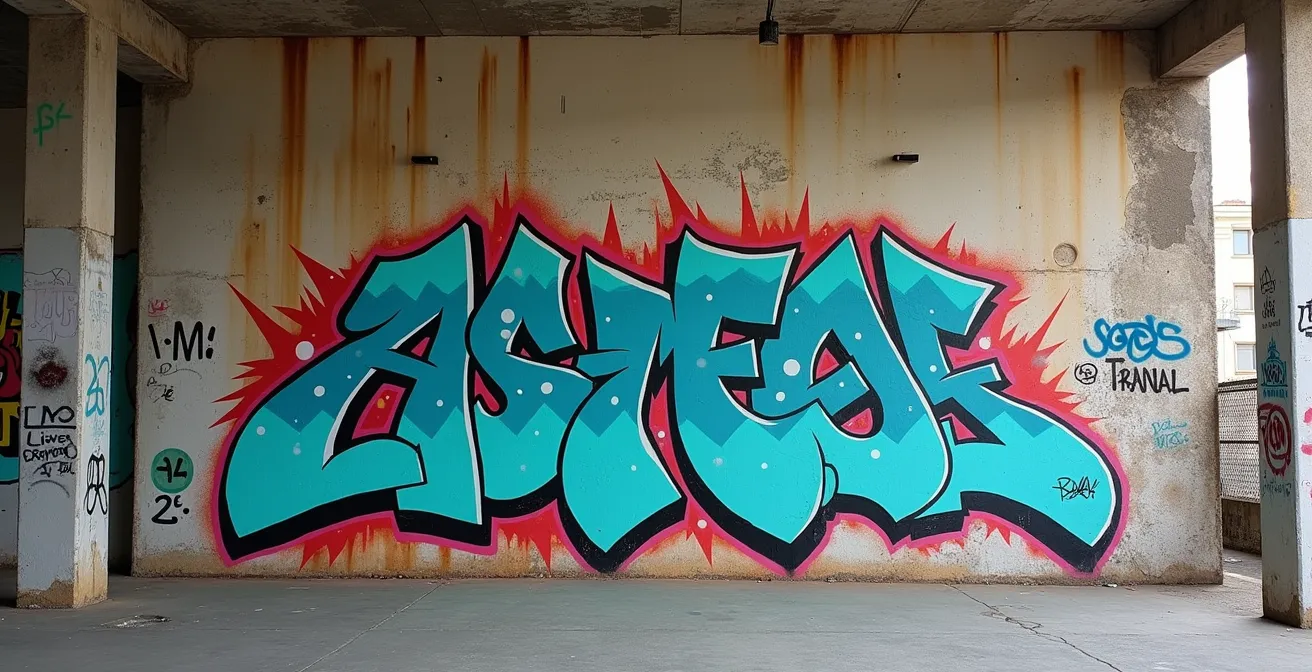
Contrary to the perception of graffiti as pure anarchy, it operates on a sophisticated set of unwritten rules. This code is not merely about etiquette; it’s a social and economic framework governing reputation, artistic development, and survival. Understanding this system reveals that respect, skill, and lineage are the true currencies in a world where the wall is both a canvas and a courtroom.
To the untrained eye, a wall covered in graffiti can look like chaos—a riot of colour and overlapping letters. It’s easy to dismiss it as vandalism, a territorial battle fought with spray cans. This perception, however, misses the intricate social structure that underpins the entire culture. For decades, writers have developed and enforced a complex code of conduct, a set of unwritten rules that dictates who can paint where, what can be painted, and what happens when those rules are broken. These aren’t arbitrary guidelines; they are the bedrock of a global subculture that thrives without formal institutions, galleries, or governing bodies.
Many newcomers hear the surface-level advice: “don’t paint over other writers,” “respect the dead,” “start with a tag.” But these are merely symptoms of a much deeper system. The real key to navigating this world is to understand the *why* behind the what. It’s about recognizing that this is a meritocracy built on skill, where your reputation is your most valuable asset. The hierarchy is not based on violence or gang affiliation, but on artistic mastery and dedication. For writers, these rules are a social contract that ensures the culture not only survives but evolves, protecting artistic integrity and managing conflict in a high-stakes environment.
This article deciphers that code. We will move beyond the surface to explore the fundamental principles that govern respect between writers and crews. We will analyze why certain acts are considered declarations of war, how the apprenticeship system protects the art form, and what separates a revered “king” from a disrespected “toy.” By understanding this hidden framework, you will learn to see the wall not as a mess, but as a dynamic, self-regulating society.
To navigate this complex world, we will break down the essential pillars of graffiti’s social contract. The following sections explore the core concepts that every aspiring writer must understand to earn their place and respect within the culture.
Summary: The Unwritten Code of the Wall
- Why Calling Someone a ‘Toy’ is the Ultimate Insult in Graffiti?
- Why You Should Sketch on Paper for 2 Years Before Touching a Wall?
- Lone Wolf or Pack: Why Joining a Crew Protects You on the Street?
- The Beef Starter: Why Painting Over Someone Else’s Piece Starts a War?
- How to Move from Train Yards to White Cubes Without Selling Out?
- How to Manage a ‘DAO’ Art Project Where 50 People Own the Creative Process
- Why a Solo Museum Show Increases a Painter’s Price by 40% Overnight?
- Aerosol Mastery: How to Control Can Pressure for Laser-Sharp Lines?
Why Calling Someone a ‘Toy’ is the Ultimate Insult in Graffiti?
In the graffiti subculture, the term “toy” is the most potent insult a writer can receive. It signifies a profound lack of skill, knowledge, and respect for the craft and its history. A toy is not just a beginner; they are a beginner who has bypassed the crucial, non-negotiable period of apprenticeship. They have gone straight to the walls without putting in the foundational work, demonstrating a lack of respect for those who have. This label is a direct challenge to a writer’s legitimacy within the community’s strict meritocracy. It implies their work is sloppy, their letterforms are weak (“wack”), and they are ignorant of the local scene’s history and key players.
The term is a cultural gatekeeping mechanism. It separates those who are serious about the art form from those who are merely dabbling. As the Graffiti Fandom Wiki notes, a toy is someone who “does not have knowledge of local graffiti, or one whose style isn’t too good, or is still developing.” The antidote to being a toy is time and dedication. In fact, many experienced writers typically spend at least two years perfecting their craft in blackbooks before ever attempting a piece on a wall. This period of study is fundamental to developing the “can control,” letter structure, and style necessary to earn respect.
Interestingly, the term can be subverted by established artists. In a clever commentary on the scene’s hierarchy, the artist Happy created a series of paste-ups depicting toy-like characters calling each other “toy.” This is a form of “anti-style,” where skilled writers adopt a deliberately crude aesthetic to play with the very notions of skill and status. For a newcomer, however, the label is a clear signal: go back to the drawing board, study the masters, and earn your place. It’s a harsh but necessary part of the structural apprenticeship that preserves the quality of the art form.
Why You Should Sketch on Paper for 2 Years Before Touching a Wall?
The informal rule to spend years sketching in a “blackbook” before painting a wall is the core of graffiti’s structural apprenticeship. It is a self-imposed educational system that serves multiple functions. First and foremost, it is about developing technical skill. Aerosol paint is an unforgiving medium; without a deep understanding of letter structure, flow, and composition developed on paper, a writer’s work on a wall will inevitably look amateurish—the work of a “toy.” The blackbook is a low-stakes laboratory for experimentation. It is where a writer forges their unique style, masters the anatomy of letters, and develops the muscle memory required for clean, confident lines.
This dedicated practice is also a rite of passage that demonstrates commitment and respect for the culture. By filling books with sketches, writers prove they are not just looking for cheap thrills but are serious students of the art form. This process builds a visual library of ideas and color schemes that can be executed flawlessly when the time comes to paint, saving time and expensive materials on the street. The blackbook becomes a writer’s portfolio, a tangible record of their journey and stylistic evolution.

Furthermore, the blackbook is a social tool. It acts as a passport within the community. Writers will often ask other respected artists to leave a “tag” or a small piece in their book. A book filled with signatures from established “kings” is a powerful symbol of connection and endorsement. It shows that the owner has been in the scene, met key figures, and earned a degree of acceptance. This process of sketching, sharing, and documenting is the single most important step in moving from outsider to insider. It is the work that earns a writer the right to touch a wall.
Your Blackbook Journey: A Plan for Graffiti Mastery
- Start with fundamentals: Begin by practicing basic letter structures on any available paper before investing in a high-quality blackbook. Focus on consistency and form.
- Develop muscle memory: Commit to daily sketching sessions to build the hand-eye coordination and muscle memory needed for smooth, controlled lines.
- Build your network: When you meet other writers, especially those with more experience, ask them to sign your book. It will become a passport of your connections in the scene.
- Test your palette: Use your blackbook to experiment with color combinations and blending techniques with markers before you commit to expensive spray paint.
- Document your progress: Date every sketch to create a visual timeline of your development. This will help you track your improvement and identify areas for growth.
Lone Wolf or Pack: Why Joining a Crew Protects You on the Street?
While a solo writer can earn individual fame, joining a crew offers an unparalleled system of support, protection, and growth. A crew is far more than a gang; it is a kinship network or a “Graffiti Family,” as one academic paper describes it. This alliance is built on trust, friendship, and a shared passion for the art. As noted in a study from Butler University’s Digital Commons, “Crews are comprised of people that an artist trusts with their legal and physical livelihood.” This trust is critical in an illegal activity where a reliable lookout can mean the difference between finishing a piece and getting arrested.
Membership in a crew provides immense practical advantages. It’s a system of shared resources and knowledge. Veteran members mentor younger writers, passing down techniques for can control, spot selection, and navigating the social landscape. Resources like paint, caps, and ladders are often pooled, allowing the group to execute larger, more ambitious productions that would be impossible for a single artist. This collective power amplifies a writer’s reputation; the fame of a crew like the Mad Society Kings (MSK), one of the world’s most respected, elevates every member associated with its name.
The process of joining a crew is often a formal one, reflecting its importance. A prospective member is typically voted in by the existing members, ensuring that the group’s integrity and trust remain intact. For a writer, being part of a crew means they are never truly alone. They have a team to watch their back, critique their work, and push them to become a better artist. The following table breaks down the clear advantages of working within this social contract versus going it alone.
| Aspect | Solo Writer | Crew Member |
|---|---|---|
| Physical Safety | Vulnerable, no lookouts | Protected by crew lookouts |
| Spot Access | Limited to personal discoveries | Shared knowledge of premium spots |
| Skill Development | Self-taught, slower progress | Mentorship and technique sharing |
| Reputation | Individual recognition only | Backed by crew’s collective reputation |
| Resources | Personal supplies only | Shared paint, caps, and equipment |
The Beef Starter: Why Painting Over Someone Else’s Piece Starts a War?
The single most sacred rule in graffiti is to not paint over another writer’s work. To do so is the ultimate act of disrespect—a direct challenge that almost always escalates into a “beef” or war. This rule is about maintaining territorial integrity in a world where physical space is earned, not owned. A finished piece represents hours of planning, significant financial cost for materials, and immense personal risk. It is a writer’s claim to a piece of the urban landscape. To cover it is to erase their effort and publicly declare that their work, and by extension their reputation, is worthless.
However, the rule has nuance. There is a clear hierarchy of disrespect. Going over a simple tag with a complex, full-color piece might be acceptable, especially if the tag is old or poorly executed. But going over a master’s intricate piece with a simple “throw-up” or, even worse, just scribbling over it (“capping” or “crossing out”), is a declaration of war. It is understood that if you are to paint over someone, your piece must be significantly better than what you are covering. This ensures that the overall quality of art on the walls is always improving. Failure to abide by this principle is a serious offense that will be met with retaliation, often by the original writer’s entire crew.
This system of conflict and resolution is a cornerstone of graffiti’s self-governing social contract. Historically, crews have even developed formal protocols to manage these disputes. For example, the “HOT110 Protocol” from mid-1970s New York served as a community-enforced penalty. According to a historical account on graffiti.org, if a writer violated the subculture’s ethics, other crews would write ‘HOT110’ over their work. It was a “safety valve,” as graffiti legend Lee Quiñones put it, to prevent escalations by providing a standardized reprimand. Breaking this fundamental rule on piece integrity isn’t just rude; it’s a direct attack on the reputation economy and an act that destabilizes the entire social order.
How to Move from Train Yards to White Cubes Without Selling Out?
The transition from illegal street artist to gallery-represented painter is a path fraught with tension. For many writers, the very idea of putting graffiti in a “white cube” gallery feels like a betrayal of the culture’s core ethos. The reputation economy of the streets is built on risk, rebellion, and peer-to-peer respect, not on commercial sales. The term “selling out” is often used to describe artists who are perceived as sanitizing their work to make it palatable for a wealthy audience, abandoning the raw energy and illegal context that gave it meaning.
However, an increasing number of artists have successfully navigated this transition by refusing to compromise their artistic integrity. The key is to bring the authenticity of the street into the gallery, rather than leaving it behind. This means staying true to their style, their letterforms, and the history of the medium. Instead of abandoning their roots, they use the gallery platform to educate a new audience about the complexity and artistry of the culture. They treat their canvases with the same intensity and dedication as a subway car, maintaining the technical skill and stylistic innovation that earned them respect in the first place.
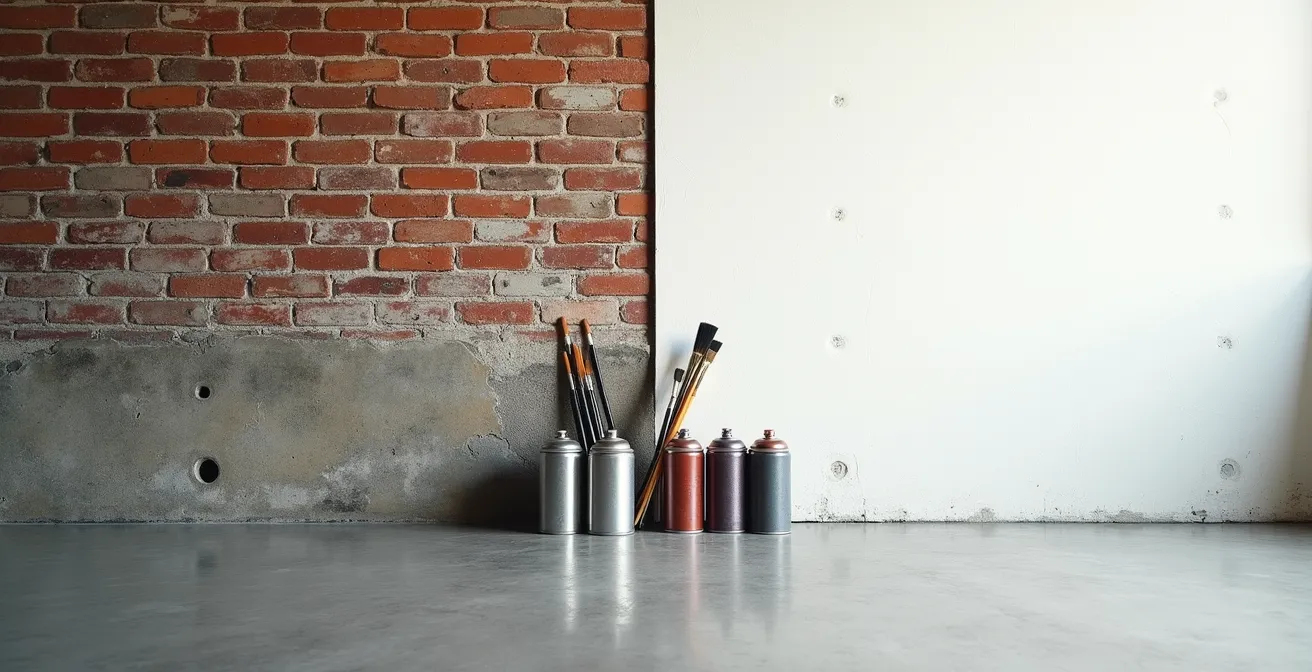
Institutions are also beginning to recognize the importance of this authenticity. The Getty Research Institute’s “L.A. Graffiti Black Book” project is a landmark example. Rather than simply displaying finished works, the Getty invited legendary L.A. writers to create a citywide black book, treating their sketchbooks—the very heart of their practice—as historical documents. The artists were shown rare calligraphic manuscripts from masters like Albrecht Dürer, and they “instantly recognized the connections to their own practices.” This project validated the process and history of graffiti on its own terms, bridging the gap between the street and the institution without forcing artists to “sell out.” It proved that legitimacy can be achieved not by abandoning the culture’s rules, but by celebrating them.
How to Manage a ‘DAO’ Art Project Where 50 People Own the Creative Process
The concept of a Decentralized Autonomous Organization (DAO), where a collective of individuals manages a project through blockchain-based voting, may seem like a futuristic web3 invention. However, its core principles of group governance, shared ownership, and consensus-driven decisions have been practiced by graffiti crews for decades. A traditional graffiti crew is, in essence, an analog DAO. It operates without a single leader, with major decisions—like admitting a new member—put to a majority vote. According to research on graffiti subculture, if a vote on a new member fails, it’s not a final rejection; “it will be put to vote again until the verdict is yes,” showing a commitment to consensus.
This parallel provides a powerful model for managing a modern DAO art project. Both systems rely on a social contract to function. In a crew, reputation (“street cred”) is the primary currency, earned through skill and adherence to unwritten rules. In a DAO, this is mirrored by on-chain contribution history and token ownership. Conflict resolution in a crew is handled through internal discussion and, if necessary, “beef,” while a DAO relies on smart contract protocols and governance proposals. The core idea is the same: the group’s strength and direction are determined by the collective will of its members, not by a single director.
Translating the crew model to a DAO involves formalizing these unwritten rules into smart contracts. The table below illustrates the striking parallels between these two governance structures, showing how the old-school street wisdom of graffiti crews provides a time-tested blueprint for the future of collaborative digital art.
| Aspect | Traditional Graffiti Crew | DAO Art Collective |
|---|---|---|
| Membership Process | Majority vote by existing members | Token-based governance voting |
| Reputation System | Street credibility and piece quality | On-chain contribution history |
| Conflict Resolution | Crew meetings and unwritten codes | Smart contract protocols |
| Resource Sharing | Informal paint/cap exchanges | Treasury management via blockchain |
| Identity | Crew tag/letters | Wallet address/NFT membership |
Key Takeaways
- Graffiti is governed by a strict, merit-based code, not chaos. Reputation is earned through skill and respect for the rules.
- The “blackbook” is a mandatory apprenticeship. Skipping this stage and painting walls prematurely earns the ultimate insult: “toy.”
- Crews are not gangs but “kinship networks” that provide protection, mentorship, and shared resources, operating like analog DAOs.
Why a Solo Museum Show Increases a Painter’s Price by 40% Overnight?
The premise that a solo museum show increases a painter’s price by 40% overnight reflects the logic of the conventional art market, where institutional validation directly translates to commercial value. For a traditional painter, this is a career-defining moment. For a graffiti writer, however, the calculation is entirely different. Within the authentic subculture, a museum show and its associated price tag are, at best, irrelevant and, at worst, a sign of having sold out. The graffiti reputation economy does not operate on dollars; it operates on respect.
The true measure of a writer’s “value” is not determined by gallery owners or auction houses, but by their peers on the street. As one analysis of the culture makes clear, fame in graffiti culture is measured by respect from peers. The opinion of a legendary “king” who has been painting trains for decades carries infinitely more weight than that of an art critic or a wealthy collector. Fame is earned by getting your name up in difficult, high-risk locations, by demonstrating superior style and can control, and by winning battles against other skilled writers. The ultimate museum is not the MoMA; it’s the city’s subway system.
Crews function as an artist’s ‘Graffiti Family’. They are established to illustrate social alliances within this subculture. Crew members are usually very close friends who enjoy painting with each other.
– Butler Digital Commons, The Perpetuation of Graffiti Art Subculture
The landmark 1983 documentary *Style Wars* captured this value system perfectly. It showed a world where teenage writers risked their freedom not for money, but for the glory of painting a “whole car”—a subway car completely covered from end to end. These rolling masterpieces were their exhibitions, seen by thousands of commuters across the city. The film documents the constant struggle against the authorities, who saw their work as a blight to be erased. For those writers, the “value” was in the act itself and the recognition it brought from their community. Therefore, while a gallery show might increase a writer’s bank account, it does nothing to increase their status where it truly counts: on the street.
Aerosol Mastery: How to Control Can Pressure for Laser-Sharp Lines?
Ultimately, all the rules of respect, crew dynamics, and reputation management rest on one non-negotiable foundation: technical skill. Without the ability to control the can, a writer has no currency in the graffiti economy. The difference between a respected “king” and a “toy” is, in its purest form, “can control.” It is the ability to manipulate an unwieldy, high-pressure tool to create lines that are sharp, clean, and confident. As the editors at Bombing Science state, “Graffiti is about control. Straight lines, smooth fills, and clean outlines separate toys from real writers.”
Mastering can pressure is a science. It involves a deep, intuitive understanding of how distance, speed, and cap type interact. A writer learns to paint close to the wall with a skinny cap for crisp, laser-sharp outlines and details. They pull back, using a fat cap, to fill large areas quickly and evenly, without drips or overspray. This control is not something that can be learned overnight; it is the product of years of practice, starting in the blackbook and progressing to countless hours on walls. It’s about developing a physical relationship with the tool, where the can becomes an extension of the hand.
This technical prowess is the ultimate sign of professionalism and dedication. It’s visible in every piece a writer creates. Are the lines shaky or solid? Is the fill opaque and smooth, or patchy and thin? Are the edges clean, or are they fuzzy with overspray? These are the details that other writers see immediately. They are the language of skill. A writer who has achieved aerosol mastery can execute complex ideas flawlessly, a testament to their commitment to the craft. This is why the unwritten rules place such a high premium on practice; without that foundational control, a writer cannot earn respect, no matter how ambitious their ideas are.
- Master basic straight lines and consistent pressure before attempting complex pieces.
- Practice can control at different distances from the wall—close for detail, far for fills.
- Learn your caps: understand that fat caps are for quick fills, while skinny caps are for precise outlines.
- Develop speed without sacrificing quality; efficiency and cleanliness are marks of a professional.
- Perfect your hand movements to eliminate drips and maintain a consistent line weight throughout your work.
By internalizing this code—from the foundational respect for apprenticeship to the complex dynamics of crews and beefs—a newcomer can begin to navigate this world not as an outsider, but as a student of a rich and powerful artistic tradition. The next step is to observe these rules in action on the walls of your own city.