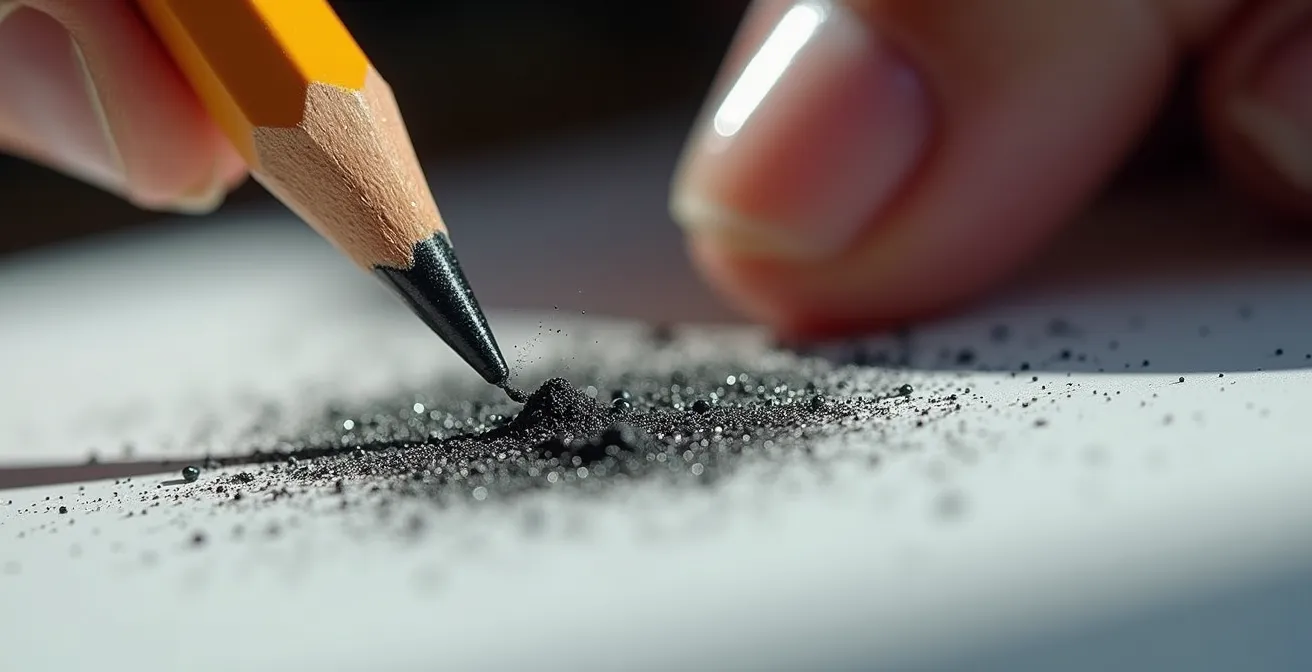
The surging valuation of hyper-realistic graphite art is driven less by its photorealistic mimicry and more by a sophisticated connoisseurship of its unique material properties, which serve as tangible markers of authenticity and skill.
- Irreplicable physical traits like graphite sheen and hand-drawn hatching are becoming key indicators of value, distinguishing original works from digital prints.
- The choice of archival-quality materials, from 100% cotton paper to specific pencil grades like 9B, is now viewed as a critical component of the artwork’s long-term asset integrity.
Recommendation: Investors should shift their evaluation criteria from simple aesthetic appeal to a detailed analysis of the work’s material authenticity and the artist’s technical draftsmanship.
In the contemporary art market, a quiet but significant shift is underway. Hyper-realistic pencil drawings, once relegated to the realm of preparatory sketches or technical exercises, are now commanding unprecedented attention and prices. Investors and collectors are beginning to recognize that the value of these intricate works extends far beyond their startling resemblance to photographs. While the time and skill involved are undeniable, the most astute market observers are looking deeper, analyzing the very fabric of these creations. This growing appreciation is not just about what is depicted, but how it is brought into existence through the mastery of humble materials.
The common discourse often stops at “it looks just like a photo,” but this misses the core investment thesis. The real story lies in the tangible, physical qualities that defy digital replication. We are witnessing the rise of a new form of material connoisseurship, where the ability to discern the depth of a 9B pencil stroke, the specific character of graphite sheen under light, or the subtle imperfections of manual cross-hatching are becoming the true measures of an artwork’s worth. These are not mere technical details; they are authenticity markers, forming a direct, unbreakable link to the artist’s hand in an age of digital saturation.
But if the real value is not just in the image, where should a collector or investor focus their attention? The answer is in the physicality of the medium itself. The true valuation of graphite mastery lies in understanding its limitations and its unique strengths—from the way light interacts with its crystalline surface to the archival stability of its support. This analysis will deconstruct the key material and technical factors that are transforming graphite drawings from impressive novelties into serious, investment-grade assets, providing a framework for identifying true value beyond superficial likeness.
To navigate this emerging market, this guide breaks down the essential criteria for evaluating hyper-realistic graphite art, from the artist’s fundamental tools to the principles of long-term preservation and display. The following sections provide a detailed roadmap for the discerning investor.
Summary: Graphite Mastery: Why Are Hyper-Realistic Pencil Drawings Surging in Value?
- Why a 9B Pencil Creates Depth That an HB Simply Cannot Achieve?
- How to Spot the Graphite Sheen That Inkjet Prints Can Never Replicate
- Paper or Bristol Board: Which Support Prevents Warping Over Decades?
- The ‘Silvering’ Effect: When Graphite Becomes Impossible to Photograph
- At What Height Should You Hang Intricate Graphite Art for Best Viewing?
- How to Spot Flawed Anatomy in a Figure Drawing in Under 5 Seconds
- How to Detect the ‘Perfect Imperfections’ of Hand-Drawn Cross-Hatching
- Centuries-Old Draftsmanship: Why Modern Collectors Are Returning to Classical Skill?
Why a 9B Pencil Creates Depth That an HB Simply Cannot Achieve?
The valuation of a graphite work begins with its most fundamental component: the pencil. An artist’s choice of graphite grade is not a matter of preference but a strategic decision that directly impacts the work’s tonal range and perceived depth. While a standard HB pencil offers control, it lacks the material composition to produce true, deep blacks. The 9B pencil, by contrast, represents the pinnacle of softness and blackness on the graphite scale. This is because its lead contains the highest ratio of graphite to clay binder. According to the Strathmore graphite scale classification, this composition allows the 9B pencil to deposit more particles onto the paper with less pressure.
This material difference is what enables an artist to achieve value compression—the ability to render a full spectrum of light and shadow within a monochromatic palette. A master artist using a 9B can create velvety, light-absorbing blacks that an HB or even a 6B pencil simply cannot. This is not just an aesthetic advantage; it is a quantifiable indicator of technical mastery. An investor can learn to spot the difference: works that exhibit a wide and seamless tonal range, from the paper’s stark white to the rich, non-reflective black of layered 9B, demonstrate a higher level of control and are inherently more complex and valuable.
The ability to create this depth without oversaturating the paper or creating unwanted shine requires immense skill. By layering applications of elongated hatches (parallel strokes) or cross-hatches, the artist builds up tone, allowing the graphite platelets to accumulate and form a deep, matte surface. This process is deliberate and unforgiving, making the successful use of soft-grade pencils a key marker of an experienced and confident hand.
How to Spot the Graphite Sheen That Inkjet Prints Can Never Replicate
One of the most definitive authenticity markers of a graphite drawing is a physical property that no digital print can emulate: the graphite sheen. This phenomenon occurs because graphite is composed of flat, crystalline platelets. When layered heavily and burnished on paper, these platelets align and create a reflective, semi-metallic surface. While often seen as a challenge for photographers, for a collector, this sheen is an irrefutable sign of an original, hand-drawn work. An inkjet print, which deposits ink that soaks into the paper fibers, will always have a uniform, matte finish under angled light.
To spot this, an investor or collector should view a piece not just from the front, but from a 45-degree angle under a single light source. In an authentic graphite drawing, the light will catch on the burnished areas, creating a traveling, silvery luster that changes with the viewing angle. This effect is a direct result of the physical interaction between light and the layered graphite particles. It is, in essence, the artwork’s physical fingerprint. This is not a flaw; it is a feature that confirms the work’s manual genesis.
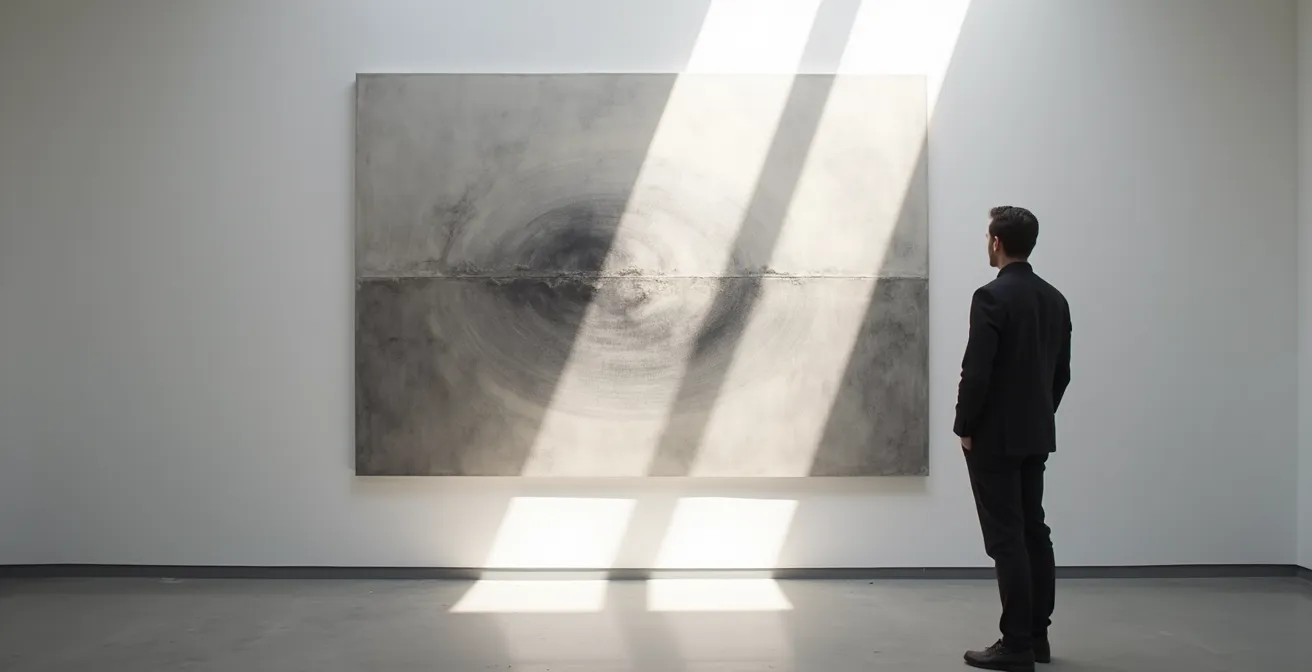
The case of Japanese artist Kohei Ohmori demonstrates this principle. His hyper-realistic drawing of an Asahi beer can went viral partly because of his masterful rendering of metallic surfaces. As detailed in a feature by Designboom on his intricate works, he meticulously captures lighting and shading effects that rely on the physical properties of graphite. His ability to control the sheen to replicate the look of polished metal is a testament to an advanced understanding of the medium, elevating the work far beyond simple mimicry and making it a prime example of investment-grade graphite art.
Paper or Bristol Board: Which Support Prevents Warping Over Decades?
An artwork’s long-term value is inextricably linked to its physical stability. For a graphite drawing, the choice of support—the paper or board it is drawn on—is a critical factor in its preservation and, therefore, its viability as a long-term asset. While many papers may feel substantial, only those with archival properties can guarantee the work will resist degradation over decades. The primary enemies of paper are acid, which causes yellowing and brittleness, and environmental instability, which can lead to warping and buckling.
If you want your artwork to last, choose acid-free, archival-quality paper. Regular paper can yellow and degrade over time, while archival options resist aging and preserve the original integrity of your drawings.
– PaperPapers Editorial Team, The Best Paper for Pencil Art Guide 2025
For the serious artist and investor, the debate often centers on two high-quality options: 100% cotton hot-press paper (like Arches) and high-ply Bristol board. While both are superior to standard drawing paper, they offer different advantages for ensuring the longevity of a graphite masterpiece. An artist’s choice here is an indicator of their commitment to the permanence of their work. A piece rendered on a dimensionally stable, archival support is a fundamentally more secure investment.
The following table breaks down the key differences between top-tier supports, highlighting why a foundation of 100% cotton paper is often considered the gold standard for investment-grade graphite art.
| Property | Arches Hot-Press (100% Cotton) | Bristol Board 500 Series | Standard Drawing Paper |
|---|---|---|---|
| Archival Quality | Yes – 100% cotton, archival quality | Yes – archival quality | No – acid-free but not archival |
| Black Depth Capacity | Holds blacks beautifully | Moderate – requires patience | Limited |
| Erasure Resistance | Can stand multiple erasures | Good | Fair |
| Pencil Range Support | 9H to 9B full range | 2H to 6B | HB to 4B |
| Surface Stability | Excellent – minimal warping | Very Good – dimensionally stable | Poor – prone to warping |
The ‘Silvering’ Effect: When Graphite Becomes Impossible to Photograph
Paradoxically, one of the characteristics that makes graphite art a strong tangible asset is the very thing that makes it difficult to reproduce digitally: the ‘silvering’ effect. This is an extreme form of the graphite sheen, where heavily layered or burnished areas reflect so much light they appear as a flat, silvery-white glare in photographs, completely obscuring the underlying detail. This happens when the microscopic graphite platelets become perfectly aligned, acting like a mirror. For an artist or gallery trying to document the work, this is a significant challenge. For an investor, however, it is another powerful, built-in certificate of authenticity.
The silvering effect is a physical guarantee that the viewing experience of the original object can never be fully captured by a camera or replicated by a printer. It creates an ‘experiential gap’ between the physical artwork and its digital representation. A photograph might show a blown-out highlight, but the naked eye, able to process a much higher dynamic range, can still perceive the subtle tonal variations within that same area. This quality reinforces the primacy of the original object, making its ownership a unique and non-replicable experience—a key driver of value in the art market.
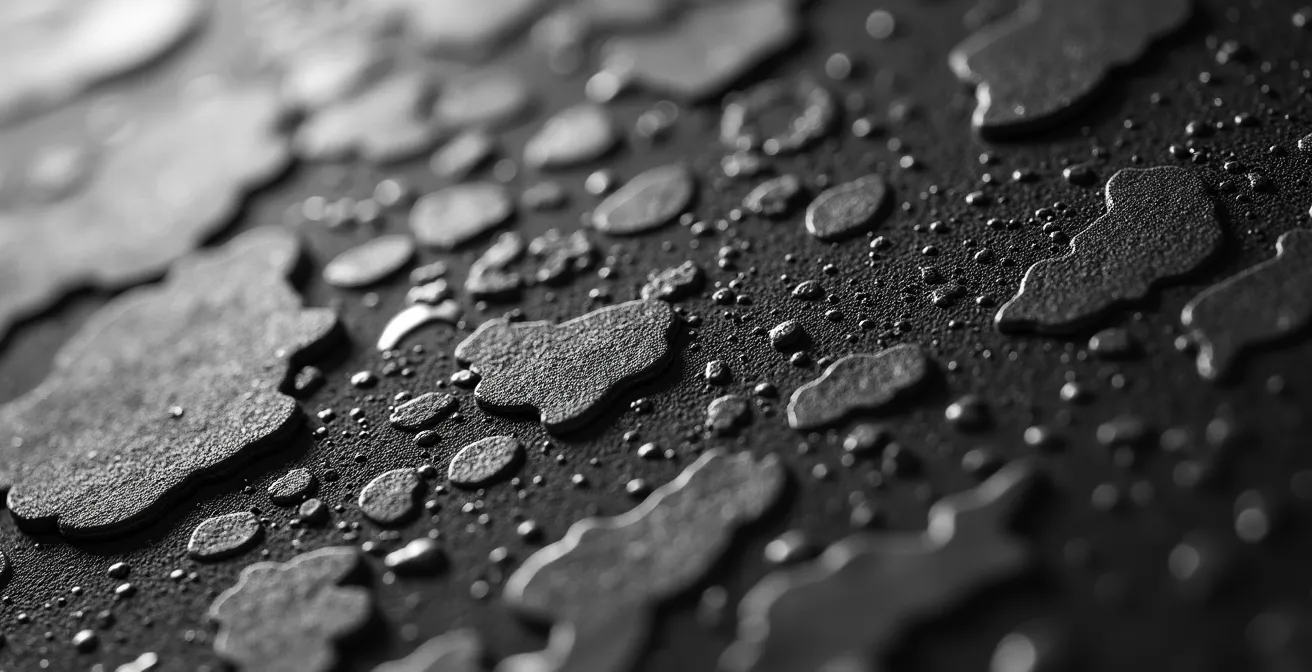
While artists employ sophisticated techniques to mitigate this effect for documentation—such as using cross-polarization filters or composite bracketing—the fundamental challenge remains. This inherent difficulty in capturing the full essence of a graphite work digitally ensures that the physical piece will always hold superior value. It is a material truth that protects the investment from the devaluing effect of perfect digital copies, a problem that plagues many other forms of two-dimensional art.
At What Height Should You Hang Intricate Graphite Art for Best Viewing?
The acquisition of an investment-grade artwork is only the first step; its proper display is crucial for both its appreciation and its long-term preservation. For intricate graphite drawings, display standards differ significantly from those for large-scale paintings. The standard gallery practice of hanging a work with its center at 60 inches (152 cm) is often too high for graphite pieces, which demand close, intimate examination. A lower hanging height encourages viewers to get closer, allowing them to appreciate the fine details of the draftsmanship, from the texture of the paper to the precision of the hatching.
The Metropolitan Museum of Art, for instance, provides a compelling model for this approach. In its specialized galleries, the museum often displays works on paper with their center at a lower height of approximately 52 inches. This small adjustment fundamentally changes the viewer’s relationship with the artwork, shifting it from a public declaration to a private conversation. Furthermore, the lighting is just as critical. The museum employs highly controlled, UV-filtered lighting at a maximum of 50 lux to prevent degradation. For display, lighting experts recommend positioning picture lights at a 30-degree angle. This specific angle is optimal for revealing the paper’s texture and the artist’s mark-making while simultaneously controlling the reflective graphite sheen.
For a collector, adopting these museum-level standards is not just about aesthetics; it is an essential part of asset management. Proper hanging and lighting not only enhance the viewing experience but also demonstrate a commitment to the work’s conservation. A well-presented piece in a collection signals a higher level of connoisseurship, which can positively influence the perceived value of the entire portfolio. It shows an understanding that the value of the art is protected not just by its creation but by its careful stewardship.
How to Spot Flawed Anatomy in a Figure Drawing in Under 5 Seconds
Beyond the material science of graphite and paper, the ultimate driver of value is the artist’s skill. In figure drawing, one of the quickest ways to assess an artist’s level of mastery is to evaluate their understanding of anatomy. A trained eye can spot fundamental errors in seconds, separating a technically proficient artist from a true master. These flaws often hide in plain sight, normalized by our brains’ tendency to overlook minor inconsistencies. However, for an investor, identifying these weaknesses is crucial to avoid acquiring work from an artist who has not yet mastered the fundamentals.
The key is not to look for perfect, textbook anatomy, but for anatomical logic and storytelling. Is the figure’s weight believably distributed? Do the muscles tense and relax in a way that corresponds to the implied action? Even small errors in proportion or balance can betray a lack of deep understanding and break the illusion of life that is the hallmark of great draftsmanship.
The biggest flaw isn’t a slightly off proportion, but a lack of anatomical storytelling. A technically perfect but ‘lifeless’ figure represents a more significant failure than minor proportion errors.
– Drawing Academy, Fundamentals of Figure Drawing
Developing this quick assessment skill is invaluable. It allows a collector to cut through the initial “wow factor” of hyper-realism and analyze the structural integrity of the artwork. The following checklist provides a systematic method for performing a rapid anatomical audit, a technique used by curators and experienced collectors to quickly gauge an artist’s foundational skill.
Your Action Plan: The 5-Second Anatomy Assessment
- Apply the Gravity Line Test: Mentally trace a vertical line from the pit of the neck straight down. For a balanced figure, this line should fall between the feet, indicating stable weight distribution.
- Check the Head-to-Body Ratio: Quickly assess if the figure adheres to realistic proportions. An average adult figure measures approximately 7.5 to 8 heads tall. Significant deviations can signal a lack of training.
- Verify Joint Alignment: Ensure that the shoulders, hips, and knees are aligned in a way that logically supports the figure’s weight and pose. Unnatural angles can indicate a structural flaw.
- Assess Muscle Tension Logic: Look for correspondence between action and anatomy. If an arm is lifting a weight, the bicep should be contracted. Lifeless or incorrect muscle groups suggest copying rather than understanding.
- Use the Mirror Flip Technique: If viewing a digital image, flip it horizontally. If viewing in person, imagine it reversed. This simple trick bypasses your brain’s familiarity with the image and instantly reveals asymmetries and proportional errors.
How to Detect the ‘Perfect Imperfections’ of Hand-Drawn Cross-Hatching
In the world of hyper-realism, the pursuit of perfection can be a misleading metric of value. True draftsmanship is not about creating a flawless, machine-like surface. Instead, it is often revealed in the “perfect imperfections” of the artist’s hand, most notably in their cross-hatching. Cross-hatching—the layering of parallel lines in different directions to build tone—is a fundamental drawing technique. When executed by a master, it contains a subtle, organic variation that a computer algorithm or a mechanical printer can never truly replicate. These minute inconsistencies in line weight, spacing, and angle are not flaws; they are the artist’s signature at a microscopic level.
For an investor, learning to read these marks is like learning to read an artist’s DNA. A high-resolution digital print may replicate the overall tone, but under close inspection (or a magnifying glass), its marks will be perfectly uniform dots (dithering). A hand-drawn piece, however, will reveal a web of intersecting lines, each with its own character. This human element is becoming increasingly prized in the market. In fact, a 2024 art market report noted $473 million in print sales, reflecting a significant shift toward works that offer a tangible connection to the artist’s hand.
The dedication required to achieve this level of detail is immense. Artist Kohei Ohmori, for example, is known for investing hundreds of hours in a single drawing. By meticulously refining proportions and details, he embeds his time and focus into the paper. This intense labor is a form of value creation in itself. When a work visibly contains thousands of deliberate, hand-placed marks, it becomes an undeniable testament to human commitment and skill, differentiating it from both lower-effort works and all forms of mechanical reproduction.
Key takeaways
- The value of hyper-realistic graphite is shifting from photorealistic mimicry to the connoisseurship of its unique material properties.
- Authenticity markers like graphite sheen, paper choice, and hand-drawn imperfections are key differentiators that digital prints cannot replicate.
- Long-term asset value is directly tied to the use of archival materials and an artist’s foundational draftsmanship skills.
Centuries-Old Draftsmanship: Why Modern Collectors Are Returning to Classical Skill?
The renewed interest in graphite mastery is not an isolated phenomenon; it is part of a broader market trend—a return to valuing foundational, classical skill. In an art world often dominated by conceptualism and digital media, collectors and investors are increasingly seeking works that demonstrate undeniable technical proficiency. This trend, sometimes termed “digital fatigue,” reflects a growing desire for tangible assets that showcase human dexterity and dedication. Works on paper, particularly drawings, offer a direct and intimate connection to the artist’s creative process, a quality that is increasingly rare and valuable.
Market data supports this shift. The appetite for works on paper, prints, and drawings is growing, with one 2024 report highlighting that the category reached an all-time high of 132,000 transactions. This surge indicates that collectors are not just buying images; they are investing in authenticity, skill, and the tangible evidence of an artist’s labor. A hyper-realistic graphite drawing is the epitome of this value proposition. It is a definitive statement of skill that requires no complex theoretical explanation to be appreciated, yet it possesses layers of technical and material complexity for the serious connoisseur to analyze.
This return to draftsmanship positions highly skilled graphite artists as a compelling investment category. Their work serves as a hedge against the ephemeral nature of digital trends and the volatility of more conceptually driven markets. As one gallery investment report notes, physical art offers a unique sense of permanence and personal connection.
Digital fatigue is fuelling a renewed appreciation for physical assets. In an era of fleeting screens and intangible investments, art offers something much more personal, alongside tangible benefits in the long term. It serves as a hedge against inflation and market tension, a future legacy and a strategic pillar in a well-balanced portfolio.
– Maddox Gallery Investment Report, 5 Best Artists to Invest in 2025
For the discerning collector, the path forward is clear. The next stage of portfolio growth involves moving beyond passive appreciation and actively developing the eye to recognize these crucial markers of quality, authenticity, and long-term value in the burgeoning graphite art market.