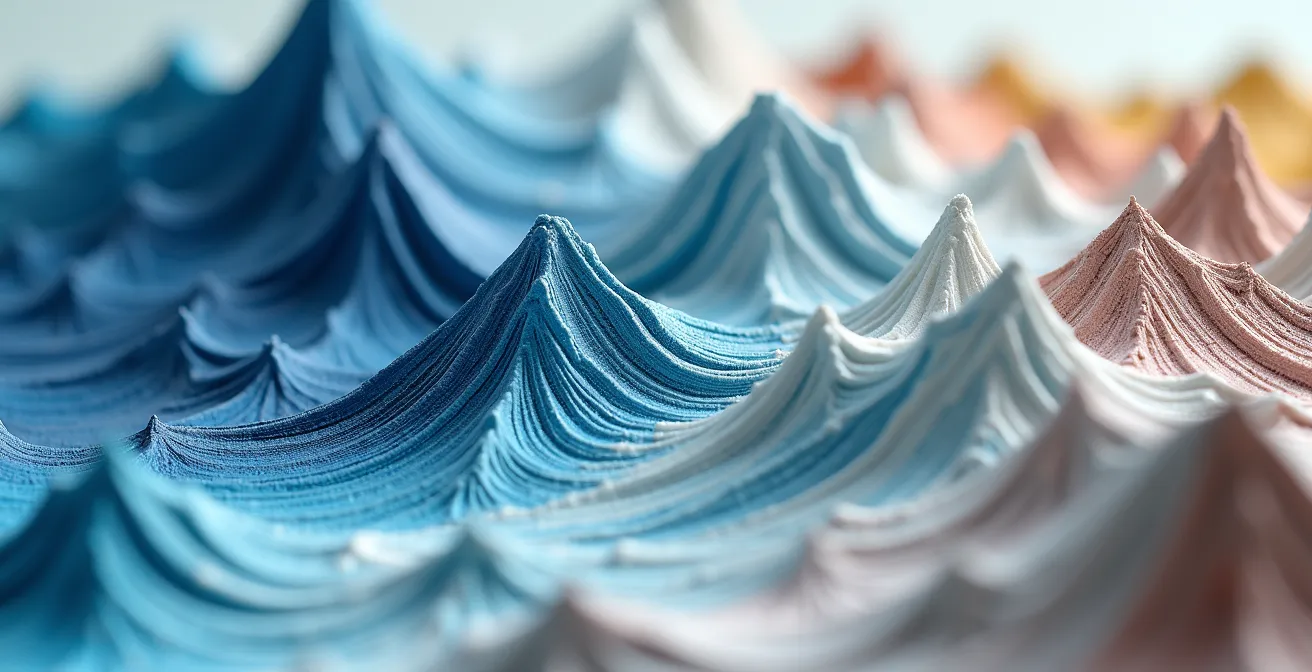
The preservation of a heavy impasto painting depends less on careful handling and more on a technical understanding of its material science, treating it as a fragile structure, not just a surface.
- Acrylic remains flexible, resisting vibration better, while oil becomes brittle over decades and is prone to cracking during transit.
- Heat from sunlight or even gallery lighting can cause thermoplastic acrylic peaks to slump, permanently altering the artwork’s texture.
- Standard insurance often voids claims due to “inherent vice”—the natural fragility of the medium itself—making specialist coverage essential.
Recommendation: Prioritise non-contact solutions for transport (floating crates) and display (shadow box frames), and always secure specialist, “nail-to-nail” insurance that acknowledges the artwork’s unique structural risks.
Owning a heavy impasto painting is a unique experience. The sculptural depth and dynamic texture offer a visual power that flat surfaces cannot match. Yet, this three-dimensional quality is also its greatest vulnerability. For the discerning collector, the joy of acquisition is often shadowed by a persistent logistical concern: how does one move, hang, or even dust this complex structure without causing irreparable harm? The common advice to simply “be careful” or use generic packaging like bubble wrap is not only inadequate; it is dangerous.
These conventional methods fail because they treat the artwork as a simple object. They ignore the complex physics at play within the layers of paint. The key to longevity for a sculptural painting lies not in common sense, but in material science. Understanding the fundamental differences in how oil and acrylic mediums cure, their thermal properties, and the forces they are subjected to is paramount. This is the perspective of an art registrar, where preservation is a technical discipline.
The true challenge is managing the artwork’s inherent vice—its natural propensity for self-destruction due to the materials from which it is made. But what if the solution wasn’t just about gentler handling, but about building an entire logistical framework around the specific vulnerabilities of your painting? This guide abandons platitudes and provides a technical roadmap for collectors. We will dissect the structural risks and outline the precise, professional-grade protocols required for hanging, cleaning, shipping, and framing these magnificent yet fragile works.
This article provides a structured approach to understanding and mitigating the risks associated with heavy impasto works. The following sections break down each critical aspect of care, from the wall it hangs on to the crate it travels in, ensuring you have the technical knowledge to protect your investment.
Summary: A Collector’s Technical Manual for 3D Painting Preservation
- Why Your Heavy Impasto Painting Might Need Reinforced Wall Anchors?
- How to Dust Deep Impasto Reliefs Without Snagging the Paint Peaks
- Acrylic or Oil: Which Heavy Impasto resist Cracking Better During Shipping?
- The Melting Point: Why Direct Sunlight Ruins Thermoplastic Acrylic Impasto
- How to Build a ‘Floating Crate’ so Packaging Never Touches the Surface
- How to Frame Impasto: The Shadow Box Method You Must Use
- Standard Courier vs. Art Specialist: Who Covers the Tear in the Canvas?
- Oil Glazing Mastery: Why Do Luminous Paintings Cost More Than Alla Prima Works?
Why Your Heavy Impasto Painting Might Need Reinforced Wall Anchors?
The first structural challenge for a heavy impasto work begins the moment it is hung. Unlike a standard canvas, a high-relief painting carries significant, unevenly distributed weight. This mass is not just a dead weight; it is an active force. Professional conservation guidelines demonstrate that a 20lb painting can exert significant shear stress on standard wall fixtures, pulling downwards and away from the wall simultaneously. Over time, this constant load, combined with micro-vibrations from foot traffic or closing doors, can cause standard drywall anchors to loosen or fail catastrophically.
The choice of mounting hardware cannot be arbitrary; it must be an engineered solution calculated to exceed the painting’s load requirements. For works exceeding 30 pounds, a French cleat system is the professional standard. This method distributes weight across a long horizontal rail, transforming the point-load shear stress into a more manageable and stable force. For lighter, yet still substantial works, multiple toggle bolts are a viable alternative, but each must be rated to handle the full weight of the piece independently to create redundancy.
Furthermore, the interface between the hardware and the artwork is critical. Direct metal-on-wood contact transmits vibrations directly into the painting’s brittle structure. To mitigate this, conservators often install thin neoprene or rubber washers between the hanging wire or D-rings and the frame. These washers act as tiny shock absorbers, dampening the transfer of environmental vibrations and reducing the cumulative stress on the paint film. This is not over-engineering; it is a fundamental requirement for the long-term structural integrity of the artwork.
How to Dust Deep Impasto Reliefs Without Snagging the Paint Peaks
Routine maintenance, such as dusting, presents a significant risk to high-relief surfaces. The delicate peaks and valleys that define the artwork’s character are also perfect traps for dust and airborne particles. Aggressive or improper cleaning methods can easily snag and break off brittle paint crests, causing irreversible damage. Wiping with a cloth is strictly forbidden, as it can abrade the surface and leave behind lint fibres.
A tiered, non-contact approach is required, escalating in intervention only when necessary. The first line of defence is always canned air. It should be held 6 to 8 inches from the surface and used at a 45-degree angle to gently blow dust out of crevices. It’s crucial to avoid spraying directly or too closely, as the propellant can cause thermal shock, leading to micro-cracks in the paint layer. This method should suffice for most regular maintenance.
This image demonstrates the precise technique required for more direct, yet still gentle, cleaning.
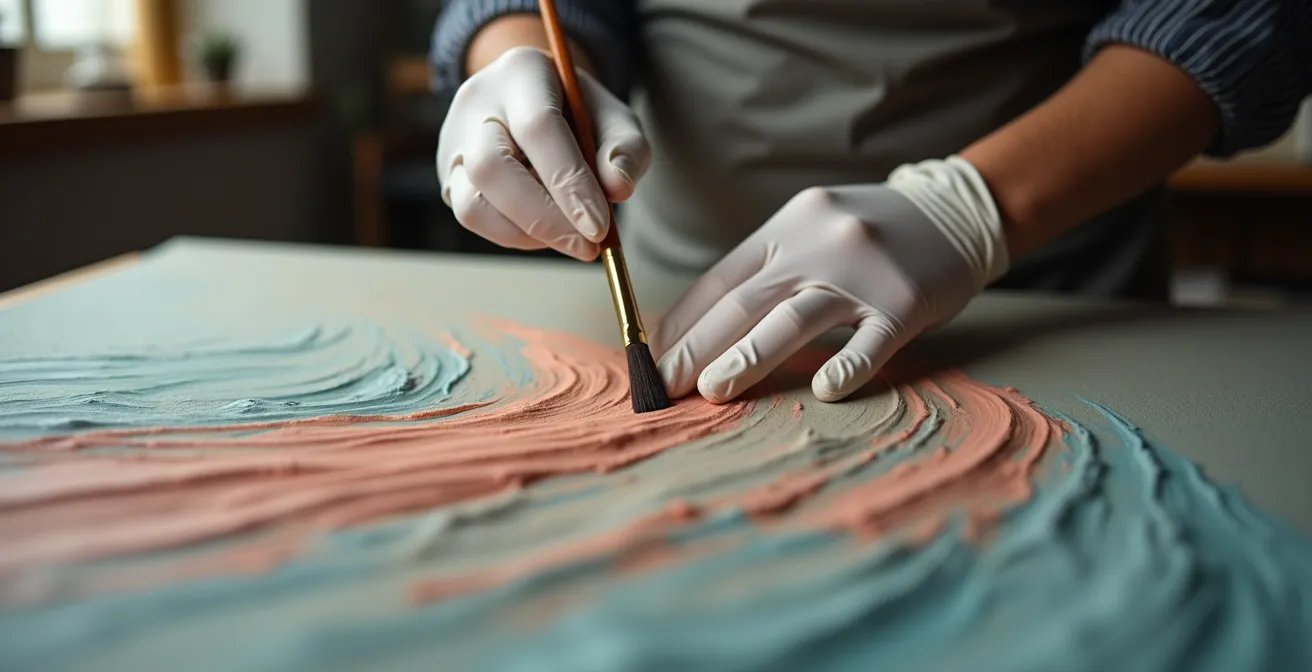
For more stubborn particles that compressed air cannot dislodge, a specialist tool is necessary. An ultra-soft, natural-bristle brush, such as a Japanese Hake brush made from goat hair, is the professional’s choice. The technique involves light, gentle sweeping motions that follow the “grain” of the paint strokes, never brushing across them. If a particle remains, the final resort is to gently dab—never wipe—the area with a clean, dry cosmetic sponge. This methodical and patient process ensures the surface is cleaned without compromising its fragile topography.
Acrylic or Oil: Which Heavy Impasto resist Cracking Better During Shipping?
The choice of medium is the single most important factor determining an impasto painting’s resilience to the stresses of transport. While both acrylic and oil can achieve thick, sculptural effects, their underlying chemical properties result in vastly different behaviours when subjected to vibration and temperature fluctuations. From a purely logistical standpoint, acrylic impasto is structurally superior for shipping.
Acrylic paint is a polymer emulsion that, when cured, remains relatively flexible. It can absorb minor shocks and vibrations far better than oil. Its cure time is also a major advantage, typically taking only a few weeks to fully harden. This stability means that a properly cured acrylic impasto is less likely to suffer from cracking or delamination during transit.
Oil paint, conversely, becomes increasingly brittle as it ages. The drying process, an oxidative polymerisation, is deceptive. While the surface may feel dry to the touch within months, conservation experts confirm it can take decades for a thick oil impasto layer to fully cure. During this time, the paint develops a dry, brittle “skin” over a still-malleable interior. This differential drying creates immense internal tension. When subjected to the vibrations of shipping, this tension can easily release in the form of catastrophic cracking or crazing.
The following table breaks down the key structural differences relevant to transport, as a comparative analysis of their properties reveals.
| Property | Acrylic Impasto | Oil Impasto |
|---|---|---|
| Flexibility when cured | Remains relatively flexible | Becomes increasingly brittle |
| Vibration resistance | Better absorption of shocks | Susceptible to shattering |
| Full cure time | 2-4 weeks | Years to decades |
| Delamination risk | Low with acrylic ground | Higher with improper ground |
The Melting Point: Why Direct Sunlight Ruins Thermoplastic Acrylic Impasto
While acrylics offer superior flexibility for shipping, they have a critical vulnerability that oils do not: heat. Acrylic paint is a thermoplastic polymer. This means it has a Glass Transition Temperature (Tg), a specific temperature at which the material transitions from a hard, glassy state to a soft, rubbery one. For most artist-grade acrylics, this Tg is around 48°C (118°F). When the ambient temperature approaches or exceeds this point, the paint can begin to soften, slump, and even become sticky.
Direct sunlight is the most obvious culprit. A painting hanging in a sunlit room can easily reach temperatures high enough to affect the paint’s stability, causing the highest peaks of the impasto to sag over time. This damage is subtle, cumulative, and irreversible. The risk is even greater during transport. Thermal testing shows that the interior of a vehicle or shipping container left in the sun can soar past this threshold quickly; in fact, car interior temperatures can exceed an acrylic’s Tg in under an hour, posing a severe risk to the artwork’s structural integrity.
Case Study: Heat Damage from Gallery Lighting
A museum case study revealed cumulative heat damage from track lighting positioned too close to acrylic impasto works. Over a period of six months, paintings displayed under halogen spots showed measurable slumping of paint peaks, with texture loss most pronounced in areas receiving direct light for over eight hours daily. The study led to revised gallery standards requiring a minimum distance of three feet between any heat-generating lights and dimensional artworks, and a shift towards cooler LED lighting solutions.
This vulnerability demands strict environmental controls. An acrylic impasto work should never be displayed in direct sunlight, near a heat source like a radiator, or lit with hot lamps such as halogens. During transit, climate-controlled vehicles are not a luxury but a necessity to prevent the artwork from reaching its glass transition temperature and suffering permanent deformation.
How to Build a ‘Floating Crate’ so Packaging Never Touches the Surface
For a heavy impasto painting, the greatest risk during transport is contact. Any packaging material that rests against the textured surface—be it bubble wrap, foam, or paper—can imprint, abrade, or fracture the delicate paint peaks. The professional solution is a custom-built “floating crate,” an enclosure engineered to suspend the artwork so that no part of the packaging ever touches its fragile face.
The principle is to secure the painting by its strongest part: the stretcher bars or frame. The construction involves building an internal “collar” or brace system within a larger, robust outer crate. The artwork is bolted to this internal collar via its rear braces, leaving a significant air gap—typically 2-4 inches—on all sides, including the front and back. This method ensures that any external impacts to the crate are absorbed by the crate’s structure and the air gap, not transferred to the painting’s surface.
This technical diagram shows a cross-section of a professionally constructed floating crate.
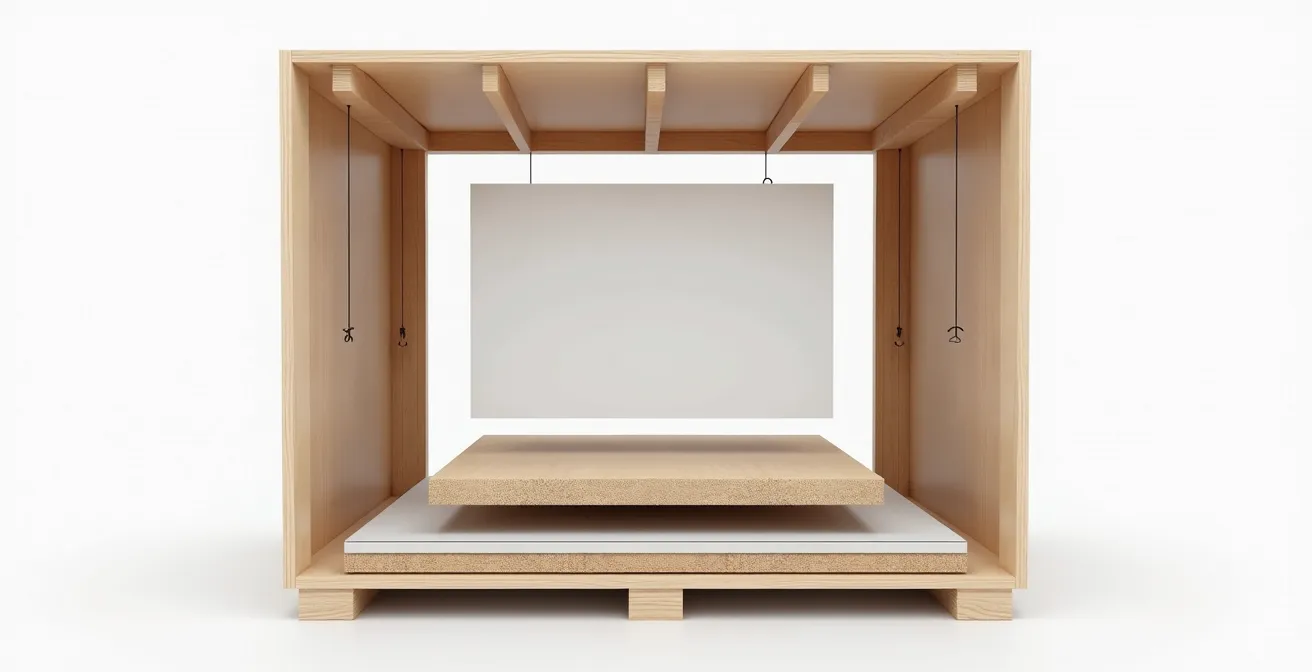
The crate’s interior is further engineered for protection. The walls are lined with high-density polyethylene for structural rigidity, followed by layers of polyurethane foam calibrated to the artwork’s weight for vibration dampening. This multi-layered approach isolates the artwork from both direct impact and the pervasive, high-frequency vibrations common in road and air freight. Building such a crate is a specialist task, but understanding its anatomy allows a collector to specify the correct requirements to an art handler and to recognize when a proposed shipping solution is inadequate.
How to Frame Impasto: The Shadow Box Method You Must Use
Framing an impasto painting serves two purposes: aesthetic presentation and physical protection. A standard frame that places glass or acrylic glazing directly against the artwork is not an option. Contact with the glazing will flatten the paint peaks and can lead to moisture buildup, mould growth, and the paint adhering to the glass over time. The only correct method is to use a shadow box frame.
A shadow box frame (or “floater frame” with a deep profile) creates a controlled air gap between the artwork and the glazing. This space is not just for visual effect; it creates a stable microclimate for the painting, buffering it from sudden ambient temperature and humidity changes. It is a protective barrier that prevents any physical contact with the fragile surface.
The depth of this air gap is a critical measurement. Framing professionals recommend a minimum of 2-3 inches between the highest peak of the impasto and the interior surface of the glazing. This generous spacing ensures that any flexing of the glazing or frame will not result in contact. It also allows for proper air circulation within the frame, preventing condensation.
The choice of glazing is also important. While glass is traditional, UV-filtering acrylic (Plexiglas) is often a better choice for impasto works. It is significantly lighter, which reduces the overall weight on the wall anchors, and it is shatterproof, eliminating a major risk during transport or in case of an accident. The UV filter is non-negotiable, as it protects the pigments—especially in oils and watercolours—from fading and degradation over time.
Standard Courier vs. Art Specialist: Who Covers the Tear in the Canvas?
When damage occurs during shipping, the difference between using a standard courier and a specialist art handler becomes painfully clear. A standard courier’s business model is built on volume and speed, not the delicate handling of unique, fragile items. Their insurance policies are notoriously restrictive and often contain exclusion clauses for “insufficient packaging” or, more critically, “inherent vice.”
Inherent vice is a term used to describe a quality within an object that makes it prone to deterioration or damage without any external cause. For an oil impasto painting, the brittle, slowly curing paint is a classic example. If it cracks due to normal transit vibrations, a standard carrier will almost certainly deny the claim, arguing that the artwork’s own nature, not their handling, was the cause. Furthermore, “declared value” is not insurance; it is merely a liability limit, and it is often voided by these same exclusion clauses.
A specialist art handler operates on a different model. They offer true, all-risk, “nail-to-nail” insurance. This coverage begins the moment the artwork is removed from the origin wall and ends only when it is securely installed at its destination. It covers all phases, including packing, transit, and unpacking, eliminating the coverage gaps and finger-pointing common with standard shipping. Most importantly, their policies are designed for art and do not contain the same “inherent vice” exclusions for conditions that are normal for the medium. To secure this coverage, however, the collector must provide unassailable proof of the artwork’s pre-shipment condition.
Action plan: Creating a Pre-Shipment Condition Report
- Overall & Detail Photography: Photograph the entire work in even, natural light. Then take high-resolution close-ups of all four corners, the signature, and any intricate areas.
- Texture Documentation: Take “raking light” photographs by shining a light from a low angle across the surface. This technique exaggerates the texture, creating a clear visual record of the 3D relief.
- Imperfection Mapping: Document any pre-existing imperfections, no matter how minor. Photograph them with a small, archival-safe ruler in the frame for scale reference.
- Written Report Creation: Compile a written condition report that includes the artwork’s precise measurements, a description of the medium and support, and a list of the documented imperfections.
- Secure Backup: Save all photographic files and the written report to a secure cloud-based storage service and share a copy with the art handler before the work is touched.
Key Takeaways
- Material Vulnerability is Key: The structural risk of an impasto painting is defined by its medium—flexible acrylics are vulnerable to heat, while brittle oils are susceptible to vibration and cracking.
- Environmental Control is Paramount: Preservation relies on managing the artwork’s environment, protecting it from direct sunlight, heat sources, and humidity fluctuations through proper placement and framing.
- Logistical Precision Overrides “Care”: Safe transport is not about gentle handling but about engineered, non-contact solutions like floating crates and securing specialist insurance that covers the medium’s inherent vice.
Oil Glazing Mastery: Why Do Luminous Paintings Cost More Than Alla Prima Works?
While the title of this section points to cost, the underlying reason for the value differential between a luminous, glazed painting and a thick, alla prima impasto work is deeply rooted in long-term structural stability and conservation risk. A heavily glazed painting is, from a material science perspective, a more robust and stable structure. It is built from multiple, thin, fully cured layers of paint and varnish. This creates a cross-linked, laminated structure that is highly resistant to cracking and environmental stress.
A heavy impasto work, particularly in oil, is the structural opposite. It consists of a single, exceptionally thick layer that dries differentially, creating a constant state of internal tension between the brittle outer skin and the more plastic interior. This inherent structural conflict is the primary reason for its long-term maintenance concerns. Repairing a crack in a glazed surface is a chemical challenge of matching colour and translucency; repairing a crack in impasto is a physical challenge of filling and re-sculpting lost texture, a far more invasive process.
A thick impasto layer dries from the outside in, creating tension that causes eventual cracking – a primary maintenance concern far lower in thin glazes
– Fine Art Tutorials Editorial Team, Impasto Painting Technique Guide
The higher cost often associated with masterfully glazed works reflects not just the significant time and skill required for their creation, but also their superior archival quality and lower projected conservation cost. The luminous depth is a by-product of a structurally sound method. Conversely, the bold immediacy of impasto comes at the price of inherent fragility, a factor that any serious collector must weigh and manage. The following table highlights the critical differences in long-term maintenance profiles.
| Aspect | Glazed Layers | Heavy Impasto |
|---|---|---|
| Structural stability | Cross-linked laminated structure | Single thick layer prone to differential drying |
| Cracking pattern | Minimal due to thin cured layers | Crazing from dry skin over liquid interior |
| Repair complexity | Chemical matching of translucency | Physical filling and texture matching |
| Conservation cost | Higher – requires specialized expertise | Moderate – structural repair possible |
Applying this technical, registrar-like mindset to every aspect of your collection’s care—from acquisition to display—is the final step in becoming a true custodian of the art you love. It transforms passive ownership into active preservation.
Frequently Asked Questions on Heavy Impasto Relief: How to Transport and Maintain 3D Paintings Without Cracking?
What is ‘nail-to-nail’ coverage and why is it essential?
Nail-to-nail coverage is a type of specialist art insurance that covers the artwork from the moment it is removed from the origin wall to the moment it is securely installed at the destination. It includes all phases of packing, transit, and unpacking. This is essential because it eliminates the coverage gaps and liability disputes that are common with standard shipping insurance, which may not cover damage that occurs during packing or unpacking.
How does ‘declared value’ differ from actual insurance?
Declared value is not insurance. It is a liability limit that a standard courier sets for a shipment. Crucially, this liability is often voided by fine print that cites “insufficient packaging” or “inherent vice.” True insurance from an art specialist, by contrast, is a separate policy designed to cover the actual financial loss of the artwork, regardless of a carrier’s assessment of the packaging, providing far more comprehensive protection.
What constitutes ‘inherent vice’ that voids standard coverage?
Inherent vice refers to the natural fragility or tendency of an object to deteriorate due to its own material composition. For a heavy impasto painting, the potential for thick paint to crack or delaminate during the normal vibrations of shipping is a classic example. Standard couriers use this concept to deny claims, arguing that the damage was caused by the artwork’s innate properties, not by their handling.