
The greatest challenge in immersive storytelling isn’t the technology, but the loss of the director’s frame. Instead of relinquishing control, successful creators master the art of invisible guidance. This guide explores how to use environmental narrative, sensory choreography, and curated agency to direct the viewer’s focus and emotion, transforming them from a passive observer into an active participant in a world they are free to explore, ensuring the story’s core is never missed.
For generations, storytellers have relied on a fundamental tool: the frame. The cinematographer’s lens, the theater’s proscenium arch, the comic book panel—all serve to direct the audience’s gaze, ensuring they see exactly what is needed, when it is needed. But what happens when that frame is shattered? When the audience is placed inside a 360-degree world, free to look anywhere at any time? This is the central, exhilarating challenge for writers and directors transitioning to virtual reality, augmented reality, and other interactive media.
The common advice often circles around technology and simplistic notions of interactivity. We’re told to “use VR for immersion” or to “give the user choices.” While true, this advice barely scratches the surface. It fails to address the core creative problem: how do you maintain narrative tension, guide emotion, and ensure critical plot points are seen without the power of the frame? The risk is a story that dissolves into a series of disconnected sights, where the viewer misses the forest for the trees.
But what if the key wasn’t to lament the loss of control, but to reinvent it? The true art of immersive storytelling lies in mastering a new grammar of direction—one based on subtle suggestion rather than overt command. It’s about learning the techniques of sensory choreography, where light and sound become your new camera angles. It’s about building worlds that tell their own stories through environmental narrative, embedding the past into the very walls and objects the viewer discovers. It’s about understanding that true agency is not about infinite endings, but about meaningful choices that deepen the emotional journey.
This article will deconstruct these advanced principles. We will move beyond the technological “what” to explore the narrative “how,” breaking down the strategies that allow you to guide the viewer’s experience with an invisible, yet deliberate, hand. You’ll learn to think less like a film director and more like an architect of worlds and a choreographer of attention.
To navigate this new landscape, we will explore the foundational principles and advanced techniques that define masterful immersive narratives. This guide is structured to build your skills progressively, from the macro-level of world design to the micro-details of interaction and sensory feedback.
Summary: A Creator’s Guide to Directing in a 360° World
- How to Make the Set Design Tell the Backstory Without Dialogue?
- How to Use Light and Sound Cues to Direct Eyes in a 360 Experience
- Observer or Hero: How Much Freedom Should You Give the Viewer?
- The Plot Hole Trap: Why Too Many Endings Dilute the Emotional Impact?
- Why Binaural Audio Is More Important Than 4K Graphics for Presence?
- How to Read the Hidden Story in the Juxtaposition of Collage Images?
- Why a Single Prop Can Change the Entire Narrative of a Conceptual Photo?
- VR Presence: How to Design Virtual Art That Feels Physically Real?
How to Make the Set Design Tell the Backstory Without Dialogue?
In immersive media, the environment is not a backdrop; it is a primary character and your most tireless narrator. When you can’t force the viewer to read a text scroll or watch an expository cutscene, you must bake the story into the world itself. This is the art of environmental storytelling, a technique that communicates history, character, and mood through the deliberate design of the space. It’s the difference between a sterile, generic room and a space that whispers secrets of its past inhabitants.
Think of the world as an archaeological site. A hastily abandoned meal suggests a sudden departure. A single child’s toy in an otherwise desolate landscape tells a story of loss more powerfully than any dialogue. The key is to use narrative decay—layers of dust, rust, overgrowth, and makeshift repairs that visually represent the passage of time and the events that have transpired. The very architecture can be a tool; the oppressive feeling of a low ceiling or the awe of a vast, empty hall are emotional cues you can deploy with purpose.
Case Study: Anor Londo in Dark Souls
The city of Anor Londo in the game Dark Souls is a masterclass in environmental narrative. The player arrives in a breathtakingly beautiful, sun-drenched city of the gods. However, the immense, echoing halls are eerily empty. The grand scale of the architecture, built for giants, makes the player feel small and insignificant. This contrast between majestic beauty and desolate emptiness tells a complete story without a single word of direct exposition: a magnificent kingdom has fallen, and you are a trespasser in its beautiful, decaying corpse. Every element reinforces the theme of lost grandeur.
By embedding clues and history into the set design, you reward the viewer’s natural curiosity. You aren’t telling them the story; you are giving them the tools to discover it for themselves. This creates a far deeper and more personal connection to the narrative, as the act of discovery feels earned and intimate.
How to Use Light and Sound Cues to Direct Eyes in a 360 Experience
With the frame gone, your new camera is the viewer’s own attention. Your job is to direct it. This is where the choreography of attention comes into play, using sensory cues to gently guide the viewer’s gaze towards points of interest. Human instinct is your greatest ally here. We are naturally drawn to light in darkness, to sudden sounds in silence, and to movement in a static scene. These primal responses are the tools you’ll use to paint with attention.
Think of light not just as illumination, but as a spotlight on a stage. A sudden glint in the corner of the viewer’s eye, a beam of light cutting through a dusty room to highlight a crucial object, or a flickering lamp that draws the gaze down a dark hallway are all directorial choices. They create a “visual-lead” that encourages the viewer to look in a specific direction without feeling forced. The goal is to make the discovery feel like the viewer’s own choice, even though you’ve subtly paved the way.
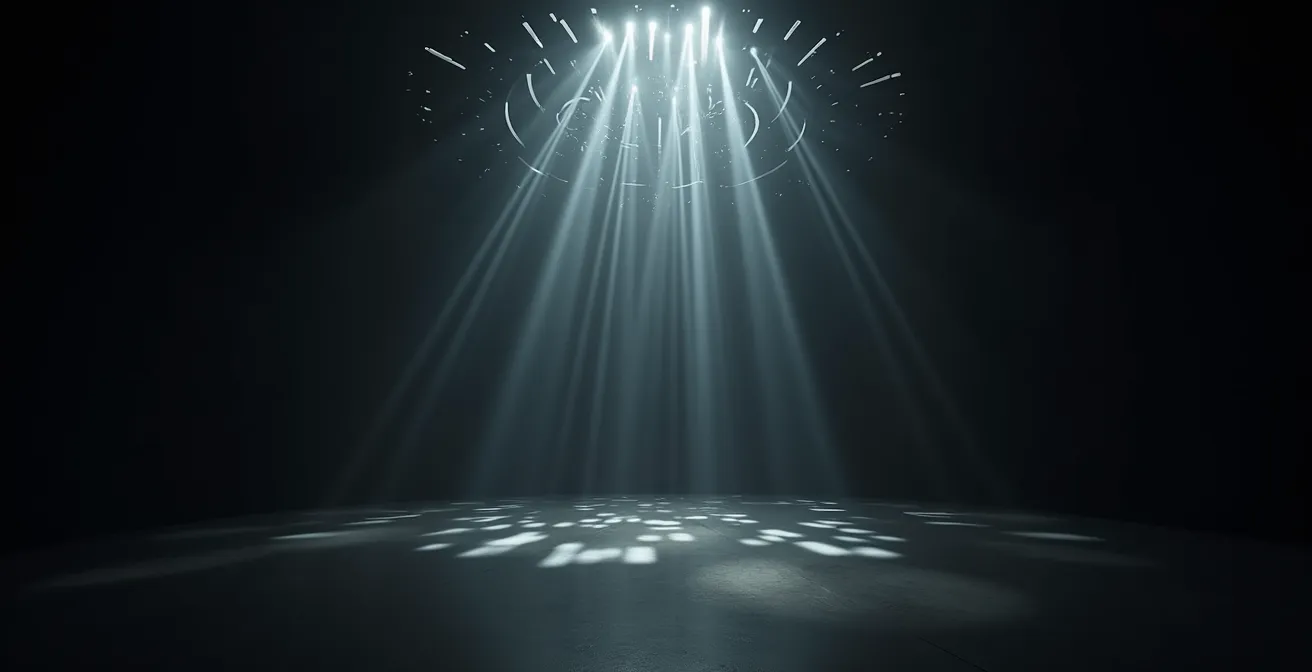
Sound is arguably even more powerful. Our ears can perceive a full 360-degree space, even when our eyes are focused forward. A twig snapping behind the viewer, a faint whisper from the left, or the distant hum of machinery are irresistible invitations to turn and look. As trends in live performance show, spatial audio and soundscaping are gaining significant traction for creating immersive atmospheres and guiding audiences. By placing sounds strategically in 3D space, you can create a clear “audio-lead” that not only directs attention but also builds world-realism and emotional tension.
Observer or Hero: How Much Freedom Should You Give the Viewer?
The question of “how much freedom” is central to designing any interactive experience. It’s not a simple binary choice but a spectrum of agency that has profound implications for the story you can tell. Giving the viewer a role is critical, but that role can range from a disembodied witness to a full-fledged protagonist who shapes the outcome. Choosing the right level of agency depends entirely on your narrative goals.
At one end of the spectrum is the Observer or Passenger model. In this mode, the viewer is present in the scene—they can look around freely—but they cannot influence events. They are a ghost, a “fly on the wall.” This model is exceptionally powerful for documentary and empathy-building experiences, where the goal is to bear witness to a reality without interfering with it. The lack of agency reinforces the authenticity of the events and focuses the viewer on absorbing the emotional and environmental context.
Case Study: ‘Clouds Over Sidra’ and Witnessing
In the landmark VR documentary Clouds Over Sidra, the viewer is placed within a Syrian refugee camp, experiencing daily life through the eyes of a 12-year-old girl named Sidra. You are in her classroom, at her family’s dinner table, and on the football pitch. You can look anywhere, but you cannot speak or interact. According to academic analysis of the experience, this carefully constrained agency creates a profound sense of presence and empathy by positioning the viewer as a privileged witness, balancing immersion with the ethical boundary of observing hardship without being able to intervene.
As you move along the spectrum, you introduce more interaction, from simple choices that alter narrative paths to complex systems where the viewer co-authors the story. Each level of agency requires a different narrative structure and carries different creative responsibilities. Understanding these models is the first step to making an informed choice.
| Agency Model | Description | Best Use Case |
|---|---|---|
| Observer/Passenger | Viewers can look around but cannot influence events | Documentary VR, historical recreations |
| Interactive Explorer | Users make choices that influence narrative paths | Branching narratives, choose-your-own-adventure |
| Vessel/Embodied | Viewers embody a character but don’t control major actions | Empathy-building experiences |
| Co-Author | Users actively shape story through meaningful interactions | Gaming narratives, collaborative storytelling |
The Plot Hole Trap: Why Too Many Endings Dilute the Emotional Impact?
The promise of “endless possibilities” in interactive narratives is a seductive one. The idea of creating a story with dozens of branches and multiple unique endings seems like the ultimate expression of viewer agency. However, this approach often falls into a critical trap: it prioritizes narrative divergence over emotional resonance. By spreading your creative energy across too many distinct paths, you risk creating a series of shallow, underdeveloped storylines instead of one powerful, resonant emotional arc.
Every narrative branch demands its own writing, design, and production resources. A story with ten endings may, in reality, be ten thinly sketched stories. The viewer, aware that their choices lead to just one of many outcomes, can feel that their journey lacks weight or consequence. The emotional climax of the story becomes diluted because it is not a singular, cathartic moment but one of several possibilities. This can lead to a feeling of “narrative FOMO” (Fear Of Missing Out), where the player is more concerned with seeing all the content than with feeling the impact of the path they are on.
The solution is not to eliminate choice, but to reframe its purpose. Instead of making choices that lead to fundamentally different endings, focus on choices that create meaningful variations in the journey toward a cohesive climax. The goal is a shared emotional destination, but a personalized path to get there. For instance, choices could determine the viewer’s relationship with another character, the tone of the ending (hopeful vs. cynical), or the personal sacrifices made along the way, all while the core narrative resolution remains intact. This approach ensures that every path feels complete and emotionally satisfying, as studies on immersive documentary journalism demonstrate that balancing viewer agency with guided storytelling is key for emotional engagement.
Ultimately, a powerful story is defined by its emotional core. Sacrificing that core for the sake of infinite branching is a poor trade. A story with one powerful ending, experienced through a dozen different emotional lenses, is often far more memorable than a story with a dozen forgettable endings.
Why Binaural Audio Is More Important Than 4K Graphics for Presence?
In the quest for immersion, creators often fixate on visual fidelity, chasing photorealistic graphics and ever-higher resolutions. While stunning visuals are valuable, they are only one piece of the puzzle. For creating a true sense of presence—the feeling of actually being in a virtual space—binaural audio is a far more powerful and efficient tool. Our brains are hardwired to build a mental map of our surroundings using sound, and realistic spatial audio taps directly into this primal system.
Binaural audio simulates how our two ears hear sound in the real world. By accounting for the tiny delays and frequency changes as sound waves travel around our head, it can place a sound source with uncanny precision in 3D space: above, below, behind, or next to us. When you hear a character whisper in your right ear, your brain doesn’t just register the sound; it feels their presence next to you. This creates a physiological response that high-resolution textures on a flat screen simply cannot replicate.

This sensory trick is the cornerstone of presence. The brain is more willing to accept a visually imperfect world if the audio landscape is perfectly convincing. A cartoony, stylized environment can feel incredibly real if the sound of rain patters realistically on the roof above you and a footstep crunches on gravel to your left. Conversely, a photorealistic world with flat, non-directional audio will always feel fake, like watching a movie rather than being in a place.
As a result, investing in high-quality sound design and binaural audio implementation often yields a greater return on immersion than pouring the same resources into marginal visual upgrades. As neuroscience-informed design shows, engaging multiple senses with coherent cues is what solidifies the brain’s belief that an experience is real. Sound is the fastest and most effective way to build that foundation of belief.
How to Read the Hidden Story in the Juxtaposition of Collage Images?
As immersive storytelling matures, creators are moving beyond literal representations of reality and exploring more abstract, poetic techniques. One of the most powerful is spatial collage, where principles of 2D collage art are applied to a 3D environment. This involves juxtaposing disparate images, objects, and even entire spaces to create a story through association and contrast, rather than linear plot.
In a spatial collage, a sterile, modern hallway might inexplicably open into an ancient, overgrown forest. A flock of paper cranes might fly through a photorealistic warzone. These jarring combinations break the rules of reality to communicate a deeper emotional or thematic truth. The story isn’t in the individual elements, but in the “spark” created between them. The hallway and forest together might speak of a character’s internal conflict between conformity and wildness. The cranes in the warzone could symbolize a desperate, fragile hope.
This technique is particularly well-suited for 360-degree experiences, where the viewer is literally inside the collage. The widespread adoption of 360-degree video on major platforms like YouTube and Facebook has given creators a massive audience to experiment with such advanced visual languages. You can design for discovery, creating arrangements that only reveal their true meaning from a specific vantage point—a technique known as forced perspective. Imagine a cloud of floating debris that, when viewed from the right spot, aligns perfectly to form a recognizable silhouette, revealing a hidden memory or symbol.
Reading these stories requires the viewer to become an active interpreter, connecting the dots and finding their own meaning in the visual poetry. For creators, it’s a way to tackle complex psychological themes and abstract concepts that would be difficult to convey through traditional narrative.
Action Plan: Auditing Your Spatial Collage
- Points of Contact: Identify all surfaces and volumes where collage elements can be placed (walls, floating spaces, interactive objects) to create narrative layers.
- Collection: Inventory existing assets (3D models, textures, sounds) that can be juxtaposed to create a specific emotional or thematic conflict.
- Coherence: Confront your juxtapositions with the core theme. Does placing a pristine object in a decaying room effectively communicate ‘a memory of the past’ or does it just look out of place?
- Memorability & Emotion: Evaluate key viewpoints. Do floating objects align from a specific angle (“Forced Perspective”) to reveal a hidden symbol or message that delivers an emotional punch?
- Integration Plan: Map out the viewer’s likely path and place “Interactive Narrative Assemblages” (collectible fragments of the story) along it to guide discovery and ensure the collage’s meaning is pieced together.
Why a Single Prop Can Change the Entire Narrative of a Conceptual Photo?
In the expansive canvas of an immersive world, it’s easy to overlook the power of the small. Yet, a single, well-placed prop can function as a narrative anchor, concentrating an enormous amount of story and meaning into one object. This is the principle of the narrative prop, an item that does more than just decorate a scene—it actively participates in the story. In immersive design, this concept evolves into the idea of “narrative affordance,” where a prop’s design and placement suggest its importance and invite interaction.
Think of it as an “immersive Chekhov’s Gun.” If you show a pristine, functional compass at the beginning of a survival story, you are making a promise. The viewer understands its purpose and potential. But the story is told in how that prop evolves. If, later in the narrative, the viewer finds that same compass, now cracked and useless, the object itself tells a story of struggle, failure, and lost direction. The prop becomes a physical timeline of the narrative.
Props can also serve as non-intrusive guides and storytellers. As explained in analyses of environmental storytelling in game design, a discarded tool can hint at a puzzle’s solution, or an object unique to a specific character can signify their presence in a scene long after they have left. These objects reward attentive viewers by offering deeper layers of context and world-building. They make the world feel lived-in and coherent, where every element has a potential purpose and history.
The most advanced narrative props are interactive. A music box that plays a haunting tune when opened, a diary that reveals different entries depending on where it’s read, or a key that doesn’t just open a door but transforms the world outside—these objects turn the viewer from an observer into a participant. They are not just looking at the story; they are touching it, manipulating it, and unlocking its secrets through direct interaction with its most meaningful artifacts.
Key Takeaways
- The World is the Story: In immersive narratives, the environment is your primary tool for exposition and backstory. Use narrative decay and spatial design to make the set a character in itself.
- Direct with Senses, Not a Camera: Master the choreography of attention by using light and spatial audio as subtle cues to guide the viewer’s gaze and build a sense of presence more effectively than graphics alone.
- Curate Agency for Emotional Impact: True viewer agency isn’t about infinite endings. It’s about providing meaningful choices that personalize the emotional journey toward a coherent and powerful narrative conclusion.
VR Presence: How to Design Virtual Art That Feels Physically Real?
Ultimately, the goal of all these techniques—environmental storytelling, sensory choreography, curated agency—is to achieve presence. Presence is the holy grail of VR: the visceral, unshakable feeling that you are truly there. It’s the moment the viewer’s brain stops simulating and starts believing. Achieving this state has less to do with photorealistic graphics and more to do with creating a world that is interactively and sensorially plausible.
The brain’s belief system is built on a foundation of coherent sensory feedback. A world feels real when your interactions with it produce expected results. If you drop an object, it should fall with believable weight and make a sound consistent with its material. If you touch a surface, a corresponding haptic buzz can sell the illusion of texture. This interaction plausibility is far more critical to presence than visual fidelity. A world that looks real but feels dead will always shatter immersion.
This is why designing for presence requires a holistic, multi-sensory approach. You must consider how all the elements work together to create a believable reality. The physics of movement, the feedback of haptics, and the positioning of audio are not separate disciplines; they are all part of the same conversation you are having with the viewer’s subconscious brain.
The following table breaks down the difference between a purely visual approach and a more effective, interaction-focused approach to creating presence.
| Factor | Visual Fidelity Approach | Interaction Plausibility Approach | Impact on Presence |
|---|---|---|---|
| Physics | Photorealistic rendering | Believable weight and collision | Higher with interaction |
| Haptics | Visual texture detail | Tactile feedback patterns | Critical for embodiment |
| Movement | Smooth animations | Proprioceptive actions required | Physical actions embed memory |
| Audio | High-quality recordings | Spatial 3D positioning | Essential for believability |
By focusing on making the virtual world feel physically real and responsive, you create a powerful and lasting sense of presence. This is the foundation upon which all truly great immersive stories are built. It transforms a technological showcase into a place where a viewer can have a genuine experience.
Begin integrating these principles of sensory choreography and environmental narrative into your next project to move beyond passive viewing and start creating truly present, emotionally resonant experiences.