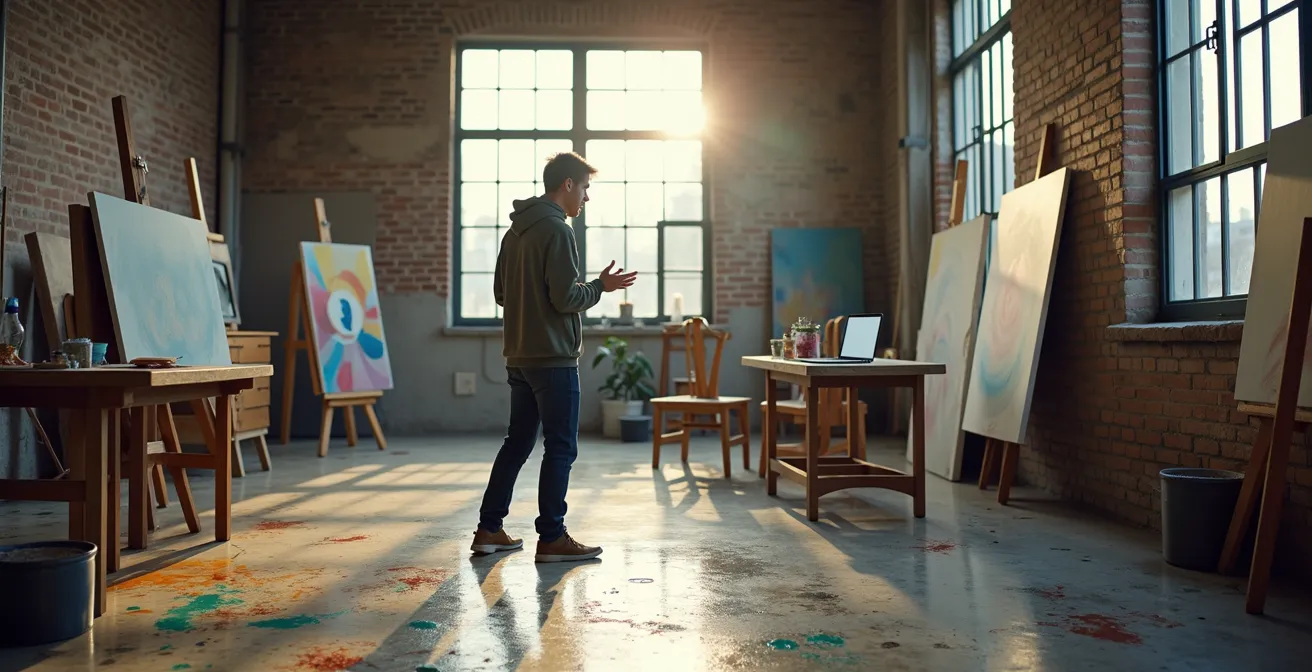
Contrary to the belief that virtual access is just a convenient substitute for a gallery visit, it’s actually a strategic tool that fundamentally reshapes an artwork’s value by granting collectors direct participation in its story.
- Direct studio access creates “intangible provenance”—a verifiable record of the creative process that enhances an artwork’s narrative and authenticity.
- Asking the right questions during a virtual tour allows a collector to perform “curatorial forensics,” assessing an artwork’s long-term value beyond its aesthetic appeal.
Recommendation: Shift your mindset from being a passive buyer to an active documentarian. Use virtual tours not just to see the art, but to understand and record its creation, making you a part of its history.
The world of art collecting has long been governed by a certain mystique. The artist’s studio, a sanctuary of creation, remained a space accessible only to a select few, while the gallery acted as the grand stage where finished works were presented to the world. For the curious collector, the story of a piece often began at its exhibition, with its history before that moment pieced together from certificates and catalogs. This traditional model provided structure and a clear, if sometimes opaque, path to valuation. The gallery buffered, the critic reviewed, and the auction house solidified an artwork’s place in the market.
Then, the digital world dissolved the studio walls. What began as a necessity has evolved into a revolutionary practice. The virtual studio visit is no longer a simple video call; it’s a portal. It offers collectors an unprecedented, intimate view into the artist’s process, workspace, and vision. But what does this really mean for the value of art? Many assume it’s simply about convenience, but that perspective misses the seismic shift occurring. The true change isn’t about seeing the art on a screen; it’s about understanding its soul before it ever meets a gallery wall.
This isn’t about replacing the gallery system but augmenting it with a new, powerful layer of insight. If the core of an artwork’s enduring value lies in its story, then virtual access gives the collector a pen to help write the first chapter. This guide explores how to wield that pen. We will deconstruct how this direct access creates a new form of provenance, how to navigate these digital encounters to unearth true value, and how to identify the signals that separate a fleeting sketch from a future masterpiece.
This article provides a complete framework for the modern collector, moving from the foundational principles of direct-from-studio value to the practical strategies for identifying the next generation of blue-chip artists. The following sections will guide you through this new landscape.
Summary: A New Framework for Art Collection in the Digital Age
- Why Works Bought Straight from the Studio Carry a Different Provenance Value?
- How to Ask the Right Questions During a 15-Minute Virtual Studio Tour
- Direct Relation or Gallery Buffer: Which Suits Your Collecting Style Better?
- The ‘Studio Sale’ Risk: Buying Sketches That Never Increase in Value
- When to Approach an Artist for a Commission: The Seasonal Sweet Spot
- Why a Solo Museum Show Increases a Painter’s Price by 40% Overnight?
- Hours in the Darkroom or Clicks on a Mouse: Which Process Adds More Value?
- Contemporary Painters: How to Identify Future Blue-Chip Artists Before They Blow Up?
Why Works Bought Straight from the Studio Carry a Different Provenance Value?
Provenance has always been the backbone of art valuation—a paper trail of ownership that guarantees authenticity and traces a work’s journey through time. However, this traditional system is fraught with peril; it can be forged, lost, or incomplete. The direct-from-studio purchase, supercharged by virtual access, introduces a powerful new concept: intangible provenance. This isn’t just a certificate; it’s the living, breathing story of creation, captured and verified at its source. When you buy a piece directly after a virtual visit, you’re not just acquiring an object; you are acquiring its documented genesis.
This captured history—the artist explaining a breakthrough, the camera panning across preparatory sketches, the confirmation of materials—becomes an immutable part of the work’s identity. It builds a valuation narrative that is far more compelling and secure than a simple signature. In a market where authenticity is paramount, this digital-first provenance acts as a powerful shield against doubt and fraud. Major institutions are already recognizing this shift, integrating technology to make provenance more transparent and secure than ever before.
Case Study: Christie’s and the Blockchain Passport
As a testament to this change, Christie’s auction house has embraced blockchain technology to secure provenance. Sebastian Sanchez, their manager of digital art sales, explains that this provides unprecedented transparency. The auction house now offers digital certificates of ownership that act like passports for artworks, guaranteeing their history and authenticity indefinitely. This move from a legacy institution signals a market-wide validation of digitally native provenance, a trend born from the intimacy of direct-to-collector interactions.
For a collector, this means a work acquired directly from the studio carries a unique layer of value. It has a story that can be retold, re-verified, and relived—a story you were a part of from the beginning. This form of provenance is not just a document; it’s a competitive advantage in the secondary market.
How to Ask the Right Questions During a 15-Minute Virtual Studio Tour
A 15-minute virtual studio tour is a condensed, high-stakes opportunity. It’s easy to fall into the trap of polite pleasantries or generic questions about “inspiration.” To transform this brief window into a powerful valuation tool, a collector must adopt the mindset of a documentarian performing curatorial forensics. Your goal is not just to see the work but to understand its DNA. The intimacy of the virtual format, when leveraged correctly, can yield profound insights.
There’s a certain level of intimacy that I’ve experienced during virtual studio visits and critiques that I haven’t felt during in-person tours or conversations. I can’t pin down why, exactly, but the conversations have seemed more genuine.
– Luján Pérez Hernández, Artsy Interview on Virtual Studio Practices
This genuine connection is unlocked by asking questions that go beyond the surface. Instead of asking what a piece *means*, ask what *problem* the artist was trying to solve. This shifts the conversation from subjective interpretation to objective process, revealing the intellectual and technical labor invested in the work. It’s in these details—the struggle with a pigment, the discovery of a new technique—that the true story and value emerge.

As the image above suggests, focusing on the tactile process of creation can open up a deeper dialogue. By observing the materials and asking about their specific properties and challenges, you gain insight into the artist’s mastery and the artwork’s physical integrity. This requires a structured approach to questioning, designed to extract the most critical information in a short amount of time.
Your Action Plan: The Strategic Virtual Visit Question Framework
- Curator Lens: Ask about the work’s position within the artist’s broader oeuvre. “How does this series connect to or depart from your previous one?” This helps you map its importance in their career trajectory.
- Conservator Lens: Inquire about materials and longevity. “What specific materials did you use, and are there any special considerations for its long-term care?” This assesses physical risk and future costs.
- Collector Lens: Discuss market mechanics. “Is this part of a limited series? What are the edition sizes? Do you have any upcoming gallery shows?” This clarifies scarcity and future validation points.
- Process-Oriented Questions: Focus on the “how.” “What was the biggest technical challenge you overcame in this piece?” This uncovers the hidden labor and innovation.
- Meta-Questions: Ask about their presentation strategy. “How has showing your work virtually changed how you think about it?” This reveals their professional and market awareness.
Direct Relation or Gallery Buffer: Which Suits Your Collecting Style Better?
The rise of virtual access has presented collectors with a fundamental choice: engage directly with artists or continue to rely on the curated guidance and security of a gallery. There is no single right answer; the optimal path depends entirely on your personality, risk tolerance, and collecting goals. Understanding your own profile is the key to navigating this new market structure effectively. The “Pathfinder” thrives on discovery and personal connection, while the “Validator” seeks the assurance and market consensus that established galleries provide.
The direct relationship offers unparalleled intimacy and the potential for acquiring works at ground-floor prices. It’s a high-engagement, high-reward strategy built on relational equity—the value derived from the personal bond with the creator. However, it also demands more research, due diligence, and confidence from the collector. The gallery, in contrast, serves as a filter. It provides a buffer by vetting artists, contextualizing their work within the broader art historical narrative, and handling the logistical and financial complexities of the transaction. This path offers security and convenience at the cost of the direct, personal narrative.
Recent market data highlights a growing divergence in these approaches, showing a significant rise in collectors comfortable with a more direct or hybrid model. The following matrix, based on recent collector surveys, can help you identify your dominant style.
This analysis, inspired by collector segmentation in reports like the UBS Global Art Market Report, helps frame the decision.
| Collector Type | Risk Tolerance | Preferred Channel | 2024 Market Share |
|---|---|---|---|
| Pathfinder | High | Direct from Artist | 22% (doubled from 2023) |
| Validator | Medium | Gallery/Dealer | 58% |
| Strategist | Low-Medium | Hybrid Model | 20% |
Ultimately, the choice is not a binary one. Many “Strategist” collectors now use virtual visits to build a relationship and gain narrative insight, while finalizing the purchase through a gallery to benefit from its institutional backing. The key is to consciously choose your approach rather than defaulting to old habits.
The ‘Studio Sale’ Risk: Buying Sketches That Never Increase in Value
One of the most alluring aspects of direct studio access is the chance to acquire preparatory works—sketches, studies, and drafts that offer a window into the artist’s mind. These pieces can feel incredibly intimate and are often more affordable than finished works. However, this is also where the biggest financial risk lies. Not all preparatory works are created equal. Many are simply ephemeral exercises, dead-end explorations that hold deep meaning for the artist but possess minimal long-term investment value.
The challenge for the collector is to distinguish a pivotal “conceptual sketch” from a mere “practice draft.” The former documents the genesis of a major series and can see its value grow in tandem with the final works. The latter is often a technical warm-up, destined to remain a footnote. As provenance expert MaryKate Cleary points out, the research required to make this distinction can be intense and requires a sharp, analytical eye.
Provenance research is often a very labor-intensive process – researchers comb through libraries, archives, and scores of documents which are rarely digitized, so you need human analysis.
– MaryKate Cleary, ARTnews on Art Authentication
Without the curatorial guidance of a gallery, the onus is on the collector to perform this analysis. A virtual visit is the perfect opportunity to do this, by asking the artist to contextualize the sketch within their broader body of work. Is it connected to a celebrated series, or was it part of an abandoned idea? Verifying its centrality to the artist’s main portfolio is crucial. To avoid the “studio sale” trap, you must evaluate these works with the rigor of an archivist, using a clear taxonomy.
- Conceptual Sketches: These document the birth of an important idea or series. They have the highest potential for value retention as they are intrinsically linked to the artist’s celebrated output.
- Technical Studies: These demonstrate mastery of a specific skill or medium, often related to a complex finished piece. They hold medium value, especially if the final work is significant.
- Practice Drafts: These are ephemeral exercises, often repetitive and lacking a direct link to a major work. They carry significant personal insight but minimal investment value.
When to Approach an Artist for a Commission: The Seasonal Sweet Spot
Beyond acquiring existing work, direct access opens the door to the ultimate collaborative act: commissioning a new piece. This is a chance to have your own story intertwined with the artist’s creation. However, timing is everything. Approaching an artist at the wrong moment—when they are deep in preparation for a major show or creatively exhausted after one—can lead to a rushed process or a polite refusal. There is a “seasonal sweet spot” for commissions, a period of creative openness and practical availability that the savvy collector can learn to identify.
This sweet spot often falls in the quiet periods between major projects. It’s a time of reflection and experimentation for the artist, when they are most open to new ideas and collaborations. The studio is not a factory with a constant production line; it operates in cycles of intense focus, exhibition, and fallow reflection. The empty studio, bathed in morning light, is not a sign of inactivity but of potential—the perfect moment for a new idea to take root.
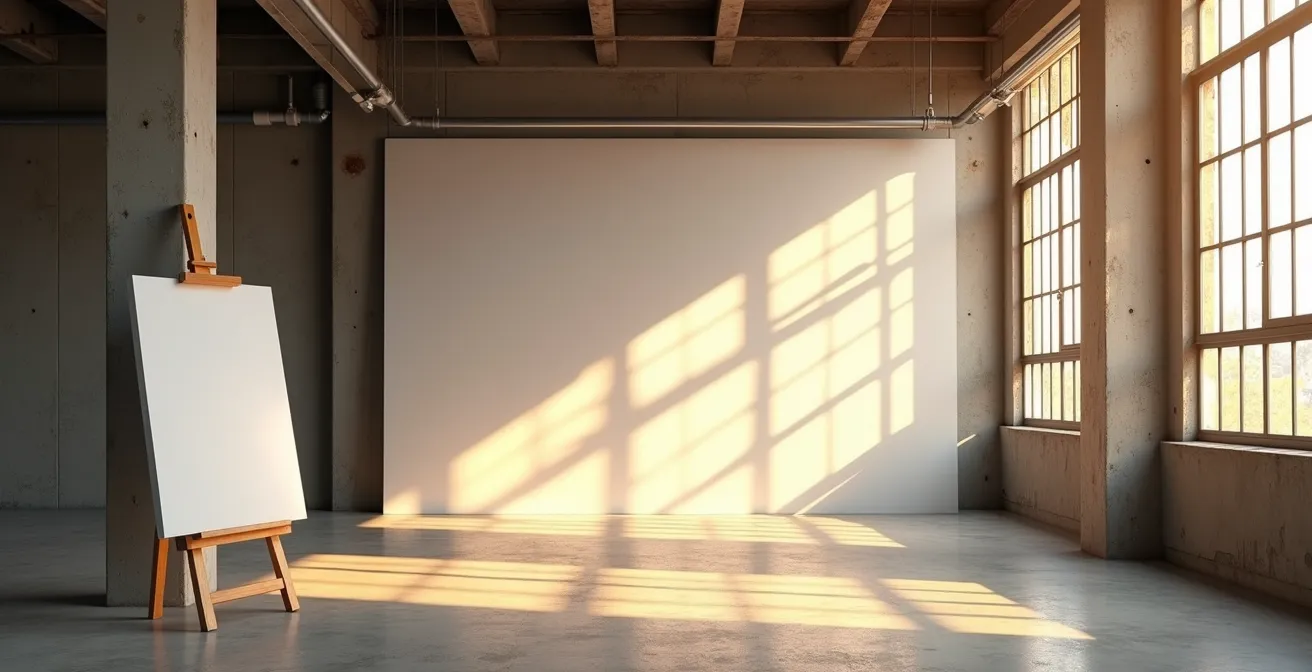
In the past, identifying these moments required insider knowledge. Today, artists are increasingly transparent about their creative cycles, using social media and newsletters as digital breadcrumbs. By following an artist’s online presence, you can learn to read the signs and understand their workflow, making your approach both timely and welcome.
Case Study: Reading the Digital Buying Signals
Industry reports note a significant shift in how artists manage their careers. Many young artists are now “very active participants in their own careers,” leveraging digital platforms to communicate directly with their audience. They might post about “clearing the studio for a new series” or “a period of research and drawing.” These are not just casual updates; they are buying signals. For a collector, these posts are an open invitation to start a conversation about a potential commission, indicating that the artist is in a receptive creative and mental space for a new project.
Why a Solo Museum Show Increases a Painter’s Price by 40% Overnight?
While direct studio access provides an intimate, micro-level view of value, the macro forces of the art market remain powerfully influential. Among the most significant of these is institutional validation, and its pinnacle is the solo museum exhibition. When a museum dedicates its space to a single artist, it sends an unequivocal signal to the market: this work is historically important. This act of curatorial consecration has a dramatic and near-instantaneous impact on an artist’s prices, with data confirming a significant leap in value.
This isn’t magic; it’s a convergence of powerful market mechanics. The museum’s stamp of approval provides a level of credibility that no gallery or private collector can match, creating a surge in market confidence. This effect is quantifiable, with research showing that such an event can trigger a massive price adjustment. According to market data, a solo museum show can lead to an average 40% price increase for an artist’s work at auction in the following months. This phenomenon is driven by several key factors:
- Institutional Validation: Curatorial approval from a respected museum solidifies an artist’s position in the art historical canon, erasing doubts about their long-term relevance.
- Induced Scarcity: During the exhibition, the artist’s best works are off the market, creating pent-up demand among collectors.
- Media Amplification: Critical reviews and media coverage expand the artist’s audience and deepen their narrative, attracting a new and wider base of collectors.
- Academic Legitimacy: Inclusion in a museum catalog and academic discourse cements the artist’s work as a subject of serious study, adding another layer of enduring value.
Case Study: The Sustained Power of Jean-Michel Basquiat
The market trajectory of Jean-Michel Basquiat serves as a powerful example of this principle. Years of institutional validation through major museum retrospectives have cemented his blue-chip status. In 2024, his work dominated the contemporary market, accounting for 12% of all sales. This consistent, high-level demand is not just a product of his genius but a direct result of sustained institutional belief in his importance, creating a feedback loop where museum shows fuel collector confidence and drive record-breaking prices.
Hours in the Darkroom or Clicks on a Mouse: Which Process Adds More Value?
The debate between analog and digital processes is as old as the first pixel. In the art world, it often crystallizes into a question of value: does the painstaking labor of a traditional craft, like hours spent in a photographic darkroom, inherently create more value than the fluid efficiency of digital tools? For a long time, the answer leaned towards the tangible, the handmade, the visibly laborious. There was a romanticism tied to the scent of turpentine or the chemical alchemy of film development—a belief that “time spent” equated to “value created.”
However, virtual access and the rise of digitally native art are challenging this paradigm. The collector’s focus is shifting from the *duration* of the process to the *uniqueness and verifiability* of the final product. A digital artist can produce countless iterations, but the blockchain can prove that only one is the “original.” The value is no longer solely in the physical effort but in the conceptual rigor and the provable scarcity of the idea. The conversation has moved from “how long did it take?” to “how innovative is the concept and how can we be sure it’s the authentic one?”
The art market is responding to this shift with force. While traditional media continue to command immense respect and value, the digital art sector is experiencing explosive growth, demonstrating that collectors are increasingly comfortable assigning high value to works born from code and clicks. Projections show that the digital artwork market is projected to reach $39.40 billion by 2032, a clear indicator that the perceived value gap between analog and digital is closing. This growth is largely fueled by technologies that solve the core problem of digital ownership and authenticity.
Ultimately, the medium is becoming secondary to the message and its verifiable singularity. Whether an artist spends 100 hours in a darkroom or 100 hours coding an algorithm, the questions for the modern collector remain the same: Is the work groundbreaking? Does it advance a unique vision? And is its authenticity beyond question? The process is part of the story, but it is no longer the sole determinant of its value.
Key Takeaways
- Virtual access provides more than convenience; it creates “intangible provenance” by documenting an artwork’s creation story directly from the source.
- The value of a preparatory work (like a sketch) is not guaranteed; it depends on its connection to the artist’s major, celebrated works.
- Institutional validation, especially a solo museum show, remains one of the most powerful external drivers of an artist’s market value, often causing a significant and rapid price increase.
Contemporary Painters: How to Identify Future Blue-Chip Artists Before They Blow Up?
For many collectors, the ultimate goal is to identify a future blue-chip artist before they achieve widespread fame—to acquire a seminal work not just for its beauty, but as a prescient investment. This requires a synthesis of all the skills discussed so far: the intimate knowledge gained from studio visits, the analytical rigor of assessing market signals, and an understanding of the macro forces of validation. Identifying emerging talent is not a dark art; it is a discipline that relies on spotting a confluence of specific, data-driven indicators.
A future blue-chip artist typically demonstrates a combination of strong market entry, consistent price growth, and growing institutional support. A debut at a major auction with a high sell-through rate, for example, is a powerful early signal. This indicates that there is already a competitive demand for their work among discerning collectors. This initial spark must then be fanned by consistent validation from galleries and, most importantly, museums. An acquisition by a respected institution is perhaps the strongest signal of all, as it places the artist within a historical context and signals long-term relevance.
This matrix, based on an analysis of recent art market trends, outlines the key signals to monitor.
| Indicator Type | Strong Signal | 2024 Data Point |
|---|---|---|
| Market Entry | Major Auction Debut | 1,343 new artists (96.5% sell-through) |
| Price Performance | YoY Growth >20% | Keith Haring: +22% ($39.1M total) |
| Institutional Support | Museum Acquisition | 66% collectors buying newly discovered artists |
| Gallery Trajectory | Multi-representation | Joint representation increasingly common |
Furthermore, global market dynamics can create new hotspots for talent. The strategic expansion of major auction houses into emerging markets creates fresh opportunities for discovering artists who are established locally but are new to the international stage.
Case Study: New Markets as Talent Incubators
The art market’s recent focus on the Middle East illustrates this perfectly. Sotheby’s recent expansion into the region, including hosting Saudi Arabia’s first international art sale, is unearthing a new generation of artists. For collectors, these developing markets are fertile ground for identifying future blue-chip talent before they are fully integrated into the mainstream Western auction circuit, offering a significant first-mover advantage.
By combining direct artist engagement with a disciplined analysis of these market signals, you can move beyond simply collecting art to actively shaping a collection of lasting cultural and financial significance. The next step is to begin applying this framework to your own collecting practice.