
Preserving charcoal art goes far beyond common advice; true stewardship requires understanding the physics of its fragility.
- The medium’s inherent weakness stems from microscopic forces, making every touch a potential act of erasure.
- Standard framing with acrylic can actively destroy a charcoal drawing through static electricity, lifting the pigment from the paper.
Recommendation: Adopt a conservator’s mindset by choosing materials and methods that actively counteract the physical risks, from anti-static glazing to specific lighting angles, to protect both the artwork and its value.
To stand before a masterfully executed charcoal drawing is to experience a unique form of artistic power. The velvety, abyssal blacks and subtle, smoky greys create a drama and an emotional depth that few other media can replicate. Yet, for the collector, this profound beauty is tethered to a constant, quiet anxiety. The very quality that gives charcoal its soul—loose particles of carbon resting delicately on paper—is also the source of its profound fragility. It is, in essence, structured dust, an artwork perpetually on the verge of disappearing.
The common wisdom for protection often involves a can of fixative spray or a standard picture frame. These are well-intentioned but dangerously incomplete solutions. A conservator knows that such interventions can be irreversible, potentially altering the artwork’s finish, darkening the light passages, or yellowing over time. Simply framing a piece without considering the specific physics at play can lead to irreparable damage. The stewardship of a charcoal drawing is not about sealing it away; it is a more delicate and informed practice.
The true key to preserving this medium lies not in a single product, but in a holistic understanding of the forces that threaten it. This is not just about preventing smudges; it’s about mastering the subtle physics of dust, light, and electricity. What if the real secret to preservation was not to fight the charcoal’s nature, but to create a perfectly controlled environment where its fragility is no longer a liability? This requires a shift in mindset from owner to custodian, armed with the precise knowledge to make informed, museum-grade choices.
This guide will walk you through the critical considerations for safeguarding your charcoal artworks. We will dissect the science behind their vulnerability and provide a clear, methodical approach to transport, framing, lighting, and long-term care, ensuring the dramatic power of your collection endures for generations.
Summary: A Conservator’s Framework for Charcoal Artwork Preservation
- Why Unfixed Charcoal Smudges at the Slightest Touch and How to Check It?
- How to Move a Charcoal Drawing Without Losing 10% of the Pigment
- Deep Black or Metallic Grey: Which Medium Creates More Drama in a Portrait?
- The Static Electricity Risk: Why Plexiglass Can Destroy Your Charcoal Drawing
- How to Light Charcoal Art so the Blacks Don’t Look Grey or Washed Out
- Paper or Bristol Board: Which Support Prevents Warping Over Decades?
- The Buckling Problem: Why Your Ink Wash Art Looks Wavy in the Frame
- Graphite Mastery: Why Are Hyper-Realistic Pencil Drawings Surging in Value?
Why Unfixed Charcoal Smudges at the Slightest Touch and How to Check It?
The exquisite vulnerability of a charcoal drawing is not a matter of opinion; it is a principle of physics. Unlike paint or ink, which chemically or physically bind to their support, charcoal particles are simply resting on the paper’s surface. They are held in place by one of the weakest interactions in nature: the Van der Waals force. As a conservator, my first duty is to respect this inherent fragility. The physical bond is so tenuous that even the slightest vibration, air current, or touch can dislodge thousands of particles, resulting in a smudge or a catastrophic loss of detail.
Indeed, a conservator’s perspective is that an unfixed charcoal drawing is in a constant state of risk. As the Artphiloso Gallery notes in its conservation guide:
Its very nature – loose, powdery particles held lightly to a surface – makes it exceptionally vulnerable.
– Artphiloso Gallery, Art Conservation Guide
This vulnerability is quantifiable. Scientific research shows that Van der Waals forces holding charcoal particles are extremely weak at 0.06-0.44 kJ/mol, orders of magnitude weaker than a true chemical bond. To check for stability without touching the surface, a conservator might gently tap the back of the framed artwork. If a fine black dust, known as “fall-out,” is visible at the bottom of the mat, it is a clear sign that the drawing is shedding pigment and requires immediate attention to its housing and handling protocols. Any attempt to “clean” the surface of a drawing yourself is strictly forbidden; this is a delicate procedure reserved exclusively for trained professionals.
How to Move a Charcoal Drawing Without Losing 10% of the Pigment
Transporting a charcoal artwork is perhaps the moment of greatest peril. Every bump, vibration, and shift in orientation threatens to dislodge the loosely bound pigment. A collector cannot simply wrap it in bubble wrap and hope for the best. A methodical, museum-standard approach is required to create a “no-contact” travel environment. The primary goal is to build a structure that entirely prevents any material from touching the artwork’s surface while securing it against movement.
The solution is to construct a custom-sized portfolio or carrying case that creates a pocket of air around the drawing. Using rigid, acid-free materials is non-negotiable. This isn’t just about preventing physical smudging; it’s about creating a stable micro-environment that minimizes the risk of abrasion from microscopic shifts during transit. A professionally constructed archival portfolio is the gold standard for this task, using layers to buffer the work from the outside world.
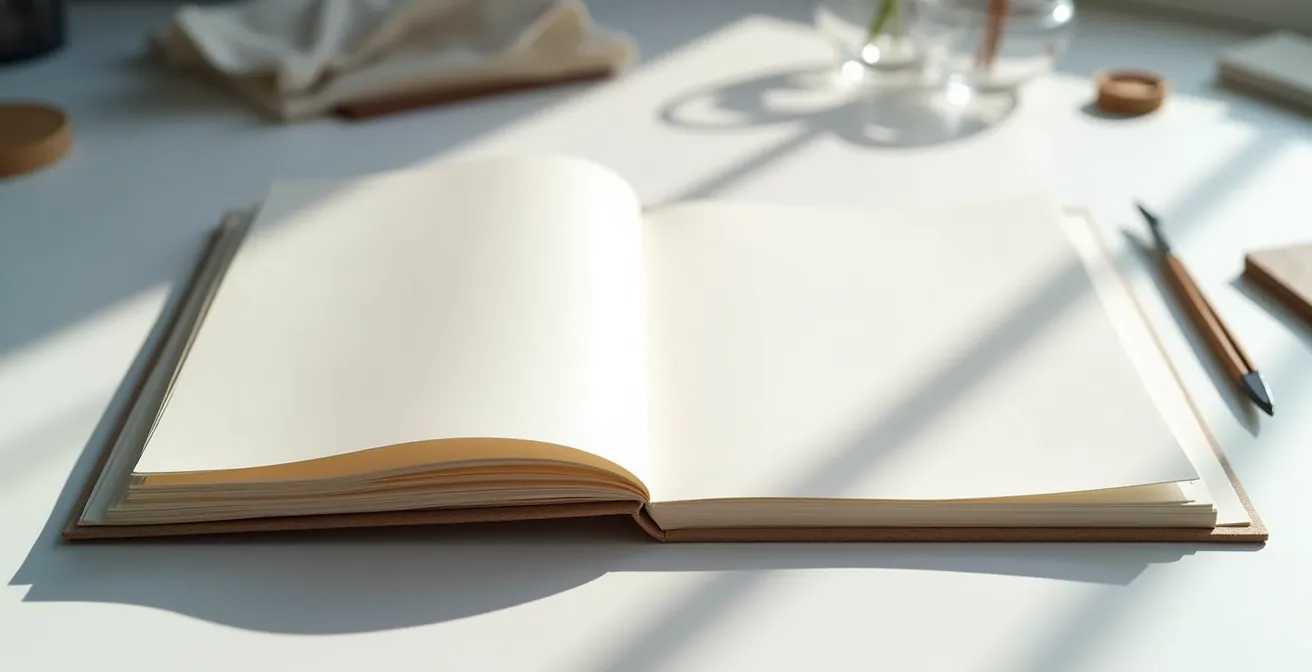
As the image above illustrates, the construction is key. The artwork is secured at the corners, often with Mylar photo corners, to a rigid backboard. Side panels or spacers are then built up around the perimeter to a height greater than the drawing’s surface texture. A lid, often made of the same rigid board or a sheet of glassine, is placed on top of these spacers, ensuring nothing makes contact. For serious collectors, following a precise protocol is not optional; it is the only way to ensure the work arrives in the same condition it left.
For those transporting valuable works, here is a simplified version of a museum-grade protocol:
- Construct a Custom Case: Use rigid foam core board to build a case that leaves at least one inch of empty space above the drawing’s surface.
- Create a “No-Contact” Border: Make side panels approximately 1.75 inches wide. These will rest on the outer borders of the paper, ensuring the central, drawn area is never touched.
- Transport with Care: If traveling by plane, the artwork must be a carry-on item. Store it flat under the seat in front of you, not in the overhead bin where it can shift and be bumped.
- Reinforce for Size: For larger drawings (over 18″ x 24″), the case must be built from sturdier materials like reinforced cardboard or thin plywood to prevent flexing.
- Always Transport Flat: A charcoal drawing must never be rolled. This will crack the paper and cause irreversible pigment loss.
Deep Black or Metallic Grey: Which Medium Creates More Drama in a Portrait?
The dramatic power of a charcoal portrait stems from its unrivaled ability to produce deep, light-absorbing blacks. This is a fundamental material property that separates it from its common cousin, graphite. While graphite pencils are capable of creating stunning realism, their darkest value is ultimately a reflective, metallic grey. Charcoal, on the other hand, is composed of amorphous carbon, which is far less crystalline and reflective. It scatters light rather than bouncing it back, creating the perception of a true, velvety black that can convey immense depth and emotion.
This difference is measurable on a standard artistic value scale. An artist using compressed charcoal can achieve a pure, non-reflective black, rated as a 10 on the value scale. In contrast, charcoal achieves true black at Value 10 while graphite typically stops at a Value of 8 or 9. That small gap on the scale represents a massive leap in dramatic potential. It’s the difference between a shadow and a void, between darkness and an abyss. This unique material quality is what allows artists to create such a profound sense of mood and gravitas.
Artist Julio Reyes, known for his masterful charcoal work, captures this sentiment perfectly when describing his choice of medium. The allure is not just technical but deeply emotional, as he stated in Realism Today:
The deep dark of the starry sky simply begged for sumptuous and sooty blacks.
– Julio Reyes, Realism Today
For a collector, understanding this distinction is crucial. You have not acquired a “pencil drawing.” You are the custodian of an artwork whose power is derived from the unique physical properties of burnt organic matter. This deep black is the heart of the drawing’s value—both aesthetically and financially—and it is precisely this quality that is most at risk from improper handling, framing, and lighting, which can cause it to appear dull, grey, and lifeless.
The Static Electricity Risk: Why Plexiglass Can Destroy Your Charcoal Drawing
One of the most counterintuitive dangers to a charcoal drawing comes from a well-intentioned choice: framing it with standard acrylic or Plexiglass. While lighter and less breakable than glass, most acrylic sheeting is a static electricity generator. The simple act of wiping the surface with a cloth creates a powerful static charge through the triboelectric effect. This charge is strong enough to literally pull the loose charcoal particles off the paper and onto the inside of the glazing, destroying the artwork slowly and silently from within its own frame.
This is not a hypothetical risk; it is a certainty with standard acrylics. The damage, known as “ghosting,” is irreversible. Once the pigment is adhered to the acrylic, it cannot be returned to the paper. As a conservator, I have seen numerous beautiful works permanently marred by this simple, avoidable mistake. The visual evidence is stark: a faint, dusty mirror of the drawing appears on the inside of the Plexiglass, while the artwork itself loses its sharpness and depth. For this reason, standard Plexiglass must never be used to frame a charcoal drawing.
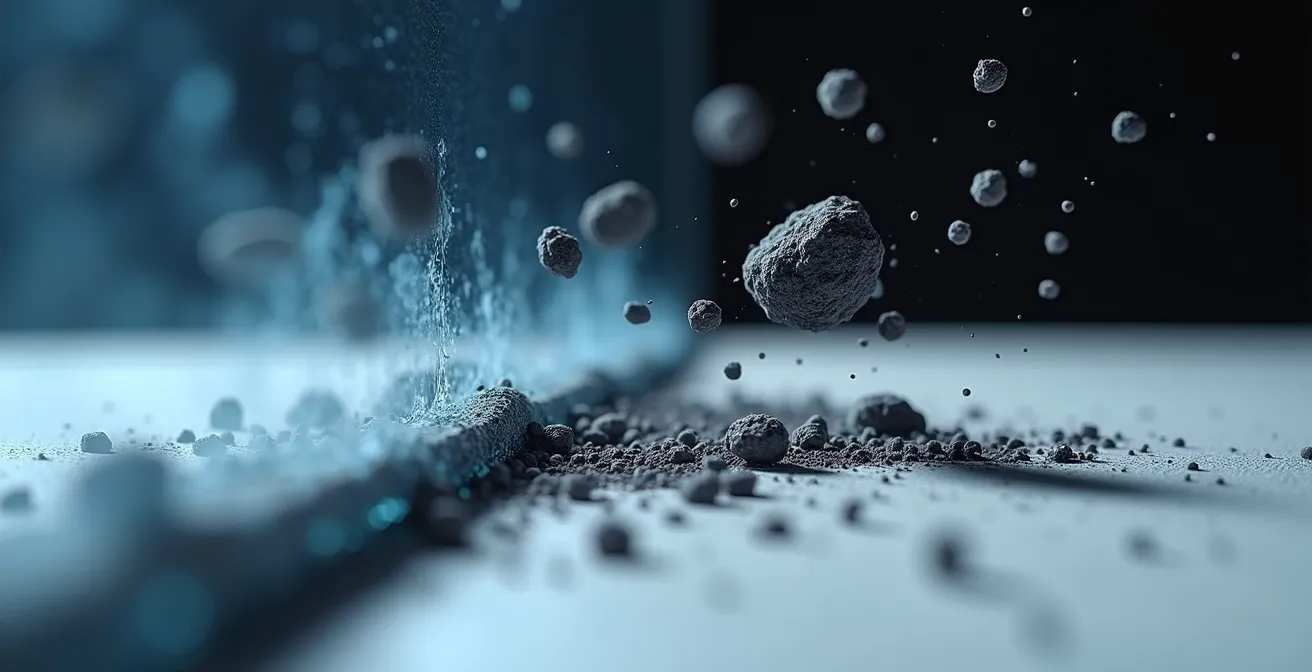
The image above demonstrates this destructive force in action, with particles “jumping” from the paper to the statically charged surface. Fortunately, the conservation industry has developed specialized solutions. There are museum-grade acrylic products that have been treated with a conductive coating or are inherently anti-static. These products dissipate any electrical charge before it can build up to a level that affects the artwork. They are more expensive, but the cost is negligible compared to the value of the artwork they protect. When choosing glazing, a collector must be specific and insistent.
This table outlines the professional glazing options, highlighting the critical difference in static protection. Making the right choice is essential for long-term preservation.
| Glazing Type | Static Protection | UV Protection | Price Range |
|---|---|---|---|
| Standard Acrylic (Plexiglass) | None – High Risk | Basic | $ |
| Acrylite Museum Acrylic | Conductive Coating | 99% UV Block | $$ |
| Optium Museum Acrylic | Anti-static Treatment | 99% UV Block | $$$ |
How to Light Charcoal Art so the Blacks Don’t Look Grey or Washed Out
Lighting is not merely for illumination; it is an active participant in how we perceive a charcoal drawing. The wrong lighting can completely undermine the artist’s intent, turning those deep, velvety blacks into washed-out, reflective greys. The primary goal is to light the paper, not the charcoal itself. This is achieved by carefully controlling the angle and quality of the light to avoid direct reflections off the carbon particles, a phenomenon known as “raking light” which can create unwanted sheen and texture.
The two most critical factors in lighting charcoal are the light source and its position. The source must have a high Color Rendering Index (CRI), which is a measure of its ability to reveal colors faithfully compared to natural sunlight. For museum-quality display, conservation experts recommend a minimum Color Rendering Index of 95+. LED sources are now the standard as they produce no harmful UV radiation and very little heat. The position of the light is equally important. It should be placed at a 30- to 45-degree angle relative to the artwork to minimize glare and prevent the light from skimming across the surface and highlighting every minor imperfection in the paper.
Furthermore, the surrounding environment plays a role. Displaying a charcoal drawing on a stark white wall can cause the lighter areas of the paper to blend in, reducing the perceived contrast. A neutral grey wall (specifically, a Munsell N5 to N7 grey) provides the best background for simultaneous contrast, making the whites in the drawing appear brighter and the blacks appear deeper. This is a subtle but powerful tool used by galleries and museums to enhance the drama of monochromatic works.
Your Action Plan: Auditing Your Lighting Setup
- Points of Contact: Identify all light sources illuminating the artwork. Note their type (LED, halogen, incandescent) and their angle relative to the wall.
- Collecte: Inventory the existing setup. Are you using track lighting with adjustable spots, or a general overhead room light? Note the bulb specifications if available.
- Cohérence: Confront your setup with conservation standards. Is the light source an LED with a CRI of 95 or higher? Is the angle between 30 and 45 degrees to prevent glare?
- Mémorabilité/Émotion: Observe the artwork from different positions. Do the blacks look deep and matte, or do they appear shiny or grey from certain angles? Look for distracting glare on the glazing.
- Plan d’Intégration: Create a prioritized plan. First, replace any non-LED or low-CRI bulbs. Second, adjust the position of your light fixtures to achieve the optimal angle. Consider painting the wall a neutral grey as a longer-term project.
Paper or Bristol Board: Which Support Prevents Warping Over Decades?
The long-term stability of a charcoal drawing depends as much on its foundation—the paper or “support”—as it does on its handling and framing. A support’s ability to resist warping, buckling, and acid degradation over decades is paramount. While artists have many choices, the primary factor determining stability is the weight and construction of the paper. Lighter, thinner papers are far more susceptible to environmental changes, particularly fluctuations in humidity.
Paper is a hygroscopic material, meaning it naturally absorbs and releases moisture from the air. When it absorbs moisture, its fibers expand; when it dries, they contract. This constant, subtle movement is what causes “buckling” or a wavy appearance. A heavier, thicker support has more internal strength and dimensional stability to resist this movement. The difference is significant; testing shows a dramatic difference in buckling between lightweight 90 gsm paper and a heavy-duty 300-600 gsm support. For a collector, an artwork on a heavier, archival-quality paper is a much more stable long-term investment.
Bristol board, or Bristol paper, is a particularly stable option because of its construction. It is not a single sheet but consists of multiple layers of paper (plies) bonded together under pressure. This multi-ply structure creates a stiff, dense, and highly resilient support that is far less prone to warping than a single-ply sheet of the same weight. Furthermore, a high-quality, acid-free Bristol board provides a robust foundation that is also chemically stable, ensuring it will not yellow or become brittle over time. While artists may choose various papers for their textural properties, a heavy, multi-ply, acid-free support is always the superior choice from a conservation standpoint.
The Buckling Problem: Why Your Ink Wash Art Looks Wavy in the Frame
The unsightly waviness or “buckling” visible in many framed works on paper is a direct physical response to environmental instability, primarily changes in relative humidity. This issue is not exclusive to ink wash but is particularly pronounced in any medium that introduces a significant amount of moisture to the paper, or in works that are simply housed in an unstable environment. As we’ve established, paper fibers swell with moisture and shrink as they dry. If this process occurs unevenly or is constrained by a frame, the paper has nowhere to go but to buckle.
For a collector, this problem often appears long after the artwork has been framed. A piece may look perfectly flat in a climate-controlled gallery, but when moved to a home with fluctuating humidity—perhaps a humid summer followed by a dry, heated winter—the buckling begins. The frame itself can exacerbate the problem. If the artwork is mounted too tightly against the backing board, it has no room to expand and contract naturally, forcing it to warp. As experts from the Getty Conservation Institute have noted, environmental factors are a constant threat. In a discussion on conservation with Chemistry World, they highlight that even for other media, “Increasing humidity can plasticise the paint and make it sticky.” For paper, the effect is even more direct and physical.
The solution from a conservator’s perspective is twofold. First, and most importantly, is environmental control. Maintaining a stable relative humidity (ideally between 45-55%) is the most effective way to prevent buckling. Second is proper framing technique. The artwork should be “hinged” to the backing board, typically with archival tape at the top corners only. This allows the sheet to hang freely and expand or contract vertically without being constrained, significantly reducing the likelihood of buckling. If a work you own is already showing signs of waviness, it is a clear indicator that its framing and environment need to be reassessed by a professional.
Key Takeaways
- True preservation is not about generic rules but about understanding the physics of charcoal’s fragility, from weak Van der Waals forces to the triboelectric effect.
- Standard acrylic/Plexiglass is an active threat to charcoal art due to static electricity; only museum-grade anti-static glazing is a safe choice.
- The drama of charcoal comes from its ability to create true, non-reflective blacks (Value 10), a quality that must be protected with specific lighting (high CRI, 30-45° angle) to prevent it from looking grey.
Graphite Mastery: Why Are Hyper-Realistic Pencil Drawings Surging in Value?
In recent years, the art market has seen a remarkable surge in appreciation for monochromatic works on paper, particularly hyper-realistic drawings. Artists wielding graphite pencils are achieving astonishing levels of detail and nuance, and their work is commanding significant attention and value. This rise in “Graphite Mastery” provides a crucial point of contrast for the charcoal collector. Graphite is inherently more stable; its smaller particles are bound with wax or clay and adhere more strongly to the paper, creating a more durable and less smudge-prone surface. It is, in many ways, the “safer” medium.
The growing visibility of drawing as a fine art form, fueled by social media where top charcoal and graphite artists now reach audiences of 920K YouTube subscribers or more, elevates the status of all masterworks on paper. However, it also highlights the unique position of charcoal. If graphite’s value is in its precision and stability, charcoal’s is in its raw, elemental power and its inherent risk. The drama of a charcoal work is inseparable from its fragility. Its deep, matte blacks cannot be replicated by the metallic sheen of graphite. This makes the act of preserving charcoal not just a technical task, but a profound act of stewardship.
You are the guardian of a medium that is more difficult, more vulnerable, and, in some ways, more emotionally potent. The meticulous care required is not a burden; it is a recognition of the artwork’s exceptional nature. As conservator Odile Madden of the Getty Conservation Institute wisely stated regarding the preservation of modern materials, the promise of permanence is often an illusion. Her words resonate deeply for charcoal:
‘People want to hear that we can keep these objects forever, but… we can only delay the process’.
– Odile Madden, Getty Conservation Institute
Your role as a collector is to be a master of that delay. By understanding the science and embracing the meticulous practices of conservation, you ensure that this powerful, ephemeral beauty can be experienced for as long as humanly possible, distinguishing your collection as one of true connoisseurship.
By applying these conservator-led principles to framing, lighting, and handling, you are not merely protecting an asset. You are honoring the artist’s vision and ensuring the dramatic soul of the artwork remains vibrant for the next generation of admirers.