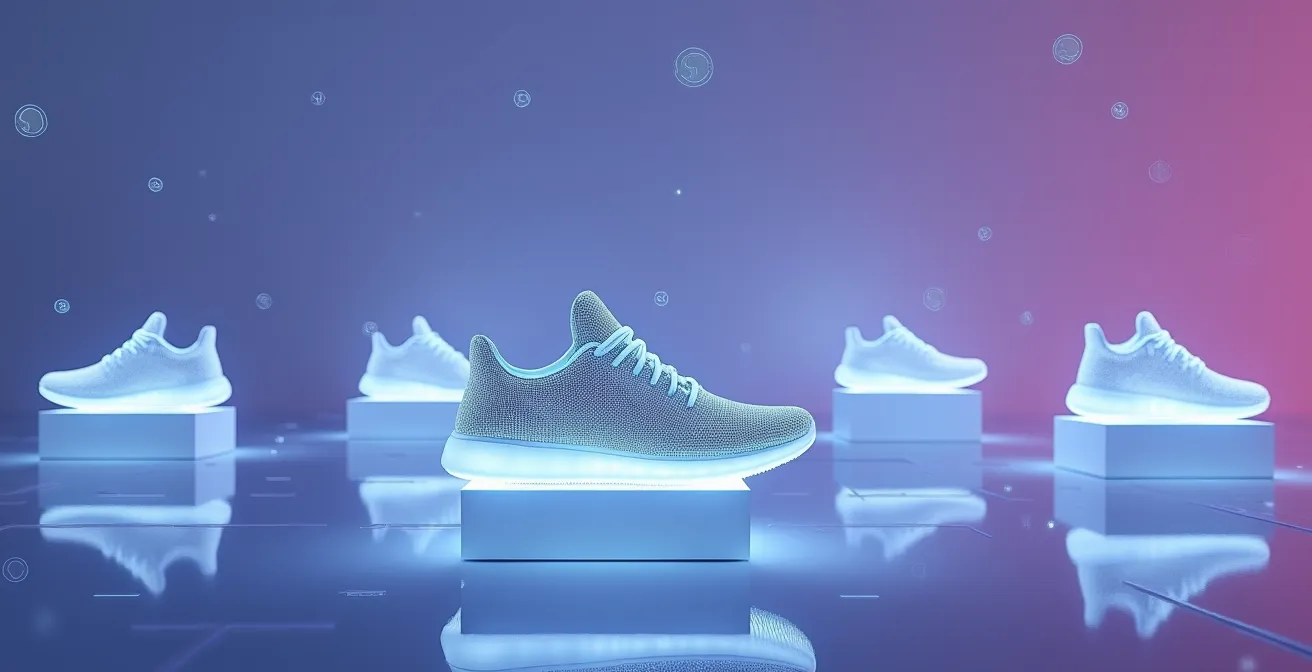
The value of a virtual object isn’t just a digital copy of physical-world economics; it’s a new asset class defined by the tension between platform-specific utility and the dream of universal ownership.
- Digital assets derive value from a mix of in-game function (utility), social status (exclusivity), and proven ownership history (provenance).
- “True ownership” is often an illusion, as assets are typically controlled by the terms of service of centralized platforms, creating a “platform-risk premium.”
Recommendation: Before acquiring a digital asset, analyze its interoperability limitations and the platform’s long-term stability, not just its aesthetic appeal.
The idea of paying substantial, real-world money for a pair of sneakers or a jacket that you can’t physically touch strikes many as absurd. For skeptics, the metaverse marketplace—a burgeoning digital frontier—appears to be a confusing bubble of speculative hype. Early adopters, meanwhile, are already navigating this new economy, building collections of items that exist only as lines of code. The common discourse often falls into simple analogies, comparing digital collecting to its physical-world counterpart, or dismisses it entirely as a transient fad.
But these surface-level assessments miss the fundamental economic shift at play. The valuation of digital assets is not a simple mirror of physical goods. It operates on a different set of principles, driven by a complex interplay of technology, community, and platform control. Understanding this value requires moving beyond the initial shock and dissecting the very architecture of the virtual world. The core of this new asset class is defined by a constant tension: the dream of universal, interoperable ownership versus the current reality of fragmented, “walled-garden” ecosystems.
This analysis will deconstruct the layers of value that constitute a digital object. We will explore why your assets are often trapped in digital silos, how they can be brought into your physical space through augmented reality, and what makes them retain value in a volatile market. By examining the risks of centralized servers and the technical design choices that impact user experience, we can build a comprehensive framework for understanding why real money is flowing into objects that only exist in the virtual realm.
This article provides an analytical framework to navigate the emerging economy of the metaverse. The following sections will break down the key factors that determine the true value of digital assets, moving from platform limitations to the nuances of design and market behavior.
Summary: Deconstructing the Real-World Value of Digital Assets
- Why Your Digital Jacket Can’t Be Worn in Roblox if You Bought it in Decentraland?
- How to Place Your NFT Sculpture in Your Living Room Using Augmented Reality
- Functional Game Sword or Fashion Hat: Which Virtual Item Retains Value Better?
- The Server Wipe Risk: Do You Really Own an Item Stored on a Private Server?
- How to Reduce Texture Size so Your Virtual Object Loads Instantly on a Phone?
- Why a Dent in the Box Devalues Your Collectible Figure by 30%?
- Unique Masterpiece or 10k Avatar Project: Which Hold Value During a Bear Market?
- VR Presence: How to Design Virtual Art That Feels Physically Real?
Why Your Digital Jacket Can’t Be Worn in Roblox if You Bought it in Decentraland?
The fundamental promise of the metaverse is a persistent, interconnected digital universe. Yet, the current reality is one of profound fragmentation. A digital jacket purchased in the world of Decentraland cannot be worn by your avatar in Roblox for a simple economic reason: these platforms are not open highways but competing, walled gardens. This lack of asset interoperability is the single greatest friction point in the virtual economy. Each metaverse platform functions as a sovereign digital nation with its own code, asset formats, and internal markets. This creates a system of digital feudalism, where platforms act as landlords, controlling the context and utility of the assets sold within their borders.
This model is intentional. By creating exclusive content and experiences, platforms lock in users and capture all economic activity. As a Threekit Industry Report on the metaverse notes:
While some virtual worlds strive toward universality, most common virtual environments are intentionally limited to certain games, objectives, or communities.
– Threekit Industry Report, Virtual Products & NFTs in the Metaverse Guide
The acquisition of RTFKT by Nike is a prime example of this strategy. Nike isn’t just selling digital sneakers; it is building a proprietary ecosystem where its assets offer unique value. This value is derived precisely from their exclusivity within Nike’s controlled environment. The market is vast, with projections suggesting the metaverse will reach a US$103.6bn market size in 2025, but this growth is happening in parallel, isolated ecosystems, not a single unified one. The value of your digital jacket is therefore inextricably tied to the popularity and longevity of the specific platform you bought it on.
How to Place Your NFT Sculpture in Your Living Room Using Augmented Reality
While virtual assets are confined to their native digital platforms, augmented reality (AR) provides a powerful bridge to the physical world. It allows owners to project their digital items into their own environment, transforming an abstract line of code into a tangible, visual experience. This capability significantly enhances an asset’s value by increasing its perceptual presence and social utility. An NFT sculpture is no longer just an entry on a blockchain ledger; it becomes a piece of art you can “place” in your living room and share with others, blurring the line between the digital and the real.
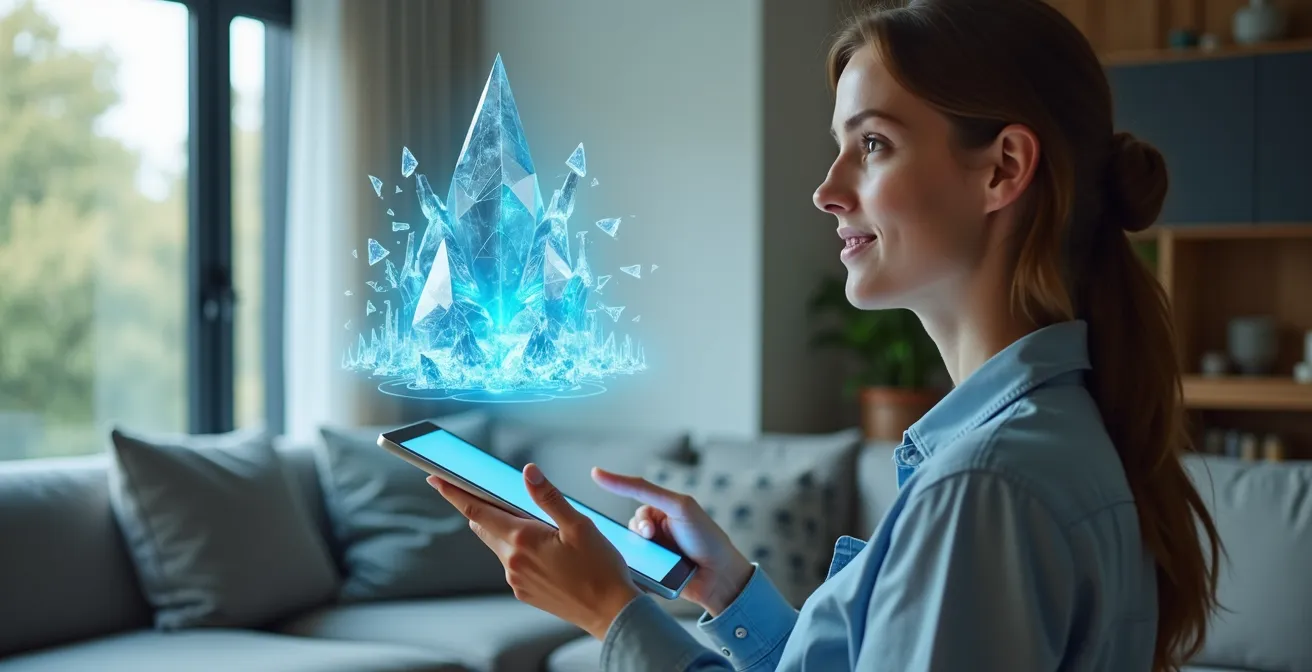
As the image above illustrates, AR technology allows for a direct and personal interaction with a digital object. Brands like RTFKT have leveraged this by integrating AR filters directly into their purchasing experience. A user can not only buy a pair of digital sneakers but can “try them on” via a Snapchat filter, or place a digital mannequin wearing the item next to them for a photo. This creates a powerful sense of ownership and provides a new avenue for social signaling. The process involves sophisticated technology that detects room surfaces and lighting to render the object with incredible realism.
Action Plan: Displaying Your NFT in AR
- Access the AR Filter: For items from platforms like RTFKT, scan the provided QR code, often found on their website, to launch the experience through an app like Snapchat.
- Calibrate the Environment: Position your phone’s camera so it can accurately detect the surfaces, dimensions, and lighting conditions of your room. This ensures the virtual object is grounded realistically.
- Position and Scale: Once the object appears, use touch controls to move, rotate, and scale it to fit your space aesthetically. Ensure it interacts believably with your physical surroundings.
- Simulate Realism: Advanced AR can simulate how light and shadows from your room affect the digital object, enhancing its realism.
- Capture and Share: Take photos or videos of your AR experience and share them on social platforms, extending the asset’s visibility and social value beyond its native metaverse.
Functional Game Sword or Fashion Hat: Which Virtual Item Retains Value Better?
Within the virtual economy, not all assets are created equal. Their ability to retain value depends heavily on their core purpose, which can be broadly categorized into two types: functional utility and social utility. A functional item, like a powerful sword in a role-playing game, derives its value from the competitive advantage it provides. Its price is tied to its in-game performance and its ability to help a player achieve objectives. In contrast, a social item, like a rare designer hat, derives its value from exclusivity, brand prestige, and the status it confers upon the owner’s avatar. This distinction creates different risk profiles and value-retention dynamics.
The gaming segment held the largest market revenue share in 2024, demonstrating the massive economic engine of functional utility. However, these assets are vulnerable. A game developer can release a “balancing update” that nerfs a powerful sword overnight, instantly erasing its value. Fashion items are less susceptible to developer whims but are tied to volatile cultural trends and brand perception. A collaboration that is hyped today may be forgotten tomorrow. The following table breaks down these differences:
| Aspect | Functional Game Items | Fashion NFTs |
|---|---|---|
| Value Driver | In-game competitive advantage | Social status & exclusivity |
| Risk Profile | Subject to game balancing updates | Tied to cultural trends |
| Market Size | Gaming segment: 25.3% of metaverse | Fashion/collectibles: Growing segment |
| Liquidity | High within game ecosystem | Variable based on brand prestige |
| Long-term Outlook | Dependent on game longevity | Collectible value can appreciate |
Ultimately, the most resilient assets are often those that blend both functional and social utility. A sword that is not only powerful but also visually unique from a famed digital artist holds value on two fronts, making it more robust against market shifts. An investor must analyze whether an item’s value is based on fleeting performance metrics or on a more durable social or aesthetic significance.
The Server Wipe Risk: Do You Really Own an Item Stored on a Private Server?
The concept of “ownership” is the philosophical and technical bedrock of the NFT market. The blockchain ledger provides a public, immutable record of who owns a specific token. However, this is where a critical misunderstanding often occurs. The NFT itself is typically just a pointer, a unique address on the blockchain. The actual digital asset—the JPEG, the 3D model of the sneaker, the audio file—is usually too large to store on-chain. For instance, research shows it cost up to $20,000 to store 500 KB of data on the Ethereum blockchain in early 2022. Consequently, the asset’s metadata and files are stored “off-chain” on centralized servers, such as Amazon Web Services, controlled by the company that issued the NFT.
This creates a profound vulnerability. If the company goes out of business, decides to shut down the server, or alters its terms of service, your asset can effectively disappear. You still “own” the token on the blockchain, but it may now point to a dead link. This introduces a significant platform-risk premium to the valuation of any digital asset. Your ownership is only as secure as the company that hosts the files. As one legal analysis in The Fashion Law bluntly states, technology alone is not a panacea for ownership rights:
Case Study: The Sandbox Terms of Service
An examination of the terms of service for The Sandbox, a major metaverse platform, reveals the true nature of digital ownership. The platform explicitly reserves the right, at its sole discretion, to terminate a user’s ability to use or even access their purchased digital assets if it “reasonably believes” the user engaged in prohibited activities. Crucially, it can do so “without any notice or liability to you.” This means that despite having paid for an asset and holding its corresponding NFT, a user’s access can be revoked unilaterally by the platform, highlighting the centralized control that underpins many “decentralized” ecosystems.
This centralized control is not a bug but a feature of the current metaverse landscape. It grants platforms the power to moderate their communities and enforce rules, but it fundamentally contradicts the narrative of “true, decentralized ownership.” The value of your digital asset is therefore contingent on the goodwill and longevity of a private company, a risk that every investor must factor into their calculations.
How to Reduce Texture Size so Your Virtual Object Loads Instantly on a Phone?
In the virtual economy, performance is a feature. A beautifully designed digital jacket that takes 30 seconds to load on a mobile device has failed in its primary function. The value of a virtual object is directly impacted by its technical optimization, especially for accessibility across a wide range of devices, from high-end VR rigs to standard smartphones. Large, uncompressed textures are one of the biggest culprits of slow loading times and poor performance, creating a frustrating user experience that devalues the asset. Therefore, mastering texture optimization is not just a technical task for developers; it is a core component of value preservation.
The goal is to strike a delicate balance: reducing file size for instant loading while maintaining the highest possible visual fidelity. This involves a suite of techniques designed to make assets lightweight and efficient. For example, texture baking can simulate complex lighting and shadow details on a low-polygon model, giving the illusion of high detail without the computational cost. Another key method is using progressive Levels of Detail (LODs), where a high-resolution version of the object is shown up close, but the system automatically switches to lower-resolution versions as the viewer moves further away, saving processing power.

Modern formats like KTX2 are specifically designed for efficient GPU delivery, and techniques like “lazy loading” prioritize loading only the textures that are immediately visible to the user. An 8K texture might look stunning in a developer’s rendering suite, but for practical application, a well-compressed 1K texture is often visually indistinguishable on a phone screen and provides a vastly superior experience. An object that is accessible and performs smoothly for everyone is inherently more valuable than one that is exclusive to users with high-end hardware.
Checklist: Key Texture Optimization Points
- Model Complexity: Audit if texture baking can be used to transfer high-detail information onto a lower-polygon model, reducing computational load.
- Texture Resolution: Inventory all textures and identify where resolutions (e.g., 8K, 4K) can be reduced (e.g., to 2K, 1K) without a noticeable loss of quality on target devices.
- Compression Formats: Check if textures are converted to modern, GPU-friendly formats like KTX2 or Basis Universal for efficient loading.
- Levels of Detail (LODs): Verify that progressive LODs are implemented, so the engine loads simpler versions of the asset at a distance.
- Loading Strategy: Determine if a “lazy loading” or “streaming” strategy is in place to prioritize loading visible textures first, improving initial load times.
Why a Dent in the Box Devalues Your Collectible Figure by 30%?
In the world of physical collectibles, condition is paramount. A mint-condition action figure in its original, undamaged box is exponentially more valuable than the same figure with a dented package. This is because the “pristine” state serves as proof of its history—or lack thereof. It’s a proxy for provenance and authenticity. In the digital realm, the same principle applies, but the “box” is the asset’s metadata and the integrity of its intellectual property (IP) rights. A “dent” in the digital box occurs when there is ambiguity about an asset’s origin, rights, or connection to the original creator.
An NFT provides a public and verifiable chain of ownership, which is a powerful form of provenance. We can see every wallet that has ever held the token, establishing its history. This is why official collections from major brands command such high prices. For example, Nike’s first NFT sneaker collection achieved 5,600 ETH (approximately 1.2 billion yen) in total trading volume on OpenSea. This value is built on the certainty that these are authentic, Nike-sanctioned assets. An unauthorized copy, even if pixel-perfect, is the digital equivalent of a counterfeit and has no collectible value.
However, the legal framework is still catching up, creating potential “dents.” The World Intellectual Property Organization (WIPO) highlights this risk, clarifying that the creation of an NFT does not automatically grant any underlying rights to the creative work itself.
Anyone who uses a sound recording or a clip from a video game in an NFT will need prior authorization from the copyright holder of such work.
– WIPO, World Intellectual Property Organization Report on NFTs
An NFT minted without the proper licenses is a tainted asset. Its value is compromised because its legal foundation is flawed. Just as a collector inspects the box for dents, a digital investor must scrutinize an asset’s metadata and associated IP rights to ensure its authenticity and long-term value are unblemished.
Unique Masterpiece or 10k Avatar Project: Which Hold Value During a Bear Market?
Market downturns are the ultimate stress test for any asset class, and the virtual economy is no exception. During a “crypto winter” or bear market, speculative froth evaporates, revealing the true foundations of an asset’s value. In this environment, two primary categories of digital assets—unique, one-of-a-kind (1-of-1) art pieces and large-scale 10,000-piece profile picture (PFP) projects—exhibit vastly different behaviors. A 1-of-1 masterpiece’s value is tied to its aesthetic merit and the historical significance of the artist. A PFP project’s value, however, is derived almost entirely from the strength, engagement, and network effects of its community.
During a bull market, both can see astronomical price increases. But when liquidity dries up, the 1-of-1 art market often becomes highly illiquid. Finding a buyer for a multi-million dollar digital painting is difficult when speculative capital has fled. PFP projects, on the other hand, often maintain a more active, albeit much lower, “floor price.” This is because the value is not just in the art but in the access it grants to a community, events, or future utility. As long as the community remains active, there is a baseline level of demand from members looking to join or existing members accumulating more assets. The table below contrasts their behavior.
| Factor | Unique 1-of-1 Art | 10k PFP Projects |
|---|---|---|
| Value Basis | Aesthetic/Historical significance | Community network effects |
| Bear Market Liquidity | Low – hard to find buyers | Higher – active floor price |
| Price Stability | More stable but illiquid | Volatile, sentiment-driven |
| Recovery Pattern | Slow but steady | Quick rebounds if utility exists |
Despite short-term volatility, long-term conviction in the space remains high, driven by the belief in the underlying technological shift. Even as individual projects fluctuate, market forecasts predict massive expansion. One report expects that by 2034, the Metaverse Market is expected to reach USD 4,473.6 billion, expanding at a compound annual growth rate of 44.8%. This suggests that while bear markets will cull weaker projects, those with strong fundamentals—either artistic or community-based—are positioned for significant long-term appreciation.
Key Takeaways
- The value of a digital asset is fundamentally tied to its native platform; a lack of interoperability creates isolated economies and platform-specific risk.
- “True ownership” via NFT is a misnomer; value is contingent on off-chain file hosting and the platform’s terms of service, which can unilaterally revoke access.
- An asset’s worth is a composite of its functional utility (in-game advantage), social utility (status), provenance (verified history), and perceptual presence (experiential quality in AR/VR).
VR Presence: How to Design Virtual Art That Feels Physically Real?
Beyond the economic layers of utility and scarcity, the ultimate frontier for digital asset value lies in the realm of experience. For virtual art to command prices comparable to physical masterpieces, it must achieve a sense of perceptual presence—the feeling that the digital object is a tangible, real entity co-existing in the user’s space. This is more than just visual fidelity; it is a multi-sensory illusion crafted through the careful integration of spatial technologies. As one market report from Grand View Research highlights, this is the core of the metaverse experience.
The integration of spatial technologies enables users to engage with digital content as if it exists in their physical surroundings, blurring the boundary between virtual and real-world experiences.
– Grand View Research, Metaverse Market Size Report 2024
Designing for presence involves several key elements. First is realistic lighting and shadow. A virtual sculpture that correctly casts shadows on your real-world floor and reflects the light from your actual windows feels grounded and physically present. Second is spatial audio, where the sounds emitted by the object change in volume and direction as you move around it, reinforcing its position in 3D space. Finally, the emergence of haptic feedback—through specialized gloves or bodysuits—allows users to “feel” the texture and shape of a virtual object, completing the sensory circuit.
When these elements combine, the brain is tricked into accepting the virtual object as part of its reality. This deep, experiential connection is what transforms a simple 3D model into a profound work of art. The most valuable digital assets of the future will not be those that are merely rare, but those that master this art of presence, offering experiences so compelling they feel indistinguishable from physical reality. The economic value, in this context, becomes a measure of the artwork’s ability to command a user’s sensory and emotional attention.
To navigate this emerging market, the next logical step is to meticulously analyze the terms of service, technological framework, and community health of any platform before investing in its assets. This due diligence is the best hedge against the inherent risks of a rapidly evolving digital economy.