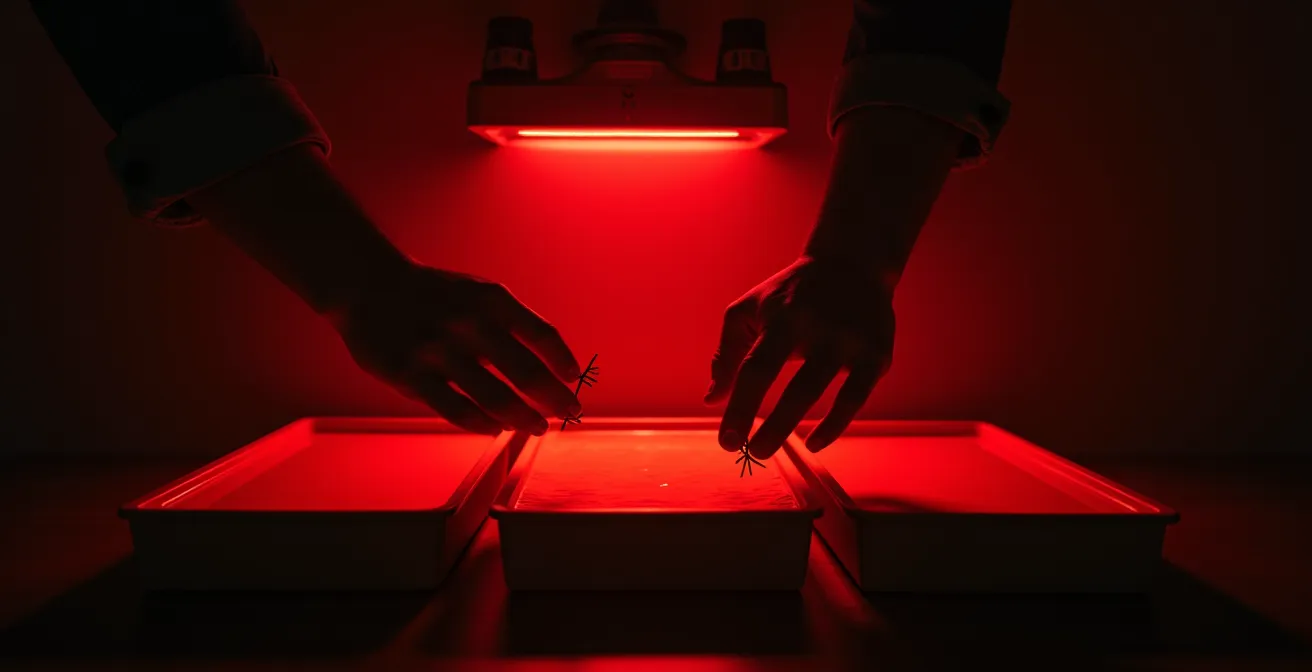
The soul of a photograph isn’t captured in a sensor; it’s forged in the chemical crucible of the darkroom, where supposed flaws become the fingerprints of authenticity.
- The physical risks and meticulous processes of the darkroom imbue the final print with a tangible value and “aura” that sterile digital workflows cannot replicate.
- True mastery lies in the physical manipulation of light and chemistry, a tactile dance that transforms a simple image into a unique, handmade artifact.
Recommendation: Embrace the unforgiving nature of analog processes. Treat the time, the risk, and the material science not as obstacles, but as the essential ingredients of genuine photographic art.
The world has become obsessed with convenience. In photography, this means instant feedback, endless undos, and the sterile comfort of a brightly lit room. A few clicks, a slide of a cursor, and an image is “developed.” The process is clean, efficient, and utterly devoid of soul. We are told this is progress, that the acrid smell of fixer and the deep, humming silence of the darkroom are relics of a bygone, inefficient era. We are told to fear the chemicals, to resent the time, and to seek the fastest path from capture to display.
But what if this narrative is a profound lie? What if the very things we are taught to avoid—the faint sting of chemistry in the air, the hours spent under a single red safelight, the unforgiving finality of an exposed sheet of paper—are not obstacles to be overcome, but the very crucible in which true artistry is forged? The truth, for the purist, is that the physical struggle, the intimate dance with light and time, and the alchemical transformation of silver halides are what separate a mere picture from a photographic artifact. This is not about nostalgia; it is about substance.
This article does not offer apologies for the darkroom’s demanding nature. Instead, it serves as a testament to its power. We will explore the uncompromising techniques that demand discipline, the chemical processes that give a print its soul, and the fundamental reasons why the value of an image is directly proportional to the effort and risk invested in its creation. Forget the digital shortcut; the true path to a masterpiece is through the dark.
text
This guide delves into the core principles that define the darkroom’s unique artistry, from managing its inherent risks to mastering its most profound techniques. Explore the sections below to understand why this traditional craft endures.
Summary: A Guide to the Darkroom’s Uncompromising Artistry
- Why Poor Ventilation in a Home Darkroom Can Cause Chronic Headaches?
- Dodge and Burn: How to Manipulate Light with Your Hands vs. Photoshop Sliders
- Silver or Platinum: Which Chemical Process Creates the Deepest Emotional Impact?
- The Sink Trap: Why Pouring Fixer Down the Drain Is Illegal in Most Cities
- How to Control Contrast by Adjusting Your Developer Temperature by Just 1 Degree
- Hours in the Darkroom or Clicks on a Mouse: Which Process Adds More Value?
- How to Stop Cyan Shift: The Storage Conditions Your C-Prints Demand
- Analog Exposure: Why the ‘Film Look’ Grain is Making a Comeback in Fine Art?
Why Poor Ventilation in a Home Darkroom Can Cause Chronic Headaches?
Let’s be clear: the chemical scent of the darkroom is not perfume. It is a warning. The volatile organic compounds (VOCs) from developers, stop baths, and fixers are real, and in a poorly managed space, they are a genuine hazard. In fact, environmental health data indicates that VOC concentrations can be up to ten times higher in an unventilated indoor environment. This is not a reason to abandon the craft; it is the first test of the printer’s discipline. A master does not work in a toxic fog. They respect their materials and their environment by engineering proper ventilation—not to eliminate the smell, but to control the exposure.
The digital world offers an escape from this reality, a sanitized environment where the only risk is carpal tunnel. But in doing so, it removes the visceral connection to the process. Managing the darkroom’s atmosphere is part of the ritual. It forces a consciousness, a deliberate approach that is absent when one is merely clicking a mouse. As noted in discussions among seasoned photographers, many have worked with these chemicals for decades without issue, but this is a result of respect and diligence, not luck. The historical impact of studies like the National Press Photographers Association Health Survey was not to end darkroom work, but to professionalize it, mandating the very ventilation systems that separate the serious artist from the reckless hobbyist.
The headache from poor ventilation is a symptom of laziness, not an inherent flaw of the process. It is a reminder that this art form demands more than just creative vision; it demands total environmental control and an uncompromising commitment to safety. This tangible risk is a filter, ensuring that those who remain are truly dedicated to the craft.
Dodge and Burn: How to Manipulate Light with Your Hands vs. Photoshop Sliders
In Photoshop, dodging and burning is a sterile, mathematical act. You select a tool, adjust its opacity, and paint with a mouse or stylus. It is precise, repeatable, and utterly disconnected from the physical medium. In the darkroom, the same process is a performance—a physical choreography of light and shadow. It is not done with a cursor, but with your hands, with cardboard cutouts on thin wires, with tools you craft yourself for a specific purpose. This is not mere manipulation; it is a live interaction with the light that is actively forming the image.
This technique, which the legendary Ansel Adams elevated to a high art form, is about feel. You are not observing pixels on a screen; you are intuiting the cumulative effect of seconds of blocked or added light. Each print is a unique performance. The slight tremor of your hand, the exact height you hold the dodging tool, the feathered edge you create with constant motion—these are not imperfections. They are the human touch, the ghost in the machine that gives the final artifact its unique character. A Photoshopped image can be perfectly replicated a million times. A hand-dodged print is a monotype; it can never be exactly duplicated.
The image below captures this intimate dance. It is not a technician at a workstation; it is an artist physically shaping their creation. This tactile engagement builds a relationship with the print that no digital tool can simulate. The value lies in the imprecision, the intuition, and the unrepeatable gesture.
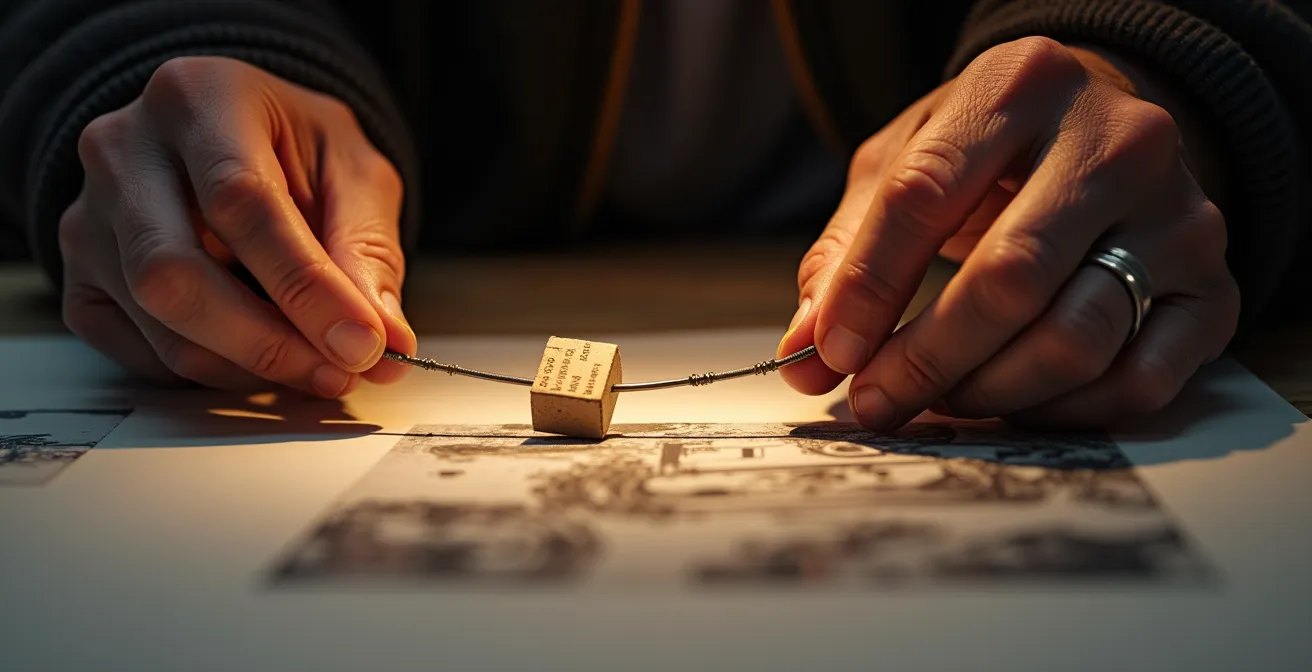
As you can see, the process is one of direct, physical engagement. The hands and simple tools become extensions of the artist’s will, painting with light itself. This is the fundamental difference between applying an effect and creating an object. Mastering this requires patience and a deep, intuitive understanding of the material’s response to light.
Action Plan for Manual Print Control
- Points of Contact: Identify all tools for light manipulation. Are you using your hands, cardboard shapes on wires, or feathers? List the specific tools for the job.
- Collecte: Create a test strip with a baseline, correct exposure. This is your control document against which all manipulations will be judged.
- Coherence: Does the planned dodging and burning serve the image’s core emotion? Confront your plan with the intended feeling of the final print. Is it to add drama, guide the eye, or soften a transition?
- Mémorabilité/émotion: During a test print, perform your dodging and burning. Evaluate the result. Does it look like an obvious manipulation, or does it feel like authentic light? The goal is to be invisible yet impactful.
- Plan d’intégration: Based on the test, create a timed “shot list” for the final print. Example: “Expose 12 seconds total. Dodge shadow under the eye from second 4 to second 7. Burn top left corner for last 2 seconds.”
Silver or Platinum: Which Chemical Process Creates the Deepest Emotional Impact?
A digital file has no substance. It is a string of code that can be displayed on any screen, printed on any paper. Its materiality is an afterthought. In the darkroom, the choice of chemistry is the choice of the print’s very soul. The process is not a coating applied to a surface; it is an alchemical reaction that determines the image’s permanence, texture, and emotional temperature. The distinction between a silver gelatin print and a platinum/palladium print is not one of quality, but of spirit.
Silver gelatin, the quintessential photographic process, is dramatic and sharp. Its particles are suspended in a gelatin layer on the paper’s surface, creating deep, rich blacks and brilliant whites. It has a cool, precise feel—the look of a moment captured. Platinum and palladium, however, are fundamentally different. Here, the noble metals are not sitting on top of the paper; they are physically embedded within the paper fibers themselves. The image and the paper become one inseparable object.
This physical integration creates an aesthetic that is more painterly than photographic. The tonal range is immense, favoring subtle, luminous mid-tones over harsh contrast. It feels warm, contemplative, and timeless. The choice, therefore, is an artistic one: do you want the immediate, graphic punch of silver, or the quiet, enduring grace of platinum?
| Characteristic | Silver Gelatin | Platinum/Palladium |
|---|---|---|
| Physical Formation | Particles suspended in gelatin layer on paper surface | Particles embedded within paper fibers |
| Tonal Range | Deep blacks, high contrast capability | Subtle mid-tones, infinite gradation |
| Archival Quality | 75-100 years with proper storage | 500+ years, most stable process |
| Aesthetic Quality | Sharp, dramatic, ‘photographic’ | Painterly, warm, ‘handmade’ |
| Emotional Temperature | Cool, precise, immediate | Warm, contemplative, timeless |
As this comparative analysis reveals, the archival quality of a platinum print—lasting over 500 years—cements its status as a true artifact. It is not a fleeting image but a permanent object intended for generations. This is a level of materiality that digital processes can only dream of.
The Sink Trap: Why Pouring Fixer Down the Drain Is Illegal in Most Cities
The darkroom alchemist has a responsibility not only to their art but also to the world outside their studio walls. The convenience of pouring used fixer down the drain is a temptation born of ignorance and disrespect. Fixer is laden with silver, a heavy metal that is toxic to aquatic ecosystems. Disposing of it improperly is not just poor practice; in most municipalities, it is illegal. This is another of the darkroom’s uncompromising tests: it demands ethical and environmental discipline.
A true master printer understands that the process does not end when the print is washed. The lifecycle of the chemicals is part of their domain. This means collecting used fixer, storing it safely, and using a silver recovery system or taking it to a proper hazardous waste facility. It is an extra step, an inconvenience, a cost. And it is absolutely necessary. This act of responsibility is part of the craft, a silent acknowledgment of the potent materials being wielded.
The image below shows a professional electrolytic silver recovery unit. This is not a complex, industrial machine; it is a straightforward tool for any serious darkroom. It represents a commitment to sustainability and a rejection of the lazy, destructive shortcut. The digital workflow, with its lack of physical waste, claims a moral high ground, but it’s a hollow victory. The darkroom practitioner who manages their waste is not just making a picture; they are engaging in a holistic, responsible practice from start to finish.

This disciplined approach to waste is a far cry from the thoughtless disposal that gives the practice a bad name. It is a quiet statement of professionalism, proving that the potent chemicals of the darkroom can be handled with the respect and care they demand. The choice to be responsible is a choice to elevate the craft.
How to Control Contrast by Adjusting Your Developer Temperature by Just 1 Degree
Digital contrast is a slider. You move it left, you move it right. The algorithm does the work. It is predictable, linear, and soulless. In the darkroom, contrast is not a setting; it is a variable you coax from the chemistry. One of the most powerful and subtle tools for this is temperature. A one-degree change in your developer can be the difference between a flat, lifeless print and one that sings with dynamic range. This is the realm of intuition and sensory feedback.
Your thermometer is as crucial a tool as your enlarger lens. While the standard is typically 20°C (68°F), a master printer knows that raising the temperature slightly will accelerate the developer’s action, building contrast more quickly in the highlights. Lowering it will soften the effect, preserving delicate highlight detail. This is not a precise science in the digital sense; it is a learned feel. You must learn how your chosen developer and paper combination responds to these minute thermal shifts. It requires testing, record-keeping, and a deep, patient familiarity with your materials.
This is where the true control lies. As noted by photography experts, enlargers provide immense control over the image, and temperature is one of the most nuanced levers available. It requires a stopwatch, a precise thermometer, and unwavering attention. You are not applying a preset; you are guiding a chemical reaction in real-time. This level of granular, physical control is what allows for true artistic expression. It’s the difference between telling a computer what to do and collaborating with the laws of physics to create something unique.
Hours in the Darkroom or Clicks on a Mouse: Which Process Adds More Value?
The modern world is pathologically obsessed with speed. A process that takes hours, let alone days, is seen as inherently flawed. Yet, in art, time is not a cost; it is an investment. The value of a handmade object is inextricably linked to the labor, skill, and time embedded within it. A quick click on a mouse adds no such value. It is an act of efficiency, not creation. The hours spent in the darkroom, wrestling with a single print, are what imbue that object with its power and worth.
Consider the work of a master like W. Eugene Smith. His iconic print, “Tomoko Uemura in Her Bath,” was not made in minutes. The process of dodging and burning to balance the extreme tonal range of the scene was an epic struggle. A similar effort was seen in other works; one of his famous prints reportedly took five days to produce. Was that time wasted? Or was it during those five days that the print absorbed its profound emotional weight? The answer is obvious to anyone who has seen the final artifact.
The Aura of the Original: A Philosophical Edge
This concept of embedded value is not new. The philosopher Walter Benjamin spoke of the “aura” of an original work of art—a presence that its mechanical reproduction lacks. As one contemporary theorist put it, the darkroom process, with its direct physical contact, “imbues the final print with an ‘aura’ that a digitally produced image, by its very nature as a copy without an original, can never possess.” A digital file is always a copy. A darkroom print is always an original. Every single one. That is its fundamental, unassailable value.
The choice between hours and clicks is a choice between creating an artifact and generating a file. The sweat, the frustration, the small triumphs in the dark—these are not byproducts of the process. They are the process. They are the value.
How to Stop Cyan Shift: The Storage Conditions Your C-Prints Demand
A digital file does not age. It either exists or it is corrupted. It is binary, absolute, and fragile. A physical print, however, is an organic object. It lives, it breathes, and if neglected, it will change. For color C-prints, the dreaded “cyan shift”—where magenta and yellow dyes fade, leaving a blueish cast—is a constant threat. The digital evangelist sees this as a fatal flaw. The archival purist sees it as a characteristic of a physical object that demands respect and care.
A print is not finished when it comes out of the wash. Its life has just begun, and the artist’s responsibility extends to its preservation. This is not a matter of guesswork; it is a science. To prevent color shifts and ensure longevity, a C-print requires a strictly controlled environment. This includes:
- Storing prints in archival, acid-free boxes away from UV light.
- Maintaining a consistent temperature below 20°C (68°F).
- Keeping relative humidity between a stable 30-50%.
- Using acid-free interleaving paper to prevent chemical migration between prints.
- For ultimate permanence, considering archival cold storage.
This is not an inconvenience; it is the duty of a custodian. It acknowledges that the print is a precious artifact, not a disposable image. This need for preservation highlights the paradox of permanence in the digital age. As one lab notes, a C-print from 1980 remains viewable today, while digital files from 1995 stored on a floppy disk are likely lost forever. The physical object, when cared for, endures. The “immortal” digital file is often pathetically ephemeral.
Key Takeaways
- True artistic value is forged through physical struggle, not digital convenience.
- The darkroom transforms a photograph from a mere image into a unique, tangible artifact with an “aura.”
- Mastery of the analog process requires discipline over materials, environment, and chemistry, turning perceived flaws into strengths.
Analog Exposure: Why the ‘Film Look’ Grain is Making a Comeback in Fine Art?
The digital sensor’s ultimate goal is perfection: an image with no noise, no imperfections, no grain. It seeks a sterile, clinical representation of reality. This pursuit is a fool’s errand. Art is not about sterile perfection; it is about character, texture, and emotion. This is why film grain, once seen as a technical flaw to be minimized, is now being embraced in the fine art world as a desirable aesthetic quality. Grain is the “breathing” of the film, the very texture of the medium itself.
Film grain is not a filter you apply. It is the physical structure of the image, the randomized clumps of metallic silver that form the picture. Each film stock has its own unique grain structure, its own personality—from the fine, sharp grain of a slow film like Pan F+ to the coarse, expressive grain of a fast film like Delta 3200. This is an integral part of the artistic choice, no different than a painter choosing between a smooth canvas and a heavily textured one.
The chemical development process can produce subtle variations and imperfections that lend character and depth to the final prints… These techniques allow photographers to imbue their prints with a sense of artistry and emotion that is difficult to replicate in the digital realm.
– Boutique Film Lab, Discovering the Art of Darkroom Photography
This embrace of imperfection is the ultimate rejection of the sanitized digital aesthetic. It acknowledges that the “flaws”—the grain, the subtle variations from the chemical process—are precisely what give an image life. A perfectly clean digital file is a dead thing. A grainy, breathing, silver gelatin print is an artifact, alive with the energy of its own creation. It is a testament to the physical, alchemical process that birthed it.
Ultimately, the choice is simple. One can pursue the fleeting, sterile perfection of the digital file, or one can commit to the difficult, messy, and deeply rewarding path of creating a real, tangible artifact. For the true artist, there is no choice at all. Begin by mastering your environment, respecting your materials, and embracing the process in its entirety.