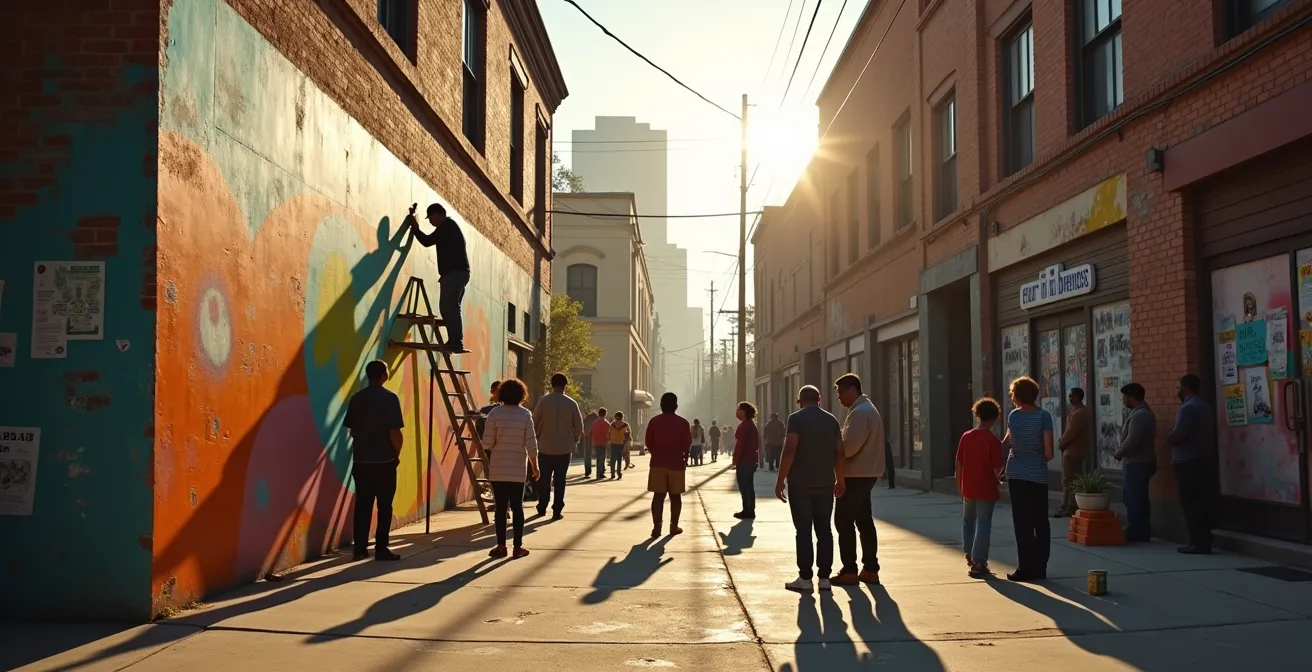
Contrary to the popular view of street art as simple beautification, it’s a complex social barometer revealing the tensions within a neighborhood.
- Murals can function as an early indicator of “aesthetic gentrification,” often preceding significant rent increases.
- The artistic and social value of street art is frequently tied to its illegality, creating a paradox where official sanction can diminish its power.
Recommendation: To understand urban art, look beyond the image and analyze its context—who painted it, who funded it, and who benefits from its presence.
A blank wall in a city is a vacuum. One day it’s a forgotten slab of brick and concrete; the next, it’s alive with color, telling a story. For decades, the dominant narrative has been that street art is the unfiltered “voice of the voiceless,” a raw and honest form of cultural expression that reclaims public space for marginalized communities. We see it as an act of rebellion, a splash of beauty in neglected corners, a challenge to the sterile authority of traditional art galleries. This perspective holds an important truth, but it misses the profound and often uncomfortable complexities simmering just beneath the paint.
As urban sociologists and art lovers, we are trained to see patterns. And the patterns emerging around street art are increasingly contradictory. What if the same mural that celebrates a community’s heritage is also the signal that attracts the very economic forces that will displace that community? What if the “rebellious” aesthetic of graffiti is being masterfully co-opted by corporations to sell a sanitized version of “cool”? The reality is that urban art is not a monologue; it’s a dialogue, and often a heated argument, happening in plain sight.
This article moves beyond the romanticized view of street art to dissect its role as a social battleground. We will analyze the mechanics of this conflict, revealing how the same creative act can be both a tool of resistance and an instrument of displacement. We will explore its fraught relationship with gentrification, the paradox of its value when it moves from illegal to legal, the ways it’s hijacked by commercial interests, and ultimately, how it can still function as a powerful tool for genuine community empowerment.
To navigate this complex urban landscape, we will break down the key dynamics at play. The following sections explore the tensions that define modern street art, from its economic impact to its cultural significance, providing a framework for reading the true stories written on our city walls.
Summary: The Social Dynamics of Street Art in Urban Spaces
- Why Murals Appear Just Before Rents Go Up in a Neighborhood?
- How to Photograph Street Art Before the City Buffs It Tomorrow?
- Permission Wall or Illegal Bombing: Does Legality Change the Artistic Value?
- The Corporate Co-opt: When Big Brands Use Street Style to Sell Soda
- How to Paint a Mural That the Neighbors Will Protect Instead of Deface?
- How to Use Visual Metaphors That 80% of Viewers Will Understand Immediately
- The Social Media Trap: Why High Follower Counts Don’t Equal High Art Value
- Open-Air Galleries: How Street Art Festivals Are Replacing Traditional Museums?
Why Murals Appear Just Before Rents Go Up in a Neighborhood?
The appearance of large, elaborate murals in a working-class neighborhood is often celebrated as a sign of cultural revitalization. However, for a sociologist, it can also be an early warning sign of what is known as “aesthetic gentrification.” This is the process where the cultural symbols of a community are used to rebrand an area, making it more attractive to wealthier newcomers and, consequently, more expensive for existing residents. The art, intended or not, becomes a leading indicator of displacement. This isn’t just a theory; market data reveals that some neighborhoods see a documented 5% rent increase in a single month following the appearance of new murals.
This dynamic is often more calculated than it appears. While some art is grassroots, other projects are quietly encouraged, or even commissioned, by property developers. They understand that a “vibrant,” “edgy,” and “artistic” neighborhood commands higher property values. By providing walls and tacit permission, they can cultivate an atmosphere of authenticity that serves a direct economic interest. As veteran artist Meres Ones noted in the Brooklyn News Service, this is a known phenomenon.
There have been cases where real estate people, or people that have buildings, didn’t necessarily care and would give legal permission to have artists do lettering
– Meres Ones, Brooklyn News Service
The mural thus serves a dual, conflicting purpose. For the artist and some residents, it is a cultural statement. For the developer and the incoming gentrifier, it is a decorative asset and a marketing tool, signaling that the neighborhood is “safe” for investment. The art becomes a harbinger of the economic tide that will soon wash over the very community it purports to represent.
How to Photograph Street Art Before the City Buffs It Tomorrow?
Street art is, by its very nature, ephemeral. Its existence is a constant negotiation with the elements, with other artists who might paint over it, and, most decisively, with municipal authorities. The “buff” — the flat coat of gray or beige paint used by city workers to erase graffiti — is an ever-present threat. This transient quality means that documenting street art is not just a hobby; it is an essential act of cultural preservation. The photographer becomes an archivist, creating an ephemeral archive of work that might disappear overnight.
Capturing the essence of a piece before it’s gone requires more than a simple snapshot. It demands an understanding of the art’s context and texture. The goal is to document not just the image, but its interaction with the urban environment: the crumbling brick, the rust-stained concrete, the play of light at a specific time of day. This is an act of bearing witness. To capture its soul, one must focus on the details that give it life. The image below illustrates the focused, deliberate act of this documentation.
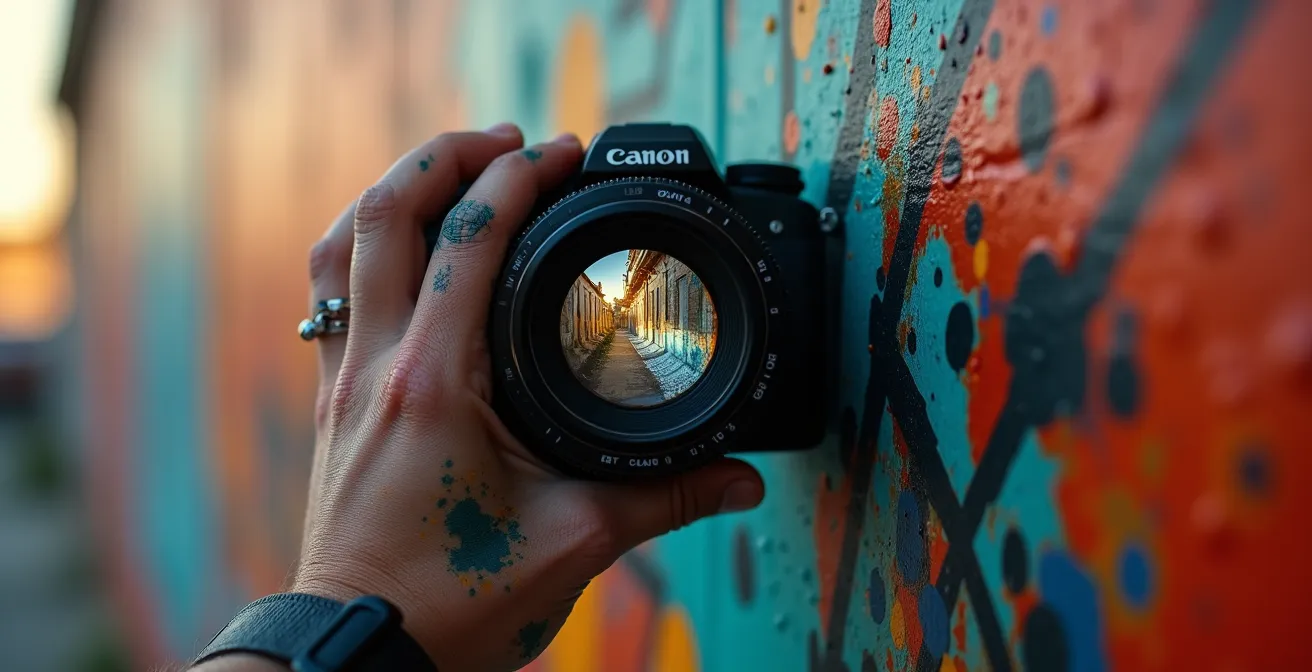
As this visualization shows, effective documentation is an intimate process. It involves capturing the layers of paint, the drips, and the texture of the wall itself. The best time to shoot is often during the “golden hour” at sunrise or sunset, when the low-angled light reveals every imperfection and detail, giving the work a three-dimensional quality. This careful act of recording ensures that even after the wall is buffed and the image is gone, its message and its presence persist in the digital and historical record.
Permission Wall or Illegal Bombing: Does Legality Change the Artistic Value?
A central tension in the world of urban art is the authenticity paradox: does a piece of art lose its power when it’s created with permission? An illegal “bombing,” executed quickly under the cover of darkness, carries an inherent message of risk, rebellion, and defiance against authority. A sanctioned mural on a “permission wall,” however, exists within a framework of approval. While it may be aesthetically brilliant, it lacks the raw, anti-establishment energy that defined graffiti’s origins. For many artists and observers, the illegal act is not incidental; it is an integral part of the artwork’s meaning.
This distinction is so critical that it is even codified by the most famous street artist of all, Banksy. Through his official authentication body, Pest Control, a clear line is drawn. As their policy states, street artworks created on public or private property are considered public art and are not authenticated for commercial sale. Only the prints and pieces created specifically for the market are given this stamp of approval. This creates a fascinating dynamic where the most “authentic” street pieces have no commercial value in the traditional art market, while their authorized replicas do. This system is reinforced by a formal process with authentication costs often exceeding £100, creating a clear boundary between the street and the gallery.
Case Study: Banksy’s Pest Control System
Pest Control, the official body for authenticating Banksy’s work, explicitly refuses to verify his pieces created in the street. Their website makes it clear: artworks on walls, doors, or other found objects in public spaces are public art, not commercial items. This self-imposed rule reinforces the idea that the value of his street work is cultural and contextual, not financial. It preserves the integrity of the public pieces as acts of commentary, separate from the works intended for the market, thus navigating the authenticity paradox by creating two distinct classes of art.
Ultimately, legality fundamentally alters the artwork’s relationship with power. An illegal piece challenges property rights and state control over public space. A legal piece, while valuable in its own right, operates with the consent of that same power structure. The artistic value may be subjective, but the social and political value is undeniably transformed.
The Corporate Co-opt: When Big Brands Use Street Style to Sell Soda
One of the most complex dynamics in modern urban art is “corporate hijacking.” This occurs when big brands, seeking to project an image of being edgy, authentic, and connected to youth culture, adopt the visual language of street art for their advertising campaigns. They hire artists to create large-scale murals that look like grassroots graffiti but are, in fact, meticulously planned commercial placements. This co-option neutralizes the rebellious spirit of the art form, turning a language of protest into a tool of consumerism.
The process is insidiously effective. As the FRESCO Collective astutely observes, the very nature of street art can be used to create a false sense of rebellion that serves a commercial or developmental agenda.
The use of murals as a tool of gentrification is both clever and deceptive: as an inherently transgressive art form, the presence of street art can create the illusion of insurgence and rebellion, while being created only at the mercy of developers and city planners.
– FRESCO Collective, The Changes of Street Art in the Face of Gentrification
A pristine, branded mural selling a soft drink, painted with professional equipment by artists on a payroll, is the aesthetic opposite of a quick, illegal tag. It borrows the visual style without any of the associated risk or political substance. The most tragic manifestation of this dynamic was the fate of 5 Pointz in Queens, New York. Once a world-renowned mecca for graffiti artists, its cultural capital helped make the neighborhood desirable. In 2013, the entire complex was whitewashed overnight and later demolished to make way for high-rise luxury condominiums, a stark example of art’s presence paving the way for its own destruction in the name of profit.
How to Paint a Mural That the Neighbors Will Protect Instead of Deface?
If murals commissioned by developers can accelerate gentrification and corporate art feels hollow, how can public art truly serve the community it inhabits? The answer lies in shifting the creation process from a top-down model to a deeply collaborative, grassroots effort. A mural that neighbors will fiercely protect is one they see as their own. It must be woven from the fabric of their lives, reflecting their histories, struggles, and aspirations. It is not enough to paint *for* a community; the art must be created *with* them.
This process moves beyond aesthetics to become an act of community organizing. It involves listening, relationship-building, and shared ownership. The artist’s role changes from a solitary creator to a facilitator, helping residents translate their collective stories into a powerful visual vernacular. When a mural contains symbols and narratives that resonate deeply with the people who walk past it every day, it becomes more than just a painting on a wall. It becomes a landmark, a source of pride, and a part of the neighborhood’s identity that residents will actively defend against defacement or erasure.
Creating such a piece requires a deliberate and inclusive methodology. It’s a slow, rewarding process that builds social cohesion as much as it creates art. The following plan outlines a proven approach for community-centered mural creation.
Action plan: Creating a community-owned mural
- Story-Gathering: Conduct workshops and interviews with residents, especially elders and youth, to identify hyper-local symbols, historical figures, and shared memories that define the neighborhood’s identity.
- Form a “Wall Council”: Establish a committee of diverse neighborhood stakeholders—such as long-term residents, local shop owners, youth leaders, and community activists—to guide the design process and ensure it aligns with community values.
- Interactive Design: Incorporate elements into the mural design where community members can physically add their own marks, names, or messages over time, making the wall a living document.
- Collaborative Painting Days: Organize public events where residents of all ages can participate in the actual painting of the mural, fostering a powerful sense of collective ownership and shared accomplishment.
How to Use Visual Metaphors That 80% of Viewers Will Understand Immediately
The power of street art as social commentary lies in its immediacy. Unlike a dense academic text, a mural must communicate its message in seconds to a passerby. To achieve this, artists rely on a powerful toolkit of visual metaphors and juxtapositions. By placing two or more familiar but contrasting images together, they can create a new, often startling meaning that challenges the viewer’s assumptions. This technique bypasses the need for text and speaks a near-universal language.
A classic example is an image of a dove of peace wearing a bulletproof vest, or a child letting go of a heart-shaped balloon that is actually a grenade. These juxtapositions work because they tap into a shared cultural dictionary of symbols. We instantly recognize the dove as a symbol of peace and the vest as a symbol of violence. Forcing them together in one image creates an immediate sense of cognitive dissonance and provokes a question in the viewer’s mind: in our world, does peace now need protection from violence?
Banksy is a master of this technique. His work is defined by its ability to provoke thought through clever and biting visual pairings. As described in a recent analysis of his work, Banksy’s art is characterized by its bold imagery and its use of juxtaposition to challenge authority and comment on social issues. For instance, his image of a protestor throwing a bouquet of flowers instead of a Molotov cocktail is instantly understood across cultures. It subverts the imagery of violent protest and replaces it with a call for peace, a complex idea conveyed in a single, powerful image.
The key for an artist is to use symbols that are widely understood but arrange them in a way that is unexpected. This creates a “visual pun” that is both easy to decode and deeply thought-provoking, ensuring the message lands with the vast majority of viewers, regardless of their background.
The Social Media Trap: Why High Follower Counts Don’t Equal High Art Value
In the digital age, social media platforms like Instagram have become the primary way many people experience street art. At first glance, this seems like a victory for democratization, bringing ephemeral public art to a global audience. However, this shift has created a significant “social media trap.” The platform’s emphasis on aesthetically pleasing, easily “likable” content often strips the art of its critical, political, or social context. A powerful piece of protest art is de-fanged, becoming just another colorful background for a selfie.
This phenomenon is not just anecdotal; it is observable in data. For instance, an analysis of #rinoartdistrict posts on Instagram, a heavily gentrifying area in Denver, reveals that the content shared by users has very little to do with the ongoing social and economic battles in the neighborhood. The political subtext of the art is erased in favor of a curated aesthetic. This transforms the digital representation of the neighborhood into a conflict-free zone of pretty pictures.
Researcher Erika Polson, in her study on the topic, provides a vivid description of this dynamic, highlighting the disconnect between the art’s potential meaning and its actual use on the platform.
Instagram posts from around the neighborhood reflected very little of the discursive battle. There, the #rinoartdistrict hashtag displayed the usual fare: pictures of women, couples, families, and dogs posing in front of the art.
– Erika Polson, From the Tag to the #Hashtag: Street Art, Instagram, and Gentrification
The trap is that artists may feel pressured to create work that is more “Instagrammable” — bright, graphic, and apolitical — to gain visibility and followers. This feedback loop risks sanitizing the entire art form, prioritizing high follower counts over high artistic or social value. The algorithm favors beauty over substance, and in the long run, this can dilute the power of street art as a tool for genuine social commentary.
Key Takeaways
- Art as an Economic Signal: Murals can serve as an early warning sign of “aesthetic gentrification,” often correlating with rising rents and the displacement of long-term residents.
- The Authenticity Paradox: The cultural and political value of street art is often deeply connected to its illegality; the process of legalizing or commercializing a piece can dilute its original message of resistance.
- Community Is Key: The most resilient and meaningful public art is co-created with local residents, reflecting their own stories and creating a “visual vernacular” that the community will actively protect.
Open-Air Galleries: How Street Art Festivals Are Replacing Traditional Museums?
While some street art is co-opted and some is lost to the buff, a powerful new model has emerged: the street art festival. These events are transforming entire districts into sprawling, open-air galleries. By inviting dozens of artists to paint in a concentrated area over a short period, they create an immersive artistic experience that fundamentally challenges the traditional museum model. This movement is not just about decorating a city; it’s about radically democratizing access to art.
The primary advantage of this model is its accessibility. Traditional museums and galleries, with their admission fees and intimidating atmospheres, can be exclusionary spaces. Street art festivals, by contrast, are free and integrated into the public realm. As Walls of Justice, an organization dedicated to social justice murals, puts it, this is a revolutionary shift in how the public engages with culture.
When art is housed in a museum or gallery, the public must choose (and often, pay) to engage with it. When it moves to the public realm, however, everyone has access. And that accessibility is key.
– Walls of Justice, Social Justice Murals: How Street Art Fuels Social Change
This model creates a dynamic, ever-changing cultural landscape where art is a part of everyday life, not something set apart from it. While these festivals can still be linked to gentrification, the best-run events actively work with communities to ensure the art reflects local culture. They provide a platform for a diverse range of voices, from international stars to emerging local talent, creating a dialogue on the city’s walls. This is confirmed by studies on free public access versus paid museum entry, which highlight the profound difference in audience reach and diversity.
By turning the city itself into a gallery, these festivals are creating a new paradigm for cultural institutions. They are more fluid, more inclusive, and more responsive to the contemporary moment than their brick-and-mortar counterparts, suggesting a future where our most important art isn’t confined within walls, but painted upon them.
To truly understand the narratives on your city’s walls, the next step is to start observing them through this critical lens. Pay attention not only to what a mural depicts, but also to where it is, who is taking pictures of it, and what new businesses are opening nearby. The story is always bigger than the image itself.