In summary:
- Hidden import costs are predictable and can be calculated in advance by accounting for duties, VAT, brokerage fees, and insurance on the total value.
- Standard couriers handle packages; art specialists manage assets. The difference lies in “nail-to-nail” insurance, condition reporting, and liability.
- Authenticity and ownership are verified through a rigorous documentation chain, including the Certificate of Authenticity (COA) and pre-shipment condition reports.
- Specialized packing, like floating crates and acclimatization protocols, is not an expense but a critical procedure to protect the artwork’s physical and financial value.
The thrill of discovering a unique piece of art in a foreign gallery or online marketplace is a powerful feeling. You’ve found it—the perfect work that speaks to you. But this initial excitement is often swiftly followed by a wave of anxiety: how do you get it home? The journey of a painting or sculpture across borders is fraught with potential complications, from bewildering customs forms to the terrifying possibility of damage in transit. Many new collectors are told to simply “check customs fees” or “get insurance,” but this generic advice fails to address the specific, high-cost failure points that can turn a prized acquisition into a financial and emotional disaster.
The core issue is that buying art internationally is not a simple retail transaction; it is a complex logistical project. The risks are not just about blatant damage but also about subtle value erosion through hidden fees, currency conversion traps, and documentation errors. The true secret to a successful international acquisition lies not in hoping for the best, but in implementing a procedural, verification-first mindset. It’s about understanding the system to preemptively neutralize the logistical landmines before they detonate.
This guide moves beyond the platitudes to provide an expert, procedural framework. We will dissect the most common and costly mistakes collectors make, from underestimating landing costs to choosing the wrong shipping partner. By the end, you will have a clear roadmap to navigate the complexities of international art acquisition, ensuring your masterpiece arrives safely, legally, and without a cascade of unexpected expenses.
To help you master this process, this article breaks down the essential checkpoints for a secure international art purchase. Explore the full table of contents below to navigate directly to the risk factors most relevant to you.
Summary: Verified International Acquisition: How to Buy Art Abroad Without Customs Nightmares
- Why Your $2,000 Painting Might Cost $2,600 After Entering Your Country?
- How to Validate a Certificate of Authenticity via Email Before Wiring Money
- Standard Courier vs. Art Specialist: Who Covers the Tear in the Canvas?
- The Exchange Rate Mistake That Can Cost You $500 on a Single Transfer
- When to Book a Crate: The Timeline for Shipping Large Art Overseas
- The Shipping Error That Ruins 1 in 50 Marketplace Deliveries
- How to Build a ‘Floating Crate’ so Packaging Never Touches the Surface
- Heavy Impasto Relief: How to Transport and Maintain 3D Paintings Without Cracking?
Why Your $2,000 Painting Might Cost $2,600 After Entering Your Country?
One of the most common shocks for international art buyers is the “landed cost”—the total price of getting an artwork from the seller’s wall to yours. The sticker price is just the beginning. That $2,000 painting can easily become a $2,600 liability because of a series of cumulative fees that are often overlooked. While many original works of art are free from basic customs duty under international tariff agreements (like Chapter 97 of the Harmonized System), this is just one small piece of the puzzle. The real costs come from other sources.
The primary addition is the Value Added Tax (VAT) or Goods and Services Tax (GST), which is calculated not just on the artwork’s price but on the total CIF value (Cost, Insurance, and Freight). If your $2,000 painting costs $300 to ship and insure, a 20% VAT would be applied to the $2,300 total, adding $460. On top of this, you must factor in customs brokerage fees, which are charges from the logistics company for preparing and submitting the required import declarations. These can range from $200 to over $800. Finally, there are often smaller, yet significant, charges like airport handling fees and disbursement fees. A detailed breakdown published by logistics experts reveals that these costs are not random but part of a standardized international art shipping cost structure.
For US importers, it’s also crucial to understand the “de minimis” threshold. While small purchases under this value may enter duty-free, most serious art acquisitions will exceed the limit and require a formal entry process, triggering these associated costs. The key takeaway is that these expenses are not a surprise but a predictable part of the process. A reputable seller or art shipper should be able to provide a pro-forma invoice that estimates these costs for you before you commit to the purchase.
How to Validate a Certificate of Authenticity via Email Before Wiring Money
Before any money changes hands, particularly in a cross-border transaction, verifying the artwork’s authenticity is paramount. The primary tool for this is the Certificate of Authenticity (COA), but a simple PDF attached to an email is no longer sufficient proof in a world of sophisticated forgery. A COA is more than a piece of paper; it’s the anchor of the artwork’s provenance and a critical part of its value. As one expert in a leading guide on art certificates states, “The strongest authentication comes when both excellent provenance and a proper certificate exist for the same artwork.” True validation requires a procedural approach.
The first step is to scrutinize the COA itself. It should contain specific details: the artist’s full name, the work’s title, year of completion, dimensions, and medium. It should be signed by an appropriate authority—ideally the artist themselves, the representing gallery director, or a recognized expert on the artist’s work. If you receive a COA via email, ask for the contact information of the signing authority. A legitimate seller will have no issue with you reaching out to the gallery or expert to confirm they did, in fact, issue that specific certificate.

Modern technology offers more robust solutions to this age-old problem. A growing number of services are using blockchain to create immutable records of authenticity. In this model, the COA exists as a non-fungible token (NFT) on a secure blockchain, often linked to a physical NFC tag on the artwork itself. This digital-physical link makes forgery nearly impossible and allows for instant, real-time verification from anywhere in the world. For instance, The Fine Art Ledger’s blockchain system demonstrates how an artwork’s entire history, from creation to current ownership, can be securely and transparently tracked. When dealing with high-value international purchases, asking if a digital or blockchain-based COA is available is becoming a standard part of due diligence.
Certificates of Authenticity (COAs) are formal documents that verify an artwork is genuine and created by the attributed artist. The strongest authentication comes when both excellent provenance and a proper certificate exist for the same artwork.
– VerifyEd Digital Authentication Expert, Authenticity Art Certificates Guide 2025
Standard Courier vs. Art Specialist: Who Covers the Tear in the Canvas?
This question cuts to the heart of one of the most critical decisions in international art acquisition. The choice between a household-name courier and a dedicated fine art shipper can mean the difference between a seamless delivery and a total loss. While it may be tempting to save money with a standard service, the risks are astronomical, a fact underscored by insurance data. Indeed, studies indicate that up to 85% of all art insurance claims are related to damage that occurs during transit. This is a clear signal that transport is the single greatest moment of risk for your artwork.
The fundamental difference lies in their business models and, consequently, their handling of liability. A standard courier’s network is optimized for speed and volume of standardized boxes. An artwork is just another package. An art specialist, however, is a logistics manager for unique, high-value assets. Their entire process is built around risk mitigation. This includes using climate-controlled vehicles with air-ride suspension, employing trained art handlers for packing and installation, and maintaining a meticulous chain of custody with photographic condition reports at every handover. Most importantly, it’s about the insurance. A standard courier offers “declared value,” which is not true insurance. In the event of a claim, the burden of proof is on you to demonstrate the courier’s negligence, an often impossible task.
An art specialist, by contrast, provides “nail-to-nail” or “all-risk” fine art insurance. This policy covers the artwork from the moment it is removed from the wall at its origin to the moment it is securely hung at its destination, including all packing, transit, and storage in between. The liability is clear, and the claims process is managed by the specialist on your behalf. The distinction is not trivial; it is the core of asset protection.
The following table, based on information from an analysis by Distinguished Insurance Services, clarifies the critical differences in coverage.
| Coverage Aspect | Standard Courier | Art Specialist |
|---|---|---|
| Coverage Type | Declared Value only | Nail-to-Nail comprehensive |
| Coverage Period | During transit only | From removal to re-installation |
| Condition Reports | None or basic | Photo-documented at every handover |
| Claims Process | Buyer manages entirely | Specialist manages for you |
| Proof Required | Must prove shipper negligence | Clear timeline establishes liability |
The Exchange Rate Mistake That Can Cost You $500 on a Single Transfer
When purchasing art abroad, the final price is subject to the whims of the foreign exchange (FX) market. However, the most significant financial losses often come not from market fluctuations, but from avoidable transactional mistakes. The most common and costly of these is accepting Dynamic Currency Conversion (DCC). When a foreign seller’s payment terminal or online checkout asks if you want to pay in your home currency, it seems like a convenience. In reality, it is a trap. By accepting, you are allowing the seller’s bank to set the exchange rate, which is typically padded with a margin of 3-7% above the wholesale rate. On a $10,000 artwork, this “convenience” could cost you an extra $300-$700 instantly. The ironclad rule is: always pay in the seller’s local currency.
Beyond avoiding DCC, the next step is to minimize the “spread”—the difference between the wholesale interbank rate and the retail rate you are offered. Banks are notorious for offering poor rates on international wire transfers, often with spreads of 2-4%. For significant purchases, using a specialized forex service (like Wise, Revolut, or a dedicated FX broker) can reduce this spread to under 1%, saving hundreds or even thousands of dollars. For very high-value acquisitions, consider a forward contract, which allows you to lock in a favorable exchange rate for a future payment date, protecting you from adverse market movements.
Case Study: The Importance of Vetted Payment Protocols
A collector’s experience highlights the importance of the entire financial chain. After purchasing what was believed to be a 14th-century masterpiece, an appraisal revealed it was a 16th-century copy, a difference of millions in value. Because the transaction was conducted through a reputable dealer with a formal warranty of authenticity and clear refund protocols, the buyer was able to receive a full reimbursement. This case underscores that financial due diligence isn’t just about the exchange rate; it’s about ensuring the entire transaction is backstopped by professional reliability before sending an international wire transfer.
Finally, for ultimate security, especially when dealing with a new seller, using an art-specific escrow service is the gold standard. These services hold your payment and only release it to the seller after you have received the artwork and verified its condition, eliminating the risk of fraud or non-delivery. This procedural approach to payment turns a moment of high financial risk into a controlled, secure transaction.
When to Book a Crate: The Timeline for Shipping Large Art Overseas
Successfully shipping large or high-value art internationally is an exercise in reverse-chronology. You cannot simply decide to ship a piece and expect it to arrive next week. The process is governed by a series of interdependent timelines involving crating, customs, and transit. The first critical threshold to be aware of, especially for US imports, is value. According to US Customs and Border Protection requirements, any importation valued at over $2,500 requires a formal entry, necessitating the use of a customs broker and triggering a more complex documentation process. This is the point where ad-hoc shipping is no longer an option.
The most effective way to plan is to use a reverse timeline, starting from your desired installation date and working backward. A professional art logistics company will follow a similar procedure:
- Installation & Acclimatization (3 days): Allow one day for installation and at least 48 hours for the artwork to acclimatize to the new environment before unpacking.
- Customs Clearance (5-10 days): This is a major variable. While routine clearances can be quick, an inquiry or inspection can add significant delays.
- International Transit (7-20 days): Air freight is faster but more expensive (7-10 days). Sea freight is slower (3-5 weeks) but more economical for very large or heavy works.
- Crate Construction (5-7 days): A custom, museum-quality crate cannot be built overnight. It requires precise measurements and construction by skilled professionals.
- Export Permits (30-60 days): This is the longest and most critical lead time. If the artwork is an antique or contains materials regulated by CITES (e.g., ivory, certain woods), obtaining an export permit can take months and must be initiated long before any shipping is booked.
This reverse timeline makes it clear that the process should begin at least one to two months before your desired delivery date. Initiating the conversation with an art shipper as soon as the purchase is confirmed is the only way to ensure all steps are properly coordinated.
The Shipping Error That Ruins 1 in 50 Marketplace Deliveries
The catastrophic failure that can ruin an international art shipment often has nothing to do with a clumsy handler or a bumpy flight. More frequently, the disaster is a quiet one, rooted in a single missing signature or an incorrectly filled-out form. Documentation errors are a primary cause of customs delays, seizures, and even forced returns. A seemingly minor mistake on a commercial invoice or customs declaration can halt a multi-million dollar painting at a border for weeks, exposing it to unnecessary risks in a warehouse. The “1 in 50” error is not a physical slip-up, but a procedural failure in the paper (or digital) trail that accompanies the art.
One of the most critical, yet often overlooked, pieces of documentation is the condition report. This is not just a cursory note; it’s a detailed, photographic record of the artwork’s state before it is packed. As an expert from Aspen Specialty Insurance warns, “Condition reports to be taken throughout the journey are a very critical point because without a condition report up-front, you could have art that was damaged before shipment. That creates a very difficult loss adjustment process down the road.” Without this baseline, it is impossible to prove when and where damage occurred, effectively nullifying your insurance claim.
The required customs documentation also varies significantly by country, creating a minefield for the inexperienced. For example, shipments to the EU require an EORI number on the commercial invoice, while business imports into the US necessitate a CBP Form 7523. Antiques over a certain age may require specific export permits from their country of origin. An art specialist’s role is not just to transport the work, but to act as a documentation expert, ensuring every form is present and correctly completed for every jurisdiction the artwork will pass through.
| Document Type | USA Requirements | EU Requirements | When Required |
|---|---|---|---|
| Commercial Invoice | 3 copies with HS code | Include EORI number | All commercial shipments |
| CBP Form 7523 | Required for business imports | Not applicable | All US art imports |
| ACE Manifest | For values over $2,500 | Not applicable | High-value shipments |
| Export Permits | Not typically required | Required for art over 50 years | Antiques and cultural property |
| Certificate of Authenticity | Recommended | Recommended | All original artworks |
Condition reports to be taken throughout the journey are a very critical point because without a condition report up-front, you could have art that was damaged before shipment. That creates a very difficult loss adjustment process down the road.
– Aspen Specialty Insurance, Risk & Insurance Art Transport Report
How to Build a ‘Floating Crate’ so Packaging Never Touches the Surface
For artworks with delicate surfaces—such as those with heavy impasto, mixed media, or a glossy, fragile finish—standard crating is insufficient. The slightest vibration during transit can cause packing materials to abrade, scuff, or even adhere to the artwork’s surface, causing irreversible damage. The solution, used by museums and top-tier galleries, is the “floating crate” or “travel frame” system. This specialized technique is the gold standard for ensuring that nothing ever touches the face of the painting during shipment.
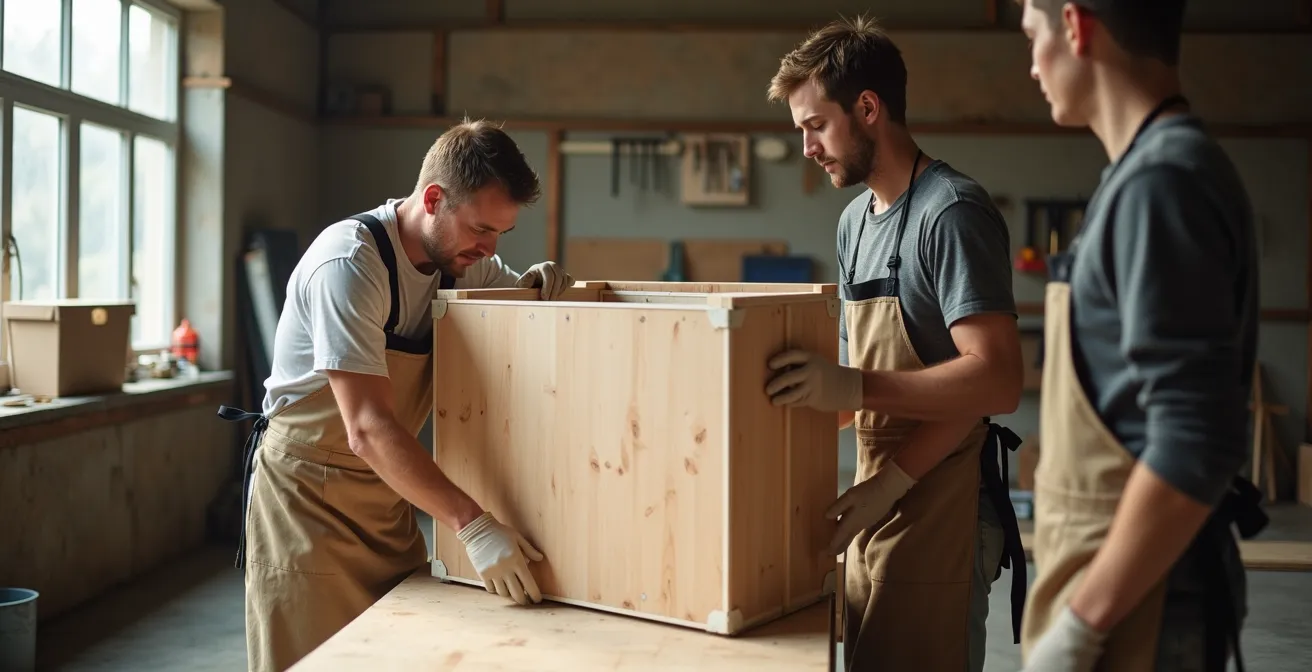
The principle is simple yet ingenious: the artwork is first secured to an inner “travel frame.” This frame attaches to the back or the sturdy edges of the artwork’s stretcher bars or chassis. This entire unit—artwork plus travel frame—is then suspended within a larger, custom-built wooden crate. The suspension is achieved using high-density foam blocks (like Ethafoam) that brace the inner frame against the outer crate walls. The result is a “cavity” of air around the entire face of the artwork. The painting “floats” within its protective shell, completely isolated from direct contact and buffered from shock and vibration.
Building such a crate is a specialized skill. It involves not just the suspension system but also a layered approach to environmental protection. The crate’s interior is often lined with a breathable vapor barrier like Tyvek to prevent moisture buildup. Desiccant packs (silica gel) may be added to control humidity. Any foam that might come into minimal contact with the artwork’s edges is a soft, non-abrasive material like Volara. For maximum protection on international journeys, this primary floating crate is sometimes placed inside a second, larger “outer crate” for an additional layer of insulation and security. This is the pinnacle of preventative care.
Your Action Plan: Museum-Standard Floating Crate Construction
- Secure the artwork to an inner travel frame, ensuring no contact with the artwork’s face.
- Use dense Ethafoam to create structural bracing and corners that will suspend the inner frame.
- Apply soft Volara foam only at points where minimal, incidental contact with the artwork’s protected edges is unavoidable.
- Line the interior of the outer crate with a Tyvek breathable vapor barrier to mitigate moisture.
- Add silica gel desiccant packs inside the Tyvek barrier to actively control humidity levels during transit.
Key takeaways
- The final price of an imported artwork is a predictable sum of its cost, insurance, freight, VAT, and brokerage fees; it should never be a surprise.
- The choice is not between shippers, but between risk transfer and risk retention. An art specialist with “nail-to-nail” insurance transfers the risk away from you.
- A complete and verified documentation trail, including the COA, bill of sale, and photographic condition reports, is your primary defense in any potential dispute or insurance claim.
Heavy Impasto Relief: How to Transport and Maintain 3D Paintings Without Cracking?
Artworks with heavy impasto or three-dimensional relief surfaces present a unique set of challenges that go beyond even the most robust crating. The thick, sculptural layers of paint are inherently fragile. They are susceptible to cracking and flaking due to vibrations and, most critically, to rapid changes in temperature and humidity. The safe transport and long-term preservation of these works depend on a strict protocol of environmental control and patient acclimatization. The biggest mistake a collector can make is to excitedly uncrate a new impasto work the moment it arrives.
The professional standard is a 48-hour acclimatization protocol. When the sealed crate arrives, it must be left in the destination room for at least 24 hours. This allows the air and materials inside the crate to slowly equalize with the room’s temperature. On the second day, the crate can be opened, but the artwork should remain in its soft, protective wrappings for another 24 hours. This two-stage process prevents the sudden condensation and material expansion/contraction that can cause fresh cracks to form in the brittle paint. Before shipping, it’s also wise to have a conservator assess fragile areas and apply consolidants if necessary to stabilize the paint layer.
Long-term maintenance is equally procedural. Dusting should only be done with a very soft, clean badger brush, as cloths can snag on the paint’s texture and cause damage. A stable environment is crucial, with relative humidity maintained between 45-55% year-round. This is why “nail-to-nail” insurance is so comprehensive; it recognizes that risk extends to these environmental factors. As one leading insurer notes, this type of coverage is designed to protect the work from the moment of deinstallation through packing, transit, and reinstallation, implicitly covering the need for these careful procedures.
Nail-to-nail insurance provides coverage for artwork or collectibles from the moment they’re removed from the wall at the point of origin to the moment they’re securely installed at their final destination, including packing, transit, and temporary storage along the way.
– Distinguished Insurance Services, Art Transit Insurance Guide 2025
By following these procedural steps for verification, logistics, and handling, you transform the acquisition of international art from a gamble into a secure and rewarding process. To begin your next acquisition with confidence, start by demanding a full, itemized pro-forma invoice that details every component of the landed cost before you commit.