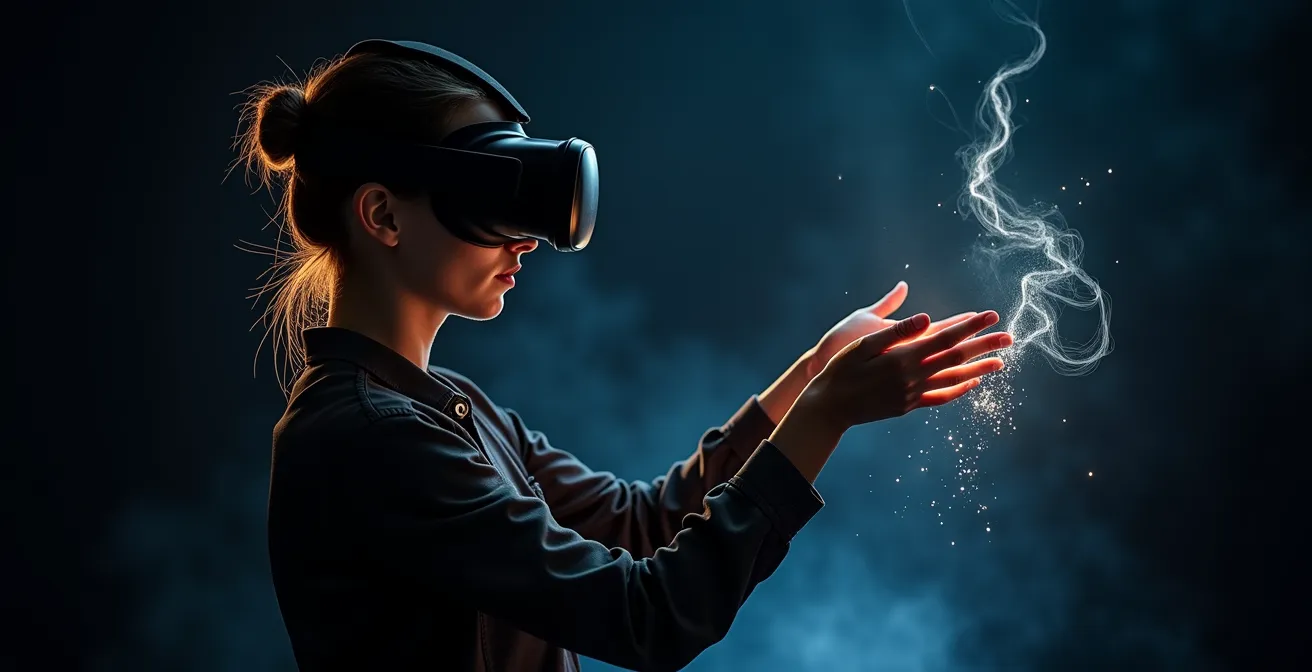
Creating true VR presence isn’t about chasing perfect graphics; it’s about strategically deceiving the user’s brain.
- Vestibular coherence and binaural audio have a greater impact on immersion than texture resolution.
- Narrative and lighting must guide, not force, a user’s attention in a 360° space.
Recommendation: Focus on managing cognitive load and sensory hierarchy to make your virtual world feel not just seen, but physically *present*.
There’s a distinct, jarring moment in a mediocre VR experience when the magic shatters. The world, once captivating, suddenly feels like a screen strapped to your face. The illusion of presence—that feeling of being physically and mentally ‘there’—is broken. Many artists and developers believe the solution is to simply boost the poly count, sharpen the textures, or add more interactive objects. They chase a photorealistic replica of our world, believing fidelity is the key to immersion.
But what if the secret to presence lies not in what the user sees, but in what their subconscious brain *believes*? True immersion is a psychological hack. It’s an act of delicate sensory manipulation that convinces the primal, instinctual parts of the mind that the virtual is real. It’s about understanding the deep-seated expectations of our senses—hearing, balance, and spatial awareness—and satisfying them so completely that the brain has no choice but to accept its new reality. This is not about brute-force rendering; it’s about sophisticated design.
This guide moves beyond surface-level technical advice. We will explore the neuroscientific and psychological principles that underpin presence. We will deconstruct how to manage sensory conflicts, guide attention with sound and light, structure experiences for human comfort, and tell stories in a world where the director no longer controls the frame. It’s time to stop designing for the hardware and start designing for the human mind.
For a practical look at the tools that bring these concepts to life, the following video explores some of the best applications for creating VR art, from sculpting to painting in a virtual space.
To navigate this deep dive into the psychology of VR design, we have structured the article around key challenges and their solutions. The following summary outlines the core topics we will address, each designed to build upon the last and provide a comprehensive framework for creating genuine presence.
Summary: The Psychology of Designing Tangible Virtual Worlds
- Why Smooth Locomotion Makes 30% of Viewers Sick and How to Fix It?
- How to Place Sound Sources to Guide the Viewer’s Attention in 360 Degrees
- Walk-Around Gallery or Sit-Down Journey: Which Fits the Average User’s Living Room?
- The Heavy Helmet Issue: Why VR Art Experiences Should Not Exceed 20 Minutes
- How to Make Your Art Look Good on a Quest 2 Without Dropping Frames?
- Caravaggio or Kubrick: How Cinematic Lighting Borrowed from Baroque Painting?
- Why Binaural Audio Is More Important Than 4K Graphics for Presence?
- Immersive Storytelling: How to Tell a Story When the Viewer Can Look Anywhere?
Why Smooth Locomotion Makes 30% of Viewers Sick and How to Fix It?
The single greatest destroyer of presence is VR sickness. It’s not a weakness of the user; it’s a failure of design. This phenomenon arises from a fundamental neurological conflict known as vestibular dissonance. Your eyes perceive smooth, continuous movement through the virtual world, but your inner ear—the body’s sophisticated balance system—reports that you are stationary. This sensory mismatch sends a panic signal to the brain, which often interprets it as a sign of neurotoxin poisoning, triggering nausea as a defense mechanism.
This isn’t a minor issue; according to a comprehensive review of multiple studies, between 40-70% of VR users experience this debilitating sickness. Research has also shown a notable difference in susceptibility, with one survey revealing women are over three times more likely to experience frequent VR motion sickness than men. To create presence, you must first eliminate this profound biological rejection of the virtual world. The goal is to restore coherence between what the user sees and what their body feels.
The solution isn’t to abandon movement but to design it intelligently. Instead of smooth, joystick-controlled locomotion that creates the most intense sensory conflict, designers can:
- Implement teleportation: This method of instantaneous point-to-point movement avoids the perception of motion altogether, preventing the sensory conflict.
- Use a static frame of reference: Techniques like adding a virtual nose or a cockpit frame (Nasum Virtualis) provide the brain with a stable anchor, reducing the feeling of disembodied movement.
- Minimize acceleration: Constant velocity is less nauseating than rapid changes in speed. If smooth locomotion is necessary, ensure it has gentle start and stop curves.
- Link movement to physical action: Room-scale VR, where users physically walk, is the gold standard as it perfectly syncs visual and vestibular input.
By prioritizing vestibular comfort, you are not just preventing sickness; you are laying the foundational trust required for the brain to accept the virtual world as a plausible space.
How to Place Sound Sources to Guide the Viewer’s Attention in 360 Degrees
In a 360-degree environment, the artist loses their most powerful tool: the frame. You can no longer dictate where the viewer looks. Attempting to force their attention with jarring visual cues only breaks immersion, reminding them they are in a constructed experience. The key to directing attention subtly and effectively lies in leveraging a different, more primitive sense: hearing. The brain possesses a powerful sensory hierarchy, and for spatial awareness, audio often trumps visuals.
A sound from behind you doesn’t suggest you should turn; it *compels* you to. This instinctual reaction is a tool for the VR artist. By placing diegetic sound sources—sounds that originate from within the world of the art piece—you can create an invisible thread that guides the viewer’s gaze. A rustle in the leaves to the left, the distant echo of a voice down a hallway, the hum of a machine overhead—these are your new narrative signposts. They don’t just tell the viewer where to look; they make them *want* to look, fostering a sense of discovery and agency.

As visualized above, spatial audio isn’t a flat layer of sound; it’s an architectural element. Each sound source should have a precise location in 3D space, with its properties (volume, reverb, occlusion) changing realistically as the viewer moves. This creates a rich, navigable soundscape that enhances presence by providing constant, subconscious spatial information. The brain starts to map the environment through hearing, building a mental model of the space that feels solid and real, even for objects outside the field of view.
Walk-Around Gallery or Sit-Down Journey: Which Fits the Average User’s Living Room?
The choice between a room-scale “walk-around” experience and a “sit-down” journey is a fundamental decision that defines the user’s relationship with your art. It’s a trade-off between physical freedom and narrative control, and the right choice depends on your artistic intent and, crucially, the practical limitations of your audience. A walk-around gallery leverages proprioceptive feedback—the brain’s sense of body position—to create a powerful, one-to-one connection with the virtual space. Walking in VR as you do in reality is a potent ingredient for presence.
However, this requires a significant physical footprint that many users simply do not have. A sit-down journey, while risking the vestibular dissonance we discussed earlier, offers a more accessible and controlled experience. It transforms the user from an explorer into a passenger on a curated tour, allowing for precise narrative pacing and dramatic reveals. As a comparative analysis of VR art approaches shows, each format serves a different purpose, trading user agency for narrative focus.
| Aspect | Walk-Around Gallery | Sit-Down Journey |
|---|---|---|
| Space Required | Minimum 2m x 2m clear area | Chair space only |
| User Agency | High – co-creator of journey | Moderate – curated experience |
| Motion Sickness Risk | Lower (natural movement) | Higher (artificial locomotion) |
| Spatial Focus | Extrapersonal (architectural awe) | Peripersonal (intimate interaction) |
| Narrative Control | User-directed exploration | Artist-authored arc |
The decision impacts the psychological scale of your work. A walk-around experience excels at creating “extrapersonal” awe—the feeling of being small within a grand, architectural space. A sit-down journey is better suited for “peripersonal” intimacy—examining detailed objects up close or having curated encounters. A hybrid approach, offering both teleportation for large-scale movement and room-scale for localized exploration, often provides the best balance of accessibility and immersion.
The Heavy Helmet Issue: Why VR Art Experiences Should Not Exceed 20 Minutes
The physical weight and discomfort of a VR headset are obvious limitations. But the more insidious barrier to long-form VR art is cognitive load. The brain is not a passive recipient of information; it is actively working every second to interpret and validate the virtual world. It’s processing visual data, spatial audio cues, and reconciling them with the body’s vestibular and proprioceptive feedback. This constant, subconscious effort is mentally exhausting.
Even in a perfectly designed experience with zero motion sickness, this sensory and cognitive processing takes a toll. After about 20 minutes, sensory fatigue begins to set in. The initial “wow” factor fades, and the brain’s critical faculties start to notice small inconsistencies. The magic of presence becomes fragile and easily broken. This is compounded by the very real after-effects of VR; studies indicate that while 60% of users recover within 30 minutes of a session, a significant portion experiences lingering disorientation. Furthermore, other research suggests that simple exposure time can be a more significant factor in cybersickness than the intensity of the stimuli, reinforcing the need for brevity.
Therefore, the 20-minute mark is not an arbitrary limit; it’s a strategic design constraint rooted in human psychology and physiology. Your goal as an artist is to deliver the most impactful, concentrated experience possible within this optimal window. Think of your VR art not as a feature-length film, but as a powerful short story or a single, breathtaking musical piece. Designing for brevity forces you to distill your vision to its most potent essence, ensuring the user leaves at the peak of their immersion, not at the trough of their exhaustion.
How to Make Your Art Look Good on a Quest 2 Without Dropping Frames?
Optimizing for standalone headsets like the Meta Quest 2 is often seen as a process of compromise—reducing quality to fit within tight performance budgets. This is the wrong perspective. Optimization is not about downgrading your art; it’s about making deliberate stylistic choices that prioritize the single most important factor for presence: a perfectly smooth, stable frame rate. A dropped frame is a stutter in reality, a tear in the fabric of the virtual world that instantly shatters the illusion.
Instead of chasing photorealism, which is computationally expensive, embrace aesthetics that are inherently performant. Techniques like flat shading, low-polygon modeling, and stylized, unlit textures can create stunning visual worlds that run flawlessly. The goal is to trade computational complexity for artistic intent. Rather than a million-polygon sculpture that chugs the processor, create a thousand-polygon version where every facet is a deliberate artistic choice, catching the light in a beautiful, geometric way.

Beyond artistic style, technical optimization is key. Use baked lighting to pre-calculate complex shadows and light bounces, saving massive amounts of real-time processing. Employ foveated rendering where possible, which renders the area in the user’s direct gaze at high resolution while lowering it in the periphery, mimicking natural human vision. Aggressively use texture atlases and draw call batching to reduce the overhead on the CPU. Every decision should serve the ultimate goal: to maintain a rock-solid frame rate that eliminates any potential for judder, which is a primary contributor to the vestibular dissonance that causes sickness and breaks presence.
Caravaggio or Kubrick: How Cinematic Lighting Borrowed from Baroque Painting?
Lighting in VR is not just for illumination; it is your primary tool for directing attention, creating mood, and defining space. The masters of Baroque painting, like Caravaggio, understood this instinctively. They used Chiaroscuro—the dramatic interplay of intense light and deep shadow—to guide the viewer’s eye to the emotional heart of a scene, creating a sense of intimacy and profound drama. This centuries-old technique is more relevant than ever in the 360-degree canvas of VR.
In a boundless virtual world, a focused beam of light acts as a spotlight, telling the user “look here.” A dark, foreboding corner suggests mystery and begs for cautious exploration. However, VR adds a dimension that painting and cinema never could: the viewer can move. As one VR design analysis notes, the medium fundamentally changes our relationship with light.
Focus on how VR’s 6DoF shatters the fixed frame of painting and cinema. The viewer can move around the light.
– VR Design Analysis, Stepping Inside Art In VR
This means light must be volumetric and dynamic. It’s not a 2D effect but a tangible substance the user can step into and out of. Implementing volumetric fog allows you to create visible sunbeams or god rays, turning light into a physical presence. The color temperature of your lights directly manipulates emotion—warm, golden light fosters comfort, while stark, cool light can evoke unease or sterility. By treating light as a sculptural element, you can carve out your narrative path from the darkness.
Your Action Plan: Implementing Volumetric Lighting in VR Art
- Use practical lights as interactive objects (lanterns, torches) that users can manipulate to feel agency.
- Apply Chiaroscuro techniques with strong light/dark contrast for focus and intimacy.
- Implement volumetric fog to make light beams tangible, with visible dust particles adding to the realism.
- Position key lights at 45-degree angles to the subject to create the classic, shaping Rembrandt lighting effect.
- Vary color temperature (from a warm 2700K to a cool 6500K) to directly influence the viewer’s emotional response.
Why Binaural Audio Is More Important Than 4K Graphics for Presence?
The pursuit of 4K textures and hyper-realistic models in VR is often a fool’s errand. The human eye is incredibly adept at spotting flaws—a slightly off reflection, a texture that repeats, a model that lacks perfect detail. High-fidelity graphics can paradoxically pull a user *out* of an experience by creating an “uncanny valley” effect. The brain’s auditory system, however, is far more forgiving and, for spatial presence, far more powerful.
This is where binaural audio becomes the most critical, yet often underrated, tool for immersion. Unlike stereo, which only provides left/right directionality, binaural audio simulates how the human ear naturally perceives sound in 3D space. It accounts for the time difference, frequency filtering, and sound bouncing that occurs as sound waves interact with the listener’s head and ears. The result is a perfect 3D soundscape where the brain can pinpoint a sound’s location—above, below, behind, or in the distance—with uncanny accuracy.
This creates a stable, believable spatial map in the user’s mind. While their eyes might be looking at a low-polygon tree, their ears can hear the wind rustling its specific leaves and a bird chirping on a branch behind them. This auditory reality anchors the visual, making it more believable than it would be on its own. A world that *sounds* perfectly real is easier for the brain to accept, even if it doesn’t *look* perfectly real. The sound of footsteps on gravel in peripersonal space—the area immediately surrounding the body—is a more powerful affirmation of presence than the most detailed 4K texture on a distant mountain.
Prioritizing your development budget on a masterfully crafted binaural soundscape over a marginal increase in graphical fidelity is one of the most effective strategies for achieving deep, unshakable presence.
Key Takeaways
- Presence is a psychological hack, not a graphical benchmark; it’s about deceiving the brain’s expectations.
- Binaural audio and stable locomotion are more crucial for immersion than 4K textures because they satisfy the brain’s primal spatial senses.
- Design for the human, not the hardware: respect cognitive load with shorter experiences and guide attention subtly with light and sound.
Immersive Storytelling: How to Tell a Story When the Viewer Can Look Anywhere?
The ultimate challenge in VR art is crafting a narrative in an environment defined by total freedom. With no frame to control the composition, traditional storytelling techniques collapse. The key is to abandon the idea of forcing a narrative and instead embrace the concept of creating a “narrative-rich” world. The story should not be a linear path but a landscape to be discovered, a principle known as environmental storytelling.
Your role shifts from a director to a world-builder, an architect of curiosity. You embed narrative clues within the environment itself—a dropped letter, a flickering monitor, a sequence of murals on a wall. You create a central “A-plot” using strong audio and visual anchors to signify key moments, but you populate the periphery with “B-plots” and subtle details that reward exploration and invite replay. This respects the viewer’s agency, making them an active participant in uncovering the story, rather than a passive observer.
This is where gaze-responsive systems can become powerful tools. Narrative elements can be triggered or altered based on where the user looks, or for how long. A character might only reveal a key piece of information if the user makes and holds “eye contact.” A hidden path might only illuminate after the user has spent time examining a specific object. As ARTDEK notes, this creates a profound shift in the artistic relationship:
Virtual art collapses or erases the distance between the artist (creator), the viewer (recipient), and the art piece itself.
– ARTDEX, The Complete Guide On Virtual Art
By designing a reactive world, you transform the viewer into a co-author of their own experience. The story becomes personal and unique to their journey, a collaboration between your world and their curiosity. This is the pinnacle of presence: a world that not only feels real but feels responsive to the user’s very being.
Now, start designing not just for the eyes, but for the mind. Begin applying these principles to your next project and build worlds that don’t just look real, but *feel* real.